Depth Jump To Broad Jump
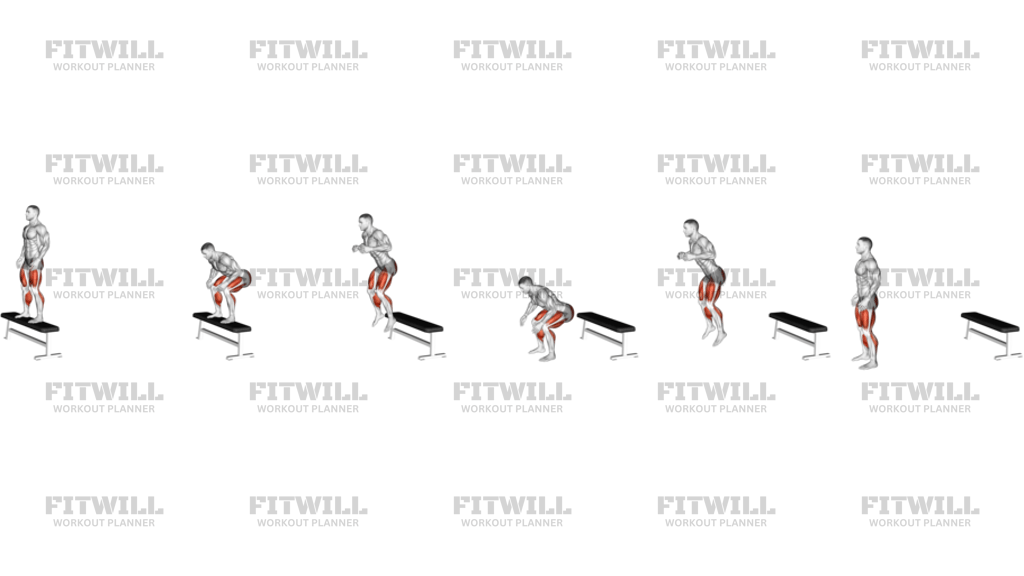
Depth Jump To Broad Jump is a plyometric drill that trains how quickly you can absorb force and turn it into a forward jump. It starts from a raised platform, then asks you to land, stabilize, and explode horizontally, so the quality of the landing is just as important as the distance of the broad jump. This makes the movement useful for athletes who need fast ground contact, strong hips, and better control when they receive force before taking off again.
The exercise places the biggest demand on the legs and hips, especially the glutes, quadriceps, hamstrings, and calves, while the core and upper back help keep the torso from collapsing during the landing. Because the drill combines drop mechanics with a jump for distance, it also challenges ankle stiffness, knee tracking, and the ability to keep the chest up as you load into the landing. The goal is not to see how high you can bounce, but to make every rep crisp, quiet, and repeatable.
Setup matters a lot. Stand tall on a box or bench with enough space in front of you to land and jump forward safely, then step or drop off so you can land with both feet at the same time. On contact, let the hips and knees bend just enough to absorb the force without folding at the waist, then immediately load into the broad jump. A good rep feels like one smooth sequence: controlled drop, stable landing, quick reset of the hips, and an aggressive forward jump.
After the forward jump, stick the landing with soft knees and hips, keep your feet pointed in the direction of the jump, and hold the finish long enough to show control. If the landing gets loud, the knees cave inward, or the torso pitches far forward, the box is probably too high or the jump is too aggressive for your current level. Short, high-quality sets are usually better than chasing fatigue, because the exercise depends on speed and precision rather than endurance.
Use Depth Jump To Broad Jump when you want to build reactive power for sprinting, court sports, field sports, or general athleticism. It also works well as a technical plyometric drill in a power session after a warm-up, before heavy strength work, or in a small dose on lower-body days. Treat every rep like a skill, keep the setup consistent, and stop the set as soon as the rebound slows or the landing stops looking clean.
[ Workout Log & Planner ]
Put your next workout in Fitwill
Keep your plan and training log ready when you are.


Instructions
- Stand tall on a sturdy box or bench with both feet about hip width and enough open floor in front of you for the broad jump.
- Keep your weight centered over midfoot, your chest tall, and your arms relaxed at your sides before you step off.
- Step or drop off the box rather than jumping up, then prepare to land on the floor with both feet at the same time.
- Land softly with bent hips and knees, letting the feet settle under you without letting the heels bounce away from the floor.
- Use the landing to load quickly into a quarter squat, keeping your chest up and your knees tracking over your toes.
- Swing your arms forcefully and jump forward into the broad jump as soon as you have absorbed the drop.
- Reach both legs out in front of you and land on both feet again with your hips back and your torso slightly inclined forward.
- Freeze the finish for a moment so you can prove the landing is under control before resetting for the next repetition.
- Step back to the box, regain your stance, and repeat only if the landing and takeoff stay crisp and explosive.
Tips & Tricks
- Start with a low box; a height that is too aggressive usually turns the landing into a collapse instead of a rebound.
- The floor contact after the drop should be short and quiet. Loud landings usually mean you are not absorbing the force well enough.
- Keep the knees from caving inward during both landings by aiming them over the second or third toe.
- Use your arms on the broad jump, not on the drop. The drop is about position and timing, while the forward jump is where the arm swing matters.
- Do not try to sit too deep after the drop. A shallow, athletic loading position is usually better for the rebound than a full squat.
- If your torso folds forward when you land, shorten the jump distance or lower the box until you can keep the chest more upright.
- Stop the set when the forward jump gets short or the landing becomes unstable; this drill is about power output, not conditioning.
- Wear shoes with a stable base so the landing does not feel mushy or unstable on contact.
Frequently Asked Questions
What muscles does Depth Jump To Broad Jump train most?
It primarily trains the glutes, quadriceps, hamstrings, and calves, with the core helping you stay organized during the landing and takeoff.
Can beginners do Depth Jump To Broad Jump?
Yes, but only with a very low box and a small jump distance. Beginners should own the landing first before trying to rebound hard.
How high should the box be for Depth Jump To Broad Jump?
Use a low box that lets you step off and land in control. If the landing is noisy or unstable, the box is too high.
Should I jump immediately after landing?
The drill is meant to be quick, but you still need a brief, controlled absorption on the floor before the broad jump. If you cannot stabilize that moment, slow the rep down.
What is the main mistake in Depth Jump To Broad Jump?
Most people either drop too hard or jump forward without controlling the landing. Both reduce power and increase the chance of sloppy mechanics.
Do I need a bench or box for this exercise?
Yes. The raised starting point is what creates the depth-jump effect, so a sturdy box or bench is part of the movement, not an optional add-on.
Where should I land on the broad jump?
Land on both feet with your hips back and your chest slightly forward, then hold the finish long enough to show you own the position.
How many reps should I use for Depth Jump To Broad Jump?
Use low reps, usually 3-5 per set, so each jump stays explosive and technically sharp.