Toe Jump
Toe Jump is a bodyweight plyometric drill built around quick, elastic hops from the balls of the feet. It trains the calves, ankle stiffness, foot control, and the ability to rebound off the floor with very little pause between contacts. In the image, the lifter stays upright with hands on the hips and the lower legs doing most of the visible work, which is a good clue that this is not a squat jump but a small, springy toe-driven bounce.
The movement is useful when you want lower-leg spring, better landing control, and cleaner ankle mechanics for running, jumping, and court sports. Because the jump is small, the value comes from speed and repeatability rather than height. Each rep should feel crisp, quiet, and symmetrical, with the feet landing under the hips and the knees staying soft instead of collapsing into a deep squat.
Setup matters more than it does in many other plyometrics. Start tall, stack the ribs over the pelvis, and keep your weight centered over the midfoot and forefoot. A slight knee bend is fine, but the torso should stay upright and the hips should not hinge back. If you begin in a lazy stance or let the heels sink heavily, the rebound turns into a calf raise instead of a jump.
On each repetition, press the floor away through the balls of the feet, let the ankles spring, and land softly on the forefoot before rebounding again. The motion should be driven by the lower leg with a short ground contact time, not by swinging the arms or dipping into a big countermovement. That makes Toe Jump a good choice for warm-ups, athletic prep, speed blocks, or conditioning circuits where the goal is elastic power rather than maximum height.
Because the calves and Achilles tendon take most of the load, the exercise is best performed with careful volume and clean mechanics. Stop the set when contacts become loud, the heels crash down, or the jumps start to drift forward. If you are rehabbing a calf or Achilles issue, reduce the volume or choose a lower-impact pogo variation until the landing feels predictable and pain-free.
[ Workout Log & Planner ]
Put your next workout in Fitwill
Keep your plan and training log ready when you are.


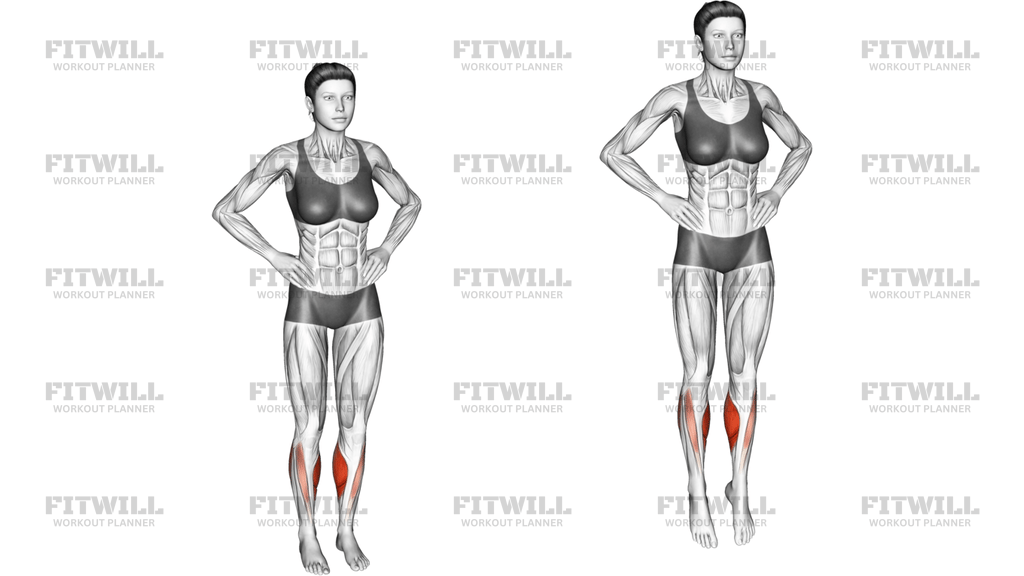
Instructions
- Stand tall with your feet about hip-width apart, toes pointing mostly forward, and your hands on your hips or held relaxed by your sides.
- Shift your weight onto the balls of your feet so the heels are light, then keep your chest stacked over your pelvis and your eyes forward.
- Keep a small bend in the knees and ankles so you can spring without dropping into a squat.
- Brace your midsection, but do not lean back or hinge at the hips.
- Press the floor away through the forefoot and make a small, quick jump straight up from the ankles.
- Land softly on the balls of your feet with the knees still slightly bent and the torso upright.
- Rebound immediately into the next jump if you are performing consecutive reps, keeping the contact time short and the bounce controlled.
- Breathe rhythmically and stop the set if the landings get noisy, the heels crash down, or your balance starts to drift.
Tips & Tricks
- Keep the jump small; the goal is a crisp ankle rebound, not maximum height.
- Think 'spring' rather than 'squat' so the calves do the work instead of the hips.
- If your heels are slamming down, reduce the height and tighten the landing rhythm.
- Hold the ribs down and the pelvis neutral so you do not arch your back while jumping.
- Let the knees stay soft but mostly in line with the toes; do not cave inward on landing.
- Use a smooth, quiet landing to judge quality; loud contacts usually mean you are absorbing too much force.
- Keep the shoulders relaxed and avoid swinging the arms unless a specific version calls for it.
- Short sets work best for this drill because the calves fatigue quickly and the bounce quality drops fast.
Frequently Asked Questions
What does Toe Jump work most?
It mainly targets the calves, especially the gastrocnemius and soleus, while also challenging the ankles, feet, and lower-leg stabilizers.
Is Toe Jump the same as a calf raise?
No. A calf raise is a slower lift and lower, while Toe Jump is a quick plyometric rebound with a brief ground contact and a jump.
How should my feet land during Toe Jump?
Land on the balls of your feet with the heels light and the knees softly bent, then rebound without letting the feet drift far in front of your body.
Should I bend my knees a lot for this exercise?
No. Keep only a small bend so the jump comes from the ankles and calves, not from dropping into a squat.
Can beginners do Toe Jump safely?
Yes, but it should start as a low-volume drill with small hops, good shoes, and a focus on quiet landings.
Why do my calves burn so fast on Toe Jump?
The exercise keeps the calf muscles under repeated elastic loading, so fatigue arrives quickly even when the jumps are small.
What is a common mistake to avoid?
The biggest mistake is turning it into a big squat jump or letting the heels crash down on every landing.
What should I do if my Achilles tendon feels irritated?
Back off the volume, shorten the jump, or switch to a lower-impact calf drill until the tendon feels calm and tolerant again.