Kettlebell Box Squat
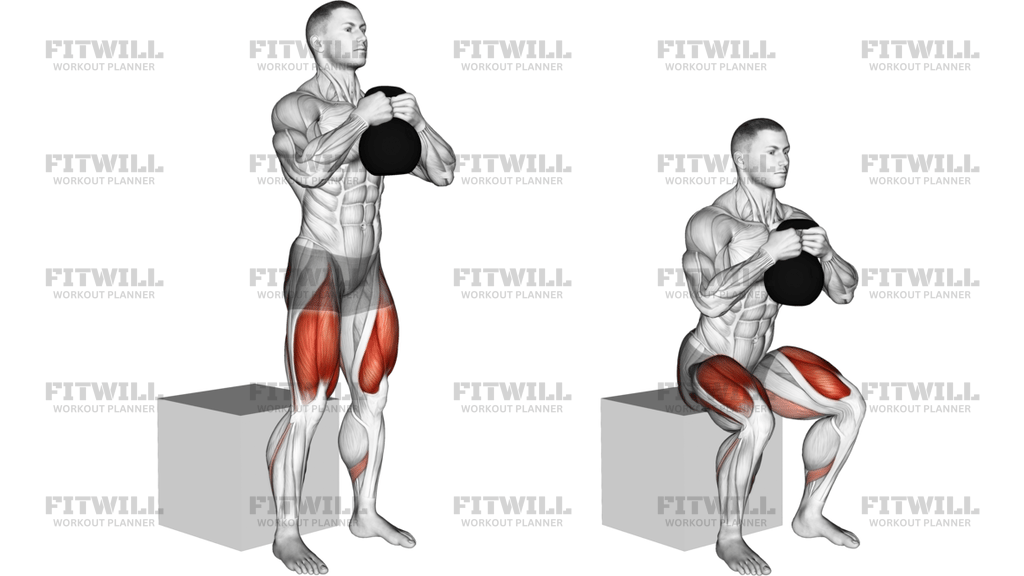
Kettlebell Box Squat is a front-loaded squat variation that uses a box or bench as a depth target. The kettlebell is held at the chest in a goblet position, which helps keep the torso organized and makes the squat easier to learn than a back-loaded version. The box does not turn the movement into a sit-down; it simply gives you a consistent target so every rep starts from the same depth and you can repeat the same mechanics.
This exercise is especially useful for building glute-dominant squat strength, reinforcing a stable brace, and teaching controlled hip and knee flexion. The main training effect comes from the glutes, with the quadriceps, hamstrings, adductors, and trunk contributing to balance and force transfer. In anatomy terms, the gluteus maximus is the prime mover, while the quadriceps, biceps femoris, rectus abdominis, and erector spinae help control the descent and drive the ascent.
The box matters because it gives you feedback. If you drop too fast, rock backward, or lose tension at the bottom, the box makes those faults obvious. Set the box at a height that lets you reach parallel or slightly above with good control. Hold the kettlebell tight to the chest, keep the ribs stacked over the pelvis, and sit back enough that the hips touch the box softly without collapsing onto it.
On the way down, think about spreading the floor with your feet and keeping the knees tracking in line with the toes. On the way up, drive the whole foot into the floor, stand up by pushing the floor away, and keep the kettlebell close so the torso does not pitch forward. The rep should feel smooth, deliberate, and repeatable rather than rushed or bouncy.
Kettlebell Box Squat is a strong choice for beginner strength work, lower-body accessory sessions, and technique-focused training blocks. It also works well for lifters who want a squat pattern with clear depth control or who need a more forgiving option than a deep free squat. Use it to build quality, not to chase fatigue with sloppy reps. When performed well, it reinforces a useful squat pattern you can carry into goblet squats, front squats, and other lower-body lifts.
[ Workout Log & Planner ]
Put your next workout in Fitwill
Keep your plan and training log ready when you are.


Instructions
- Place a sturdy box or bench behind you at a height that lets you reach about parallel or slightly above at the bottom.
- Stand with your feet about shoulder-width apart, toes turned slightly out, and hold the kettlebell at chest height in a goblet grip.
- Brace your trunk, keep your chest tall, and set your gaze forward before you start the first rep.
- Sit your hips back and bend your knees until your glutes touch the box softly.
- Keep tension in your legs as you touch the box; do not relax, rock, or fully sit down.
- Drive through the middle of your feet and stand up by extending your hips and knees together.
- Keep the kettlebell close to your chest so your torso stays stacked over your hips.
- Exhale as you drive up, then reset your brace at the top before the next rep.
- Repeat for the planned reps with the same box touch and the same stance each time.
Tips & Tricks
- Choose a box height that matches your current squat depth; too low forces compensation and usually turns the rep into a collapse at the bottom.
- Keep the kettlebell tight to your sternum so the weight helps you stay upright instead of pulling you forward.
- Touch the box lightly and keep the hips and thighs loaded; sitting hard onto the box removes tension and makes the next rep less clean.
- Let the knees travel forward as needed while they stay aligned with the toes; avoiding all knee travel usually shifts the work away from the squat pattern.
- Drive evenly through both feet so one side does not rise or twist first on the way up.
- If your torso folds, widen your stance slightly or raise the box before adding load.
- Use a controlled descent of about two to three seconds so you can keep position all the way to the box.
- Stop the set when you start reaching for the box, bouncing off it, or losing the chest-up position.
Frequently Asked Questions
What muscles does a Kettlebell Box Squat work?
It primarily trains the glutes and quadriceps, with the hamstrings, adductors, and core helping stabilize the squat and control the box touch.
Why hold the kettlebell at the chest instead of by the sides?
The goblet hold helps keep your torso upright and makes it easier to learn good squat mechanics without the load drifting forward.
How high should the box be?
Set it so you can touch down around parallel or slightly above while keeping your spine neutral and your heels planted.
Should I sit all the way onto the box?
No. Treat the box as a depth marker, not a chair. Keep tension in your legs and only let the glutes touch lightly before standing back up.
Is Kettlebell Box Squat good for beginners?
Yes. The box gives clear feedback on depth, and the front-loaded kettlebell helps most beginners stay balanced while learning the squat.
What is the most common mistake with this exercise?
The biggest mistake is crashing onto the box and losing leg tension, which turns the rep into a sit and stand instead of a controlled squat.
How do I make the squat feel more in my glutes?
Use a box height that keeps your hips back, keep your chest tall, and drive up by pushing through the whole foot instead of shifting onto your toes.
Can I use this instead of a regular squat?
It works well as a squat variation for technique and strength work, but it is not a perfect replacement for free squats because the box changes the bottom position and tempo.