Bodyweight Single Leg RDL
Bodyweight Single Leg RDL is a single-leg hip hinge that trains balance, hip control, and posterior-chain strength without adding external load. The working leg stays planted while the torso folds forward and the free leg reaches long behind you, so the rep is really about keeping the hips square and the standing side organized as you move.
This variation is useful when you want to teach the hinge pattern, clean up side-to-side stability, or build control before loading the movement with dumbbells or a barbell. The glutes and hamstrings on the standing leg do most of the work, while the foot, hip, and trunk have to resist rotation and keep the pelvis from opening or dropping.
The setup matters because the exercise becomes sloppy the moment the standing foot, knee, or hip loses position. Start tall, shift all of your weight into one foot, and keep a soft bend in that knee. As you hinge, let the free leg travel back in a straight line and keep your shoulders and hips facing the floor instead of twisting open.
Lower only as far as you can keep the pelvis level, the spine long, and the standing foot stable. Reach toward the floor or toward the shin, then drive the standing hip forward to return to tall standing. The return should feel controlled, not bounced, and the rear leg should lower with the torso instead of swinging independently.
Use this movement as a warm-up hinge drill, an accessory strength exercise, or a balance-focused lower-body drill. It works best when each rep looks almost identical, because the goal is not to touch the floor at all costs but to own the single-leg hinge position with steady breathing and clean alignment.
[ Workout Log & Planner ]
Put your next workout in Fitwill
Keep your plan and training log ready when you are.


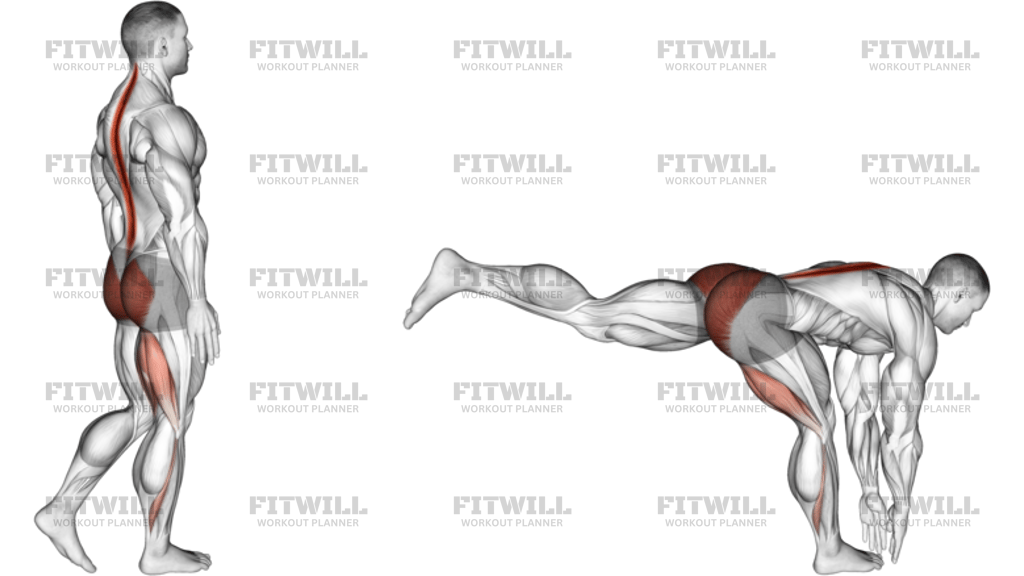
Instructions
- Stand tall on one foot with your weight centered over the whole foot and a slight bend in the knee.
- Set the free leg lightly behind you with the toes pointed down and the hips facing straight ahead.
- Soften your shoulders, keep your chest long, and brace your torso before you start the hinge.
- Push the standing hip back and let your torso tip forward as the free leg reaches straight back.
- Keep both hips level and square to the floor instead of letting the open hip rotate upward.
- Reach down toward your shin or the floor while maintaining a long spine and a stable standing foot.
- Pause briefly when you reach your deepest controlled hinge position without losing balance or rounding your back.
- Drive through the standing heel and squeeze the glute to return to tall standing while the back leg lowers with control.
- Reset at the top with both hips stacked, then repeat for the planned number of reps before switching sides.
Tips & Tricks
- Keep pressure through the big toe, little toe, and heel of the standing foot so the arch does not collapse as you hinge.
- Think about moving the hips straight back more than reaching the hands down; the torso should follow the hip hinge.
- If your pelvis opens to the side, shorten the range and keep the free hip pointed toward the floor.
- A slight bend in the standing knee is enough; turning this into a squat changes the exercise.
- Let the rear leg stay long and in line with your torso so it balances the hinge instead of swinging independently.
- Keep your neck in line with your spine by looking at the floor a few feet in front of you rather than cranking your head up.
- Use a fingertip touch on a wall or rack only if balance is the limiting factor and not the hinge pattern itself.
- Lower only as far as you can keep the standing hip loaded and the back of the body working, not until you lose control.
- Exhale as you rise to standing so the trunk stays organized through the most demanding part of the rep.
Frequently Asked Questions
What does the Bodyweight Single Leg RDL train?
It mainly trains the standing-side glutes and hamstrings, plus the foot and trunk muscles that keep you balanced while you hinge.
How should the standing knee look during the rep?
Keep a soft bend in the knee, but do not turn the movement into a squat. The knee should stay slightly bent and stable.
How far back should the free leg go?
Reach it back in line with your torso until you can no longer keep the hips square and the spine long. Range matters less than control.
Should I touch the floor with my hands?
Not necessarily. Stop when you can still keep the standing foot grounded, the pelvis level, and the hinge smooth.
What is the most common mistake?
Letting the pelvis open toward the side or rounding the lower back as the torso comes down.
Can I use support if I cannot balance well?
Yes. A light fingertip touch on a wall or rack can help you learn the hinge without stealing the load from the standing leg.
Is this a good beginner exercise?
Yes, if you keep the range small at first and focus on balance, hip position, and a slow return to standing.
How do I make it harder without adding weight?
Slow the lowering phase, pause near the bottom, or hold the hinge a little longer while keeping the hips square and the foot stable.