Reverse Flutter Kick On Floor Hand Under Head
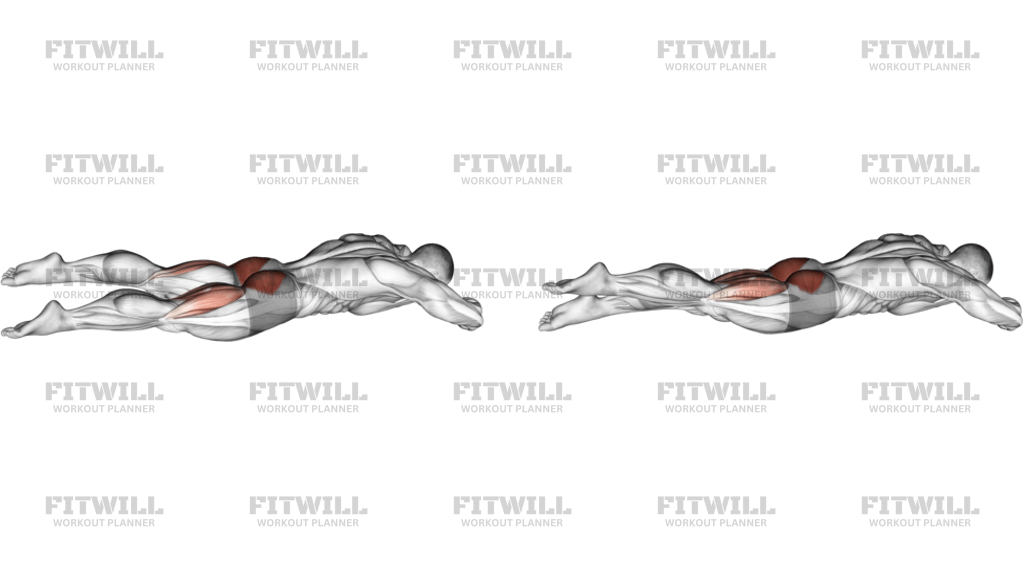
Reverse Flutter Kick On Floor (Hand Under Head) is a prone floor drill for the glutes, hamstrings, and deep core. You lie face down with your head supported by your hands and alternate small, controlled leg lifts off the floor. The exercise looks simple, but it rewards careful setup: the pelvis stays heavy, the ribs stay down, and the legs move without turning the lower back into the main driver.
The movement is useful when you want posterior-chain work without equipment, load, or setup complexity. Because the torso stays down on the floor, the exercise teaches you to keep the hips quiet while the legs move independently. That makes it a good option for warm-ups, core blocks, glute activation, conditioning circuits, or as a low-fatigue accessory after heavier lower-body training.
The quality of the rep comes from staying small and controlled. Each kick should lift only enough to clear the floor, with the knee mostly straight and the toes reaching long. If the range gets too large, the pelvis will rock, the low back will arch, and the movement shifts away from the glutes. The hands-under-head position should support the neck, not encourage you to crane upward to watch the legs.
Treat the reverse flutter kick as a tension exercise, not a speed exercise. A steady rhythm, short range, and firm brace will keep the work where it belongs. If your lower back feels pinched, shorten the kick and squeeze the glutes harder. If your hips lift off the floor, reset and make the motion smaller. Done well, this is a clean, repeatable drill for hip extension control and trunk stability, with very little equipment demand and a clear carryover to other floor-based core and glute movements.
Fitwill
Log Workouts, Track Progress & Build Strength.
Achieve more with Fitwill: explore over 9600 exercises with images and videos, access built-in and custom workouts, perfect for both gym and home sessions, and see real results.
Start your journey. Download today!




Instructions
- Lie face down on the floor or a mat with your hands under your head, elbows out to the sides, and your legs extended straight behind you.
- Keep your forehead resting on your hands and let your chest and hips settle into the floor so your neck stays neutral.
- Brace your abdomen and lightly squeeze your glutes before you start the first kick.
- Lift one leg a few inches off the floor while keeping the knee mostly straight and the thigh aligned with the body.
- Lower that leg under control as the opposite leg begins to rise, creating a small alternating flutter pattern.
- Keep the motion compact so the pelvis does not rock and the low back does not arch.
- Breathe in as one leg lowers and exhale as the other leg lifts, maintaining a steady rhythm.
- Continue alternating for the planned number of reps or time, then lower both legs to the floor and relax the brace.
Tips & Tricks
- Think about lengthening the leg away from your hip rather than kicking hard from the knee.
- If your lower back starts to take over, reduce the lift height until your pelvis stays quiet.
- A mat or folded towel under the hips can make the floor contact more comfortable during longer sets.
- Keep the toes pointed or gently stretched long so the legs stay active without bending the knees.
- Use a consistent pace; fast, sloppy fluttering usually shifts the work away from the glutes.
- Press the pubic bone and front of the hips toward the floor to keep the torso anchored.
- Do not lift the chest to chase more range of motion, because that usually turns the neck and back into compensators.
- Stop the set when you can no longer alternate smoothly without twisting the pelvis.
Frequently Asked Questions
What muscles do reverse flutter kicks on the floor work?
They mainly train the glutes and hamstrings, with the deep core and hip stabilizers working hard to keep the pelvis steady.
Why are my hands under my head in this version?
The hands under the head support the neck so you can stay face down without twisting or straining your cervical spine.
How high should each leg lift off the floor?
Only high enough to clear the floor. A small lift keeps tension on the glutes and prevents the low back from taking over.
Should my knees bend during the flutter kicks?
Keep the knees mostly straight. A big bend turns it into a different drill and usually reduces the posterior-chain challenge.
What is the most common mistake with this exercise?
The biggest mistake is kicking too high and arching the lower back instead of keeping the pelvis heavy on the floor.
Is this exercise good for beginners?
Yes. It is beginner-friendly if you keep the range short, the pace controlled, and the neck relaxed.
How long should I do reverse flutter kicks?
Most people use them for time, such as 15 to 30 seconds, or for a controlled set of alternating reps.
Can I feel this in my lower back?
You should not feel a sharp pinch. Some low-back effort can happen, but if it dominates the set, shorten the kick and brace harder.
What can I use instead if the floor bothers my hips?
A thicker mat, folded towel, or a similar prone glute drill with less floor pressure is usually the best adjustment.