Serratus Wall Slide
Serratus Wall Slide is a bodyweight wall drill for the upper back and shoulders that teaches you how to move the shoulder blades upward without losing control through the ribs and neck. It is especially useful when you want better overhead mechanics, cleaner scapular motion, or a low-fatigue accessory drill that still demands attention to detail. The exercise should feel precise and organized, not rushed.
The main training effect comes from the serratus anterior working with the lower traps and front of the shoulders to guide the arms upward while the trunk stays stacked. That coordination matters because the shoulder blades need to rotate and glide cleanly as the arms rise. If the torso arches or the neck takes over, the movement stops being a serratus drill and turns into a compensation pattern.
A good rep starts with a stable stance and a deliberate setup against the wall. Place your forearms and hands on the wall, keep the elbows bent, and lean in just enough to feel solid contact through the arms. The goal is to keep the forearms pressing into the wall while the chest stays quiet and the lower ribs remain down as the hands travel upward.
As you slide higher, think about reaching the shoulder blades around the ribcage rather than shrugging them straight toward the ears. The arms should travel in a smooth line, with the elbows and wrists staying organized instead of drifting apart. A brief pause near the top helps you own the position before you lower under control and reset for the next rep.
Serratus Wall Slide fits well in a warm-up, shoulder-prep block, accessory circuit, or rehab-style session where precision matters more than load. It is also a useful teaching exercise for anyone who loses control when reaching overhead. Keep the range pain-free, keep the neck long, and use the movement to build better upward reach rather than chasing height for its own sake.
Fitwill
Log Workouts, Track Progress & Build Strength.
Achieve more with Fitwill: explore over 9600 exercises with images and videos, access built-in and custom workouts, perfect for both gym and home sessions, and see real results.
Start your journey. Download today!




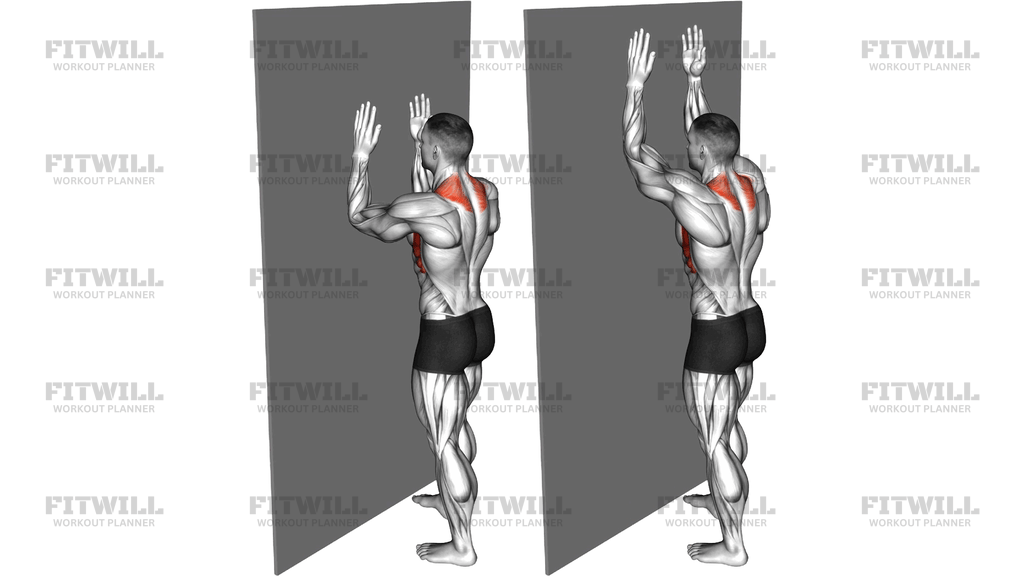
Instructions
- Stand facing a wall with your feet about hip-width apart and one step back from the surface.
- Place your forearms and hands on the wall with your elbows bent and roughly under shoulder height.
- Gently brace your abs and glutes, then keep your lower ribs stacked instead of flaring forward.
- Press your forearms lightly into the wall so your upper back stays active before you start sliding.
- Exhale and slide your forearms upward while reaching your arms long overhead.
- Keep your wrists, forearms, and elbows organized as they travel so you do not shrug into your neck.
- Pause near the top when your shoulder blades are rotating cleanly and your torso is still steady.
- Inhale and lower your arms back down the wall under control until you return to the start.
- Reset your stance before the next rep and repeat for the planned number of repetitions.
Tips & Tricks
- If your lower ribs pop forward, move your feet a little farther from the wall and shorten the range.
- Keep steady pressure through the forearms; if the hands do all the work, the serratus focus gets lost.
- Stop the slide before your shoulders climb toward your ears, even if that means a smaller top position.
- Think about reaching the shoulder blades up and around the ribcage, not pinching them together.
- A slow two- to three-second return makes the control piece much more useful than bouncing back down.
- If your wrists or elbows lose contact, reduce the height of the slide and keep the path cleaner.
- Keep your chin slightly tucked so the neck does not help finish the movement.
- A mild burn along the side of the ribcage is a better sign than a pinch at the front of the shoulder.
- Use this as a quality drill; once posture degrades, the set is already over.
Frequently Asked Questions
What does Serratus Wall Slide work most?
It mainly trains the serratus anterior with help from the lower traps and shoulder stabilizers.
Should my forearms stay on the wall during Serratus Wall Slide?
Yes, keep light but consistent contact through the forearms and hands so the movement stays controlled.
How high should I raise my arms in Serratus Wall Slide?
Raise them only as far as you can keep your ribs down, neck relaxed, and forearm contact steady.
Why do my ribs flare when I do this exercise?
That usually means the reach is outpacing your trunk control. Step back a little, exhale sooner, and shorten the range.
What should I feel during Serratus Wall Slide?
You should feel work around the side of the ribcage and lower shoulder blade area, not a pinch in the neck.
Is Serratus Wall Slide good for shoulder warm-ups?
Yes, it is a strong warm-up drill before pressing, overhead work, or any session that needs better scapular control.
Can beginners do Serratus Wall Slide?
Yes. It is a beginner-friendly bodyweight drill as long as the range stays small and the wall contact stays clean.
How can I make Serratus Wall Slide harder?
Slow the lowering phase, pause longer at the top, or use a stricter range where you can keep perfect wall contact.