Lying Prone A
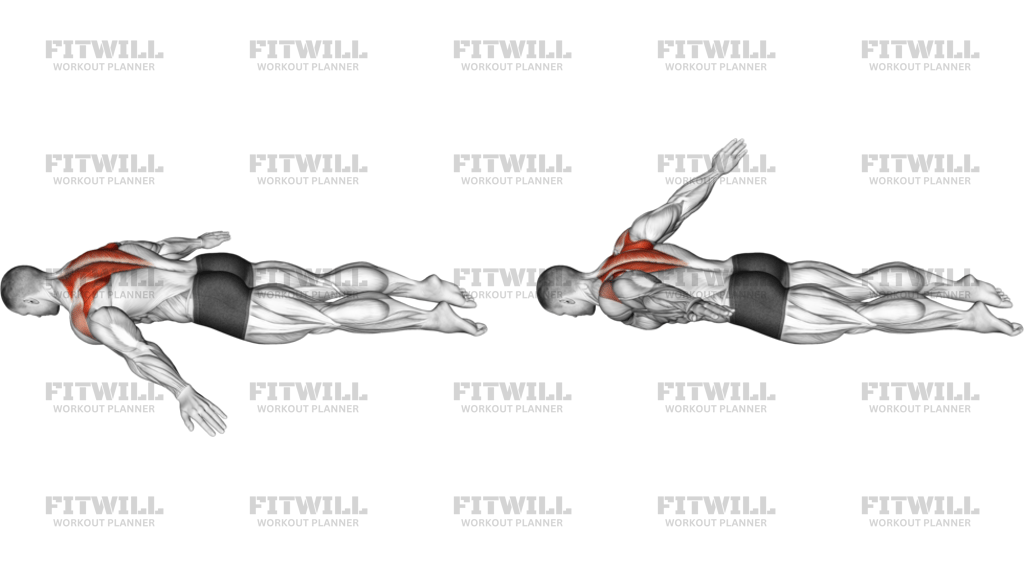
Lying Prone A is a prone upper-back and shoulder control drill done face down on the floor or a flat bench. The movement teaches you to lift the arms into a shallow A shape without shrugging, twisting, or arching through the low back. It is a small-range exercise, but it can build a very useful amount of awareness in the rear delts, upper back, and shoulder stabilizers when the setup stays strict.
The exercise works best when the chest stays heavy against the support and the ribs stay down. That stable base lets the shoulder blades move cleanly instead of turning the rep into a back extension. The visible effort should come from the muscles around the shoulder blades and the back of the shoulders, not from momentum or a big swing of the torso.
Treat each repetition as a quality drill rather than a strength lift. Reach the arms away from the body in a controlled arc, pause briefly at the top, then lower slowly along the same path. If you rush the rep, the neck and lower back usually take over before the target muscles do. A lighter load or no load at all is often the best choice for this pattern.
Lying Prone A is useful in warm-ups, rehab-style accessory work, posture-focused sessions, and upper-back finishers. It pairs well with other prone raises, face pulls, or rowing work when the goal is better scapular control and shoulder positioning. Beginners can usually learn it quickly because the range is small, but the exercise still demands patience, clean alignment, and a controlled return.
[ Workout Log & Planner ]
Put your next workout in Fitwill
Keep your plan and training log ready when you are.


Instructions
- Lie face down on the floor or a flat bench with your legs long, your forehead supported or your neck neutral, and your chest resting firmly on the pad.
- Let your arms hang beside your body to start, or slightly forward if that is the position your setup allows, with the shoulders relaxed and the palms facing in or the thumbs turned up.
- Brace your abdomen so your ribs stay down and your low back does not arch when the arms begin to move.
- Lift both arms in a shallow arc away from your sides until they form a controlled A shape overhead, keeping the elbows mostly straight.
- Reach long rather than high, and keep the shoulders away from your ears as the upper back does the work.
- Pause for a beat at the top while you keep the torso still and the neck relaxed.
- Lower the arms slowly along the same path until they return to the start without dropping or bouncing.
- Exhale as you lift, inhale as you lower, and reset fully before the next repetition.
Tips & Tricks
- If your shoulders shrug toward your ears, reduce the range and think about sliding the shoulder blades down your back before each rep.
- Keep the thumbs turned up or the palms neutral so the shoulders do not roll forward as the arms rise.
- A flat bench makes the movement easier to control; a floor version usually keeps the range shorter and the torso more stable.
- The rep should feel like a small upper-back raise, not a back extension. If your chest leaves the support, you are lifting too high.
- Slow the lowering phase to two or three seconds so the rear delts and lower traps stay under tension.
- Use no load or very light load first. In this movement, too much resistance usually turns into neck tension and momentum.
- Keep the chin slightly tucked so the neck stays long and the head does not crane upward.
- Stop the set as soon as the motion becomes jerky or the arms can no longer trace the same clean path.
Frequently Asked Questions
What muscles does Lying Prone A work?
It mainly trains the rear delts, rhomboids, mid and lower traps, and other shoulder stabilizers that help control the scapulae.
Can beginners perform this exercise?
Yes. Beginners usually learn it well with no load and a short, controlled range of motion.
Should my chest stay on the floor or bench?
Yes. Keep the chest heavy on the support and let the arms move without turning the rep into a back extension.
Why do my shoulders start to shrug during the raise?
That usually means the load is too heavy or the arms are lifting too high. Reduce the range and keep the neck relaxed.
Do I need weights for this movement?
No. Body weight alone is often enough, and a very light dumbbell or plate is only useful if you can keep the motion strict.
What should the arm path look like?
The arms should travel in a shallow arc into a soft A shape, not flare hard out to the sides or swing overhead.
How can I make Lying Prone A harder?
Add a longer pause at the top, slow the lowering phase, or use a very light load while keeping the same clean path.
What is the most common form mistake?
The biggest mistake is using momentum and arching the low back instead of keeping the torso anchored and moving only the shoulders.