Landmine Press
The Landmine Press is a standing pressing exercise that uses one end of a barbell anchored in a landmine setup. Because the bar travels on a forward-and-upward arc instead of straight overhead, it gives the shoulders a pressing pattern that often feels smoother than a strict barbell overhead press. In the image, both hands are stacked on the working end of the bar, the feet are planted, and the torso stays tall while the press finishes out in front of the head.
This movement primarily trains the front of the shoulders and triceps, while the upper chest, serratus, and trunk muscles help keep the bar path organized. The angled line of force is the reason the Landmine Press is so useful for lifters who want shoulder strength without forcing a fully vertical press. It is also a practical option for athletes who need strong overhead mechanics, because the press still asks the body to stabilize ribs, shoulders, and pelvis together.
Setup matters a lot. The bar should be fixed securely in a corner or landmine base, and the loaded end should start close to the upper chest or chin with the wrists stacked over the forearms. From there, the press should travel away from the face and finish with the elbows straight but not locked hard into the joint. If the torso leans back or the low back takes over, the load is usually too heavy or the stance is too loose.
The Landmine Press works well as a main upper-body accessory, a shoulder-strength builder, or a joint-friendlier alternative for people who do not love straight overhead work. It can be done with two hands like the image, or with one arm for more anti-rotation demand, but the pressing line should still stay smooth and controlled. The best reps feel deliberate: drive the bar up, keep the ribs down, and let the shoulders finish the press without shrugging or bouncing the weight.
Use a load that lets you keep the bar path clean from the first rep to the last, especially because the angled setup can tempt lifters to turn it into a standing incline press with excess back lean. When it is done well, the Landmine Press builds shoulder strength, pressing power, and trunk control at the same time. It is a strong choice for warm-ups, hypertrophy work, and strength sessions when you want pressing volume without the same overhead stress as a straight barbell press.
[ Workout Log & Planner ]
Put your next workout in Fitwill
Keep your plan and training log ready when you are.


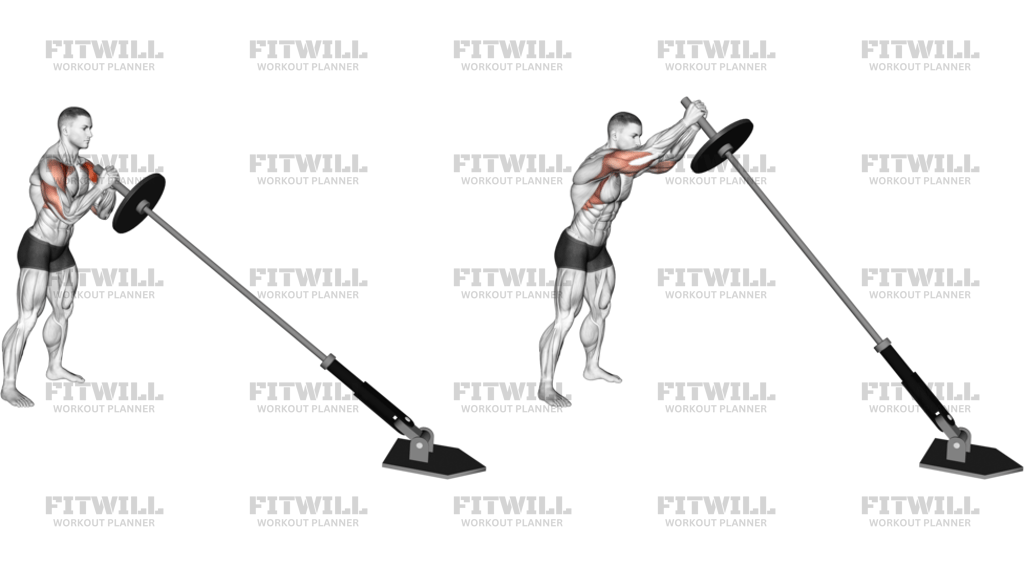
Instructions
- Anchor one end of the barbell securely in a landmine base or a stable corner, then stand facing the free end with your feet about hip-width apart.
- Hold the sleeve or bar end with both hands stacked one over the other, and start with the bar at upper-chest or chin height.
- Keep your elbows slightly in front of your torso and your wrists stacked over your forearms before you press.
- Set your ribs down, squeeze your glutes, and brace your midsection so your torso stays tall.
- Press the bar upward and slightly forward in a smooth arc, moving it away from your face as you extend your arms.
- Finish with your elbows straight but soft, and keep your shoulders from shrugging toward your ears.
- Lower the bar along the same arc until it returns to the starting point near the upper chest or chin.
- Inhale as the bar comes down and exhale as you drive it up, keeping each rep controlled and repeatable.
- Reset your stance if your back starts to lean or the bar path drifts off line.
Tips & Tricks
- A half-kneeling setup can reduce lower-back compensation, but the standing version should still keep your ribs stacked over your pelvis.
- If the bar finishes behind your head, you are pressing too vertically; let it travel up and forward instead.
- Keep the elbows slightly tucked so the shoulders can press without flaring the upper arms straight out to the sides.
- Do not let the loaded end of the bar drift toward your face on the way up or down.
- A narrow, stacked hand position is usually easier on the shoulders than a wide grip on the sleeve.
- If you feel the low back arch hard, shorten the range or reduce the load before the set turns into a back extension.
- Keep the neck long and neutral so the traps do not take over the top of the press.
- Use a smooth tempo on the lowering phase; dropping the bar makes the angled path harder to control.
- If one side rises faster than the other, match the hand pressure before adding weight.
Frequently Asked Questions
What muscles does the Landmine Press work?
The Landmine Press emphasizes the front delts and triceps, with the upper chest, serratus, and core helping stabilize the angled press.
Is the Landmine Press easier on the shoulders than a strict overhead press?
Often yes, because the bar moves on an angled path instead of straight overhead. That forward-and-upward line can feel friendlier for lifters who do not tolerate vertical pressing well.
How do I set up the bar for a Landmine Press?
Anchor one end of the barbell securely in a landmine base or corner, then stand facing the free end with the bar starting near the upper chest or chin.
Should I press the Landmine Press straight up?
No. The bar should travel up and slightly forward in an arc so it clears the face and finishes in line with the shoulder, not directly overhead.
Can beginners use the Landmine Press?
Yes. It is a good beginner pressing option if the load is light enough to keep the ribs down and the bar path smooth.
Why does my lower back arch during the Landmine Press?
That usually means the weight is too heavy or the stance is too loose. Tighten the glutes, keep the ribs stacked, and shorten the range if needed.
Can I do the Landmine Press with one hand?
Yes. The one-arm version adds more anti-rotation work, but the two-hand version in the image is a solid option for simpler pressing volume.
What grip should I use on the Landmine Press?
Use a stacked grip on the sleeve or bar end with the wrists over the forearms. A stacked hand position usually keeps the press more comfortable and stable.
What is the most common mistake on the Landmine Press?
The most common mistake is turning it into a back-leaning press. If the torso rocks or the shoulders shrug hard, reduce the load and clean up the arc.