Plank Jack On Elbows
Plank Jack On Elbows is a bodyweight core and conditioning exercise performed from a forearm plank while the feet jump apart and back together. It combines a rigid trunk position with a quick lower-body opening and closing action, so the challenge is not just cardio - it is keeping the torso quiet while the legs move.
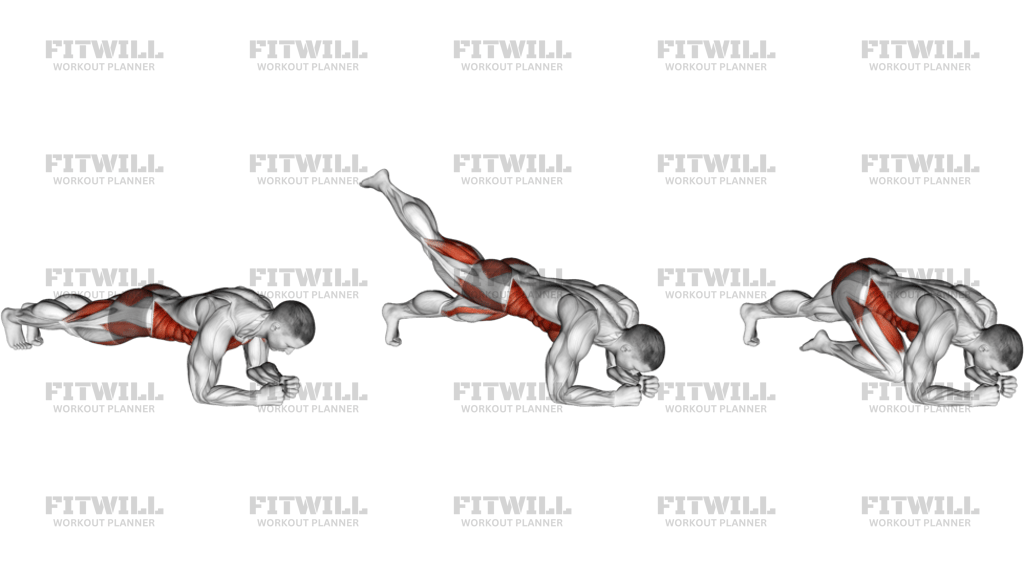
The setup matters because the elbows, shoulders, hips, and feet all have to stay organized at once. From the image, the forearms are on the floor with the elbows under the shoulders, the body is in a straight line from head to heels, and the movement happens by jumping the feet wide and then snapping them back under the hips without letting the pelvis sag or twist.
This variation trains the abdominal wall, obliques, glutes, shoulders, and hip stabilizers, with a strong conditioning demand as the tempo rises. It is useful when you want a core exercise that also elevates heart rate, improves trunk stiffness, and challenges the body to resist rotation while the legs create repeated opening and closing forces.
Good reps are short and crisp. The chest stays low, the ribs stay controlled, and the hips stay level while the feet travel out and in. If the motion becomes bouncy through the lower back or the shoulders drift ahead of the elbows, the set is usually too fast or too hard. A smaller jump or a step-out variation is a better choice than letting form collapse.
Use Plank Jack On Elbows in warmups, core circuits, athletic conditioning, or as a bodyweight finisher when you want a simple movement with a strong stability demand. It is beginner-friendly if you can hold a forearm plank first; otherwise, build up with plank holds, step jacks, or shorter intervals before using full jumping reps.
[ Workout Log & Planner ]
Put your next workout in Fitwill
Keep your plan and training log ready when you are.


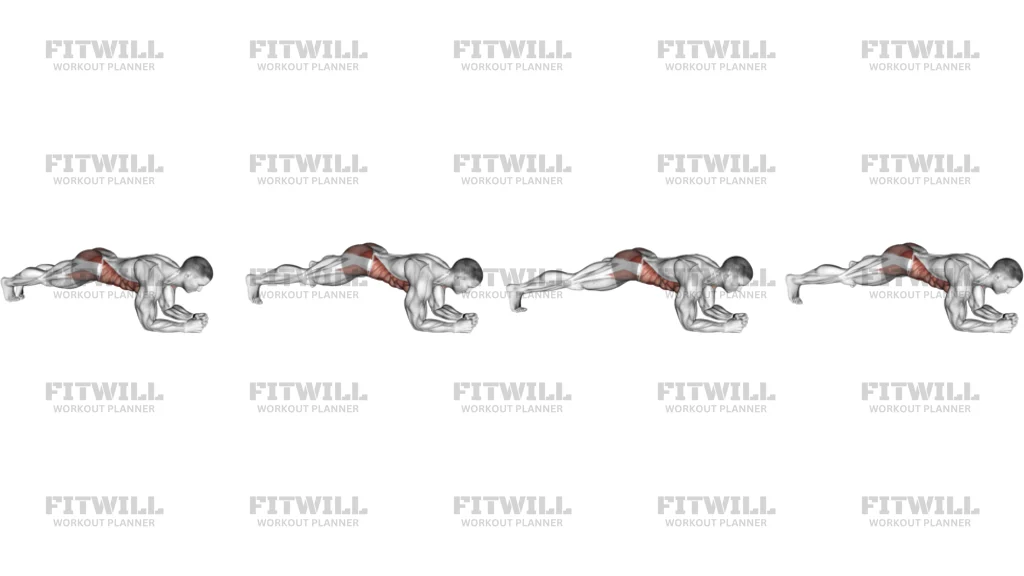
Instructions
- Start in a forearm plank with your elbows directly under your shoulders, forearms parallel, and your body in one straight line from head to heels.
- Plant the balls of your feet on the floor and tuck your pelvis slightly so your lower back does not arch before the first jump.
- Brace your abs, squeeze your glutes, and keep your ribs pulled down so the torso stays quiet while the legs move.
- Jump both feet out to a wide stance, landing softly on the balls of your feet with your hips level.
- Immediately jump the feet back together under your hips without letting your shoulders rock forward or back.
- Keep the head in line with the spine and look at the floor a short distance in front of your hands.
- Breathe out as the feet open, inhale as they come back together, and keep the breathing steady instead of holding it.
- Repeat for the planned time or repetitions, then lower your knees to the floor to end the set if you need a reset.
Tips & Tricks
- Set your elbows under your shoulders before you start; if they sit too far forward, the front of the shoulders will take over.
- Keep the jump small and quick. A huge split in the legs often makes the hips sway and the low back sag.
- Press the forearms into the floor to help the shoulder blades stay stable instead of collapsing between the shoulders.
- Think about pulling the pubic bone toward the navel to keep the pelvis neutral as the feet move.
- Land softly on the balls of your feet so the movement stays springy instead of thudding into the floor.
- If your hips start rising every rep, slow down or shorten the set; the goal is a strict plank, not just faster feet.
- For a lower-impact version, step one foot out and in at a time while keeping the same forearm-plank position.
- Stop when your low back starts to take over or when your shoulders can no longer stay stacked over the elbows.
Frequently Asked Questions
What does Plank Jack On Elbows train most?
It mainly trains core stability and conditioning, with strong work from the abs, obliques, glutes, shoulders, and hip stabilizers.
Should my elbows stay in one place during the movement?
Yes. Keep the elbows planted under the shoulders so the movement comes from the feet, not from shifting the forearms around.
How wide should the feet jump apart?
Wide enough to feel the hips and core work, but not so wide that the pelvis starts rocking or the low back arches.
What is the most common form mistake?
The usual mistake is letting the hips bounce or sag while trying to move the feet too fast.
Is this exercise okay for beginners?
Yes, if you can hold a forearm plank first. Beginners can also use step-outs instead of full jumps.
Do plank jacks work the shoulders too?
Yes. The shoulders and serratus have to keep the forearms stable while the lower body creates repeated movement.
Can I make it easier without changing the exercise completely?
Use shorter intervals, reduce the jump distance, or switch to alternating step jacks from the same forearm-plank setup.
When should I stop the set?
Stop when the shoulders drift forward, the hips rotate, or the lower back starts to sag through the plank.