Single Leg Box Jump
Single Leg Box Jump is a bodyweight plyometric drill for building unilateral power, coordination, and landing control. It asks one leg to load, explode, and stabilize on top of a box, which makes it useful for athletes and lifters who need force production without relying on both legs at once. The exercise is not about reaching the highest box possible. It is about producing a clean jump, landing softly on the working leg, and keeping the torso, knee, and foot organized through every rep.
Because the movement is unilateral, the setup matters as much as the jump itself. A box that is too high or too far away will pull the torso off balance and force the knee to cave inward or the chest to fold. Start with a sturdy box at a height you can land on quietly and hold for a moment without wobbling. The working foot should have room to plant firmly, and the non-working leg should stay out of the way as you load the jump.
The jump begins with a short dip at the hip, knee, and ankle, followed by a fast drive through the whole foot. Swing the arms to help create momentum, then bring the body up and slightly forward toward the box. Land on the working leg with a soft knee, a stable arch, and the hips stacked over the foot. A brief hold at the top helps you check that the knee did not collapse and that the landing was controlled before you step down.
Single Leg Box Jump is most useful when you want power work with low total reps and high-quality effort. It fits well in warm-ups after mobility work, in power blocks before heavy lifting, or in athletic sessions where speed and coordination matter. The best repetitions look crisp and repeatable, with enough rest between attempts to keep each jump explosive. If the jump turns into a long reach, a noisy landing, or a sideways wobble, the box is too aggressive for the current set.
Treat the exercise as a test of single-leg force and control, not as a conditioning sprint. Step down between repetitions instead of jumping off the box, especially if the goal is to protect the landing leg and preserve jump quality. Lower the box or reduce volume if the ankle, knee, or hip cannot absorb the landing smoothly. When performed well, Single Leg Box Jump teaches the body to generate force quickly and stop it just as cleanly.
[ Workout Log & Planner ]
Put your next workout in Fitwill
Keep your plan and training log ready when you are.


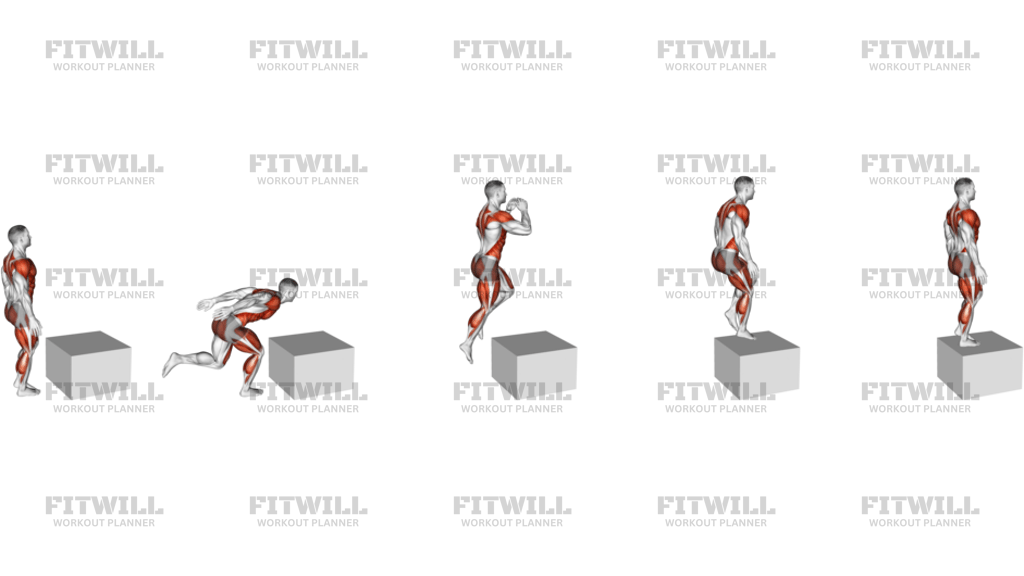
Instructions
- Place a sturdy box a short step in front of you and stand on one leg with the other leg hovering slightly behind you.
- Set your working foot flat and use a stance that lets your knee track over the middle toes instead of collapsing inward.
- Hinge slightly at the hips, bend the knee and ankle together, and let your chest tip forward just enough to load the jump.
- Swing both arms back while you keep your trunk tight and your non-working leg lifted out of the way.
- Drive forcefully through the whole foot and jump onto the top of the box with the working leg.
- Bring the body up and forward so you land on the box with a soft knee and the hips stacked over the foot.
- Hold the landing for a moment to make sure you are balanced before you stand tall.
- Step down from the box under control, reset your position, and repeat on the same side or switch legs as programmed.
Tips & Tricks
- Choose a box height that lets you land quietly on one foot without tipping forward.
- Keep the box close enough that you jump up, not out, or you will have to chase the landing.
- Let the torso lean forward a little on the load; staying perfectly upright usually kills power.
- Push the knee in line with the second toe so the landing leg does not buckle inward.
- Use the arms aggressively to help the jump, but do not twist the shoulders across the body.
- Land through the midfoot and whole foot instead of reaching for the top with just the toes.
- Step down after each rep; hopping down adds extra impact that this drill does not need.
- Stop the set when the landing gets noisy, the knee starts wobbling, or the free leg swings wide.
Frequently Asked Questions
What muscle does Single Leg Box Jump target most?
It mainly trains the quads, glutes, and calves on the working leg, with the hamstrings and core helping stabilize the jump and landing.
Can beginners perform this exercise?
Yes, but start with a low box and slow, clean reps. If you cannot land and hold the top position without wobbling, use a lower box or build up with step-ups and low single-leg hops first.
How high should the box be for Single Leg Box Jump?
Use the lowest height that lets you jump up and stick the landing on one leg. If you have to dive forward, reach with the toes, or fold at the waist, the box is too high.
Should I land on one foot or both feet?
Land on the working foot if you are doing Single Leg Box Jump as written. The point of the drill is to train unilateral takeoff and landing control.
Why do I step down instead of jumping back down?
Stepping down reduces impact on the landing leg and keeps each rep explosive. Jumping down turns the drill into extra plyometric volume that can blur technique.
Why does my knee cave inward on the landing?
The box is usually too high, too far away, or you are not controlling the hip on the way up. Lower the box and think about driving the knee over the middle toes as you land.
Is Single Leg Box Jump a strength or power exercise?
It is mainly a power exercise. Keep reps low, rest long enough to stay explosive, and stop the set once the jump turns slow or sloppy.
What should I do if I cannot clear the box cleanly?
Reduce the box height, shorten the distance to the box, or regress to single-leg step-ups and low pogo-style hops until you can jump and land with control.