Wall Walks
Wall walks are a bodyweight shoulder and trunk drill that moves from a solid plank into a near-vertical wall-supported position. They build overhead stability, serratus control, scapular upward rotation, core tension, and wrist tolerance in one sequence, which makes them useful for handstand work, gymnastics prep, and general upper-body control.
The wall matters because it gives you a fixed reference for body angle and range. If your hands start too far from the wall or your feet climb too quickly, the set turns into a shrugging, arched-back scramble instead of a controlled shoulder drill. A clean wall walk keeps the ribs tucked, the glutes on, and the push through the floor and wall constant from the first step to the last.
Each rep should feel like a slow crawl: hands stay planted long enough to support the next foot step, then the feet walk higher as the shoulders stack over the wrists. At the top, the torso should stay braced and the elbows locked while you press tall through the shoulders rather than hanging passively into the wall. The return is just as important as the ascent, because the lowering phase exposes whether you can keep control when fatigue starts to pull the hips open.
Wall walks are usually programmed as a skill-strength accessory, not a conditioning drill. They fit well in warmups, shoulder sessions, gymnastics blocks, or core work when you want a strict overhead pattern without external load. Because the movement is demanding on the wrists and shoulders, quality matters more than rep count: short sets with clean positions are far more useful than racing to the wall and collapsing back down.
If the full range is too aggressive, shorten the walk, slow the tempo, or stop before the body loses its hollow position. Beginners can use a reduced range as long as the shoulders stay active and the midline stays firm. The goal is a repeatable wall-supported line, not a dramatic kick-up or a backbend through the lumbar spine.
Fitwill
Log Workouts, Track Progress & Build Strength.
Achieve more with Fitwill: explore over 9600 exercises with images and videos, access built-in and custom workouts, perfect for both gym and home sessions, and see real results.
Start your journey. Download today!




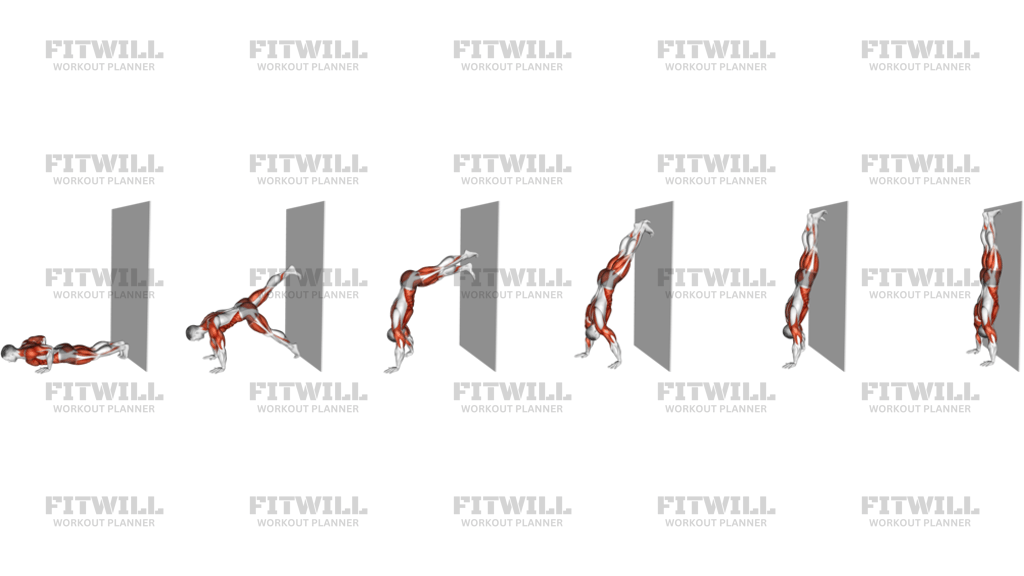
Instructions
- Start in a high plank facing the wall with your hands on the floor a little wider than shoulder width and your feet extended behind you.
- Place your toes a few inches from the wall, lock your elbows, and press the floor away so your shoulders are active before you move.
- Brace your abs, squeeze your glutes, and keep your ribs tucked so your lower back does not sag as you begin.
- Walk one foot up the wall while the other foot stays on the floor, then step the hands slightly closer to the wall.
- Continue alternating feet and hands in small controlled steps until your torso is nearly vertical and your chest is close to the wall.
- Keep your gaze between your hands, your neck long, and your shoulders pushing tall instead of collapsing into your ears.
- Pause briefly at the top with straight arms and a tight hollow body, then reverse the pattern one hand and one foot at a time.
- Walk the hands back out first, lower the feet down the wall, and finish in a stable plank before dropping to rest.
Tips & Tricks
- Take short hand and foot steps; big reaches make it much harder to keep the ribs tucked.
- Press through the whole palm, especially the fingertips, so you can control the shift of body weight as you climb.
- Keep the glutes tight the entire rep to stop the hips from drifting into a backbend.
- If your lower back starts arching, stop the walk there and work that smaller range until it stays clean.
- Keep the elbows locked at the top; bending the arms turns the drill into a shaky support hold.
- Do not rush the descent. Walking back down under control is usually where form breaks first.
- Move on the exhale as you walk up and use short, calm breaths at the top instead of holding tension too long.
- Use a dry wall and a stable floor surface so the feet do not slide when the shoulders are loaded.
Frequently Asked Questions
What do wall walks train the most?
They mainly train shoulder strength and overhead stability, with a strong demand on the core, serratus, and upper back.
Where should my hands and feet start?
Start in a high plank with your hands just wider than shoulder width and your toes close enough to the wall that you can step onto it without losing tension.
How high should I walk before coming back down?
Walk as high as you can while keeping a tucked rib cage, straight arms, and controlled breathing. If your back arches or your shoulders shrug hard, stop the ascent there.
Do wall walks have to end with my chest against the wall?
Not necessarily. The top position should be controlled and tall, but you should not force extra range if it makes you lose the hollow-body shape.
Are wall walks a good beginner exercise?
Yes, if you can hold a strong plank and tolerate the wrist load. Beginners should use fewer steps and stop well before the position breaks down.
What is the biggest mistake people make on wall walks?
The most common mistake is arching the lower back and turning the climb into a loose kick-up instead of a controlled shoulder drill.
What should I do if my wrists or shoulders get irritated?
Reduce the range, slow the reps down, and stop before pain appears. If needed, use a smaller incline-style progression before returning to full wall walks.
How can I make wall walks harder?
Increase the height of the walk, slow the descent, pause longer at the top, or add more total reps while keeping the same body line.