Kettlebell Full Squat From Deficit
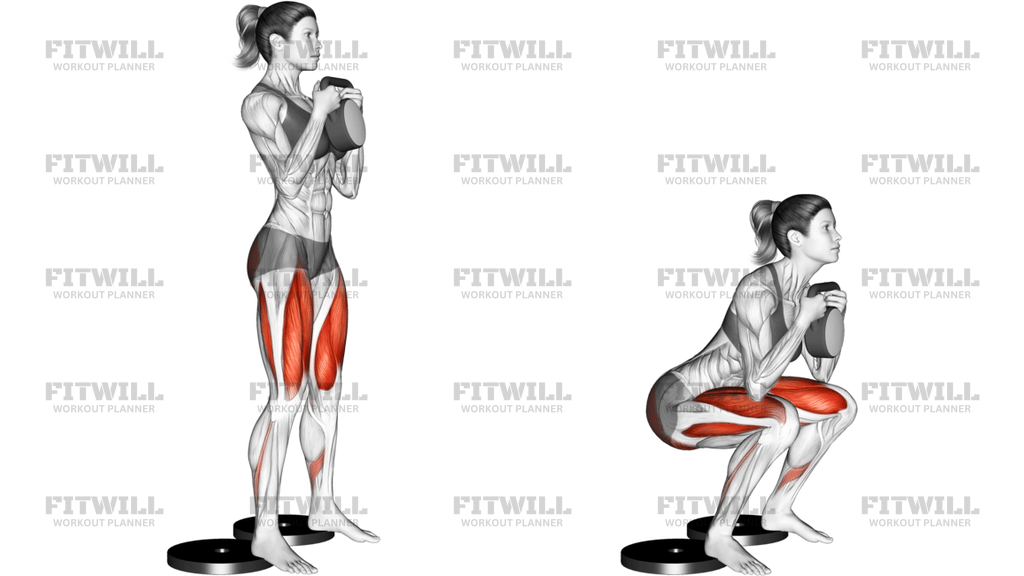
Kettlebell Full Squat From Deficit is a deep goblet squat performed with the feet standing on a low platform, plates, or other stable deficit. The extra drop increases the amount of knee and hip flexion you can access, so the exercise places a strong demand on the glutes, hips, and core while also asking the ankles and upper back to stay organized. The kettlebell stays close to the chest, which helps keep the torso more upright than a front-loaded barbell squat and makes the movement easier to control rep after rep.
The deficit is not there to make the exercise look harder. It changes the range of motion so you can reach a deeper squat position without losing balance or collapsing through the lower back. That makes the setup important: the platforms must be stable, the feet must be fully planted, and the kettlebell must sit high enough at the chest that your elbows can stay tucked while you descend. If the stance is too narrow or the load pulls you forward, the bottom position becomes a fight for balance instead of a clean squat.
At the bottom, the thighs should fold well past parallel only as far as you can keep the heels grounded and the knees tracking in line with the toes. The torso will lean forward a little, but it should stay long and braced rather than rounded. The kettlebell acts as a counterbalance, so the rep should feel like sitting between the hips while keeping the chest proud, the ribs stacked, and the head neutral. On the way up, drive the floor away evenly through both feet and let the knees and hips extend together.
This version is useful when you want more squat depth, more glute involvement out of the bottom, or a controlled lower-body accessory movement that does not rely on a barbell rack. It works well for strength work, accessory volume, and mobility-strength hybrids, but only if the deficit is appropriate for your ankles and hips. If you have to tip forward, lose foot pressure, or bounce out of the bottom, reduce the deficit or load until the movement is honest again.
[ Workout Log & Planner ]
Put your next workout in Fitwill
Keep your plan and training log ready when you are.


Instructions
- Place a low, stable platform or pair of plates under your feet and stand with your feet about shoulder-width apart, toes slightly turned out.
- Hold the kettlebell in a goblet position at chest height, with both hands around the horns and your elbows pointing down toward your ribs.
- Stand tall first, then brace your trunk so the rib cage stays stacked over the pelvis before you start the descent.
- Sit straight down between your hips, letting the knees travel forward and out while keeping the whole foot planted on the elevated surface.
- Keep the kettlebell close to your chest as you lower until you reach the deepest squat you can control without losing balance or heel contact.
- Pause briefly in the bottom position if needed, then drive through the midfoot and heel to stand back up.
- Let the knees and hips extend together as you rise, keeping the chest lifted and the spine long instead of folding forward.
- Exhale through the hardest part of the ascent, then reset your stance and breathing before the next repetition.
Tips & Tricks
- Use a deficit height that lets you keep the heels fully loaded; if the plates make you rock forward, the setup is too high.
- Think about pulling the kettlebell straight down between your thighs instead of letting it drift away from your chest.
- Keep the elbows inside the knees only as far as it helps the position; do not shove the knees inward to chase depth.
- A narrow stance usually makes the bottom position cramped, while a slightly wider stance often gives the hips room to sit between the feet.
- Keep pressure through the big toe, little toe, and heel so the feet do not collapse on the elevated surface.
- Do not relax in the hole; stay braced so the lower back does not take over at the deepest point.
- If the torso folds hard at the bottom, shorten the range or lower the deficit before adding weight.
- Use a slow descent when you are building control, then keep the ascent smooth without bouncing off the bottom.
Frequently Asked Questions
What does the deficit change in this kettlebell squat?
Standing on the plates or platform increases the range of motion and demands more control from the hips, knees, and ankles.
What should the kettlebell do during the rep?
It should stay close to the chest in a steady goblet hold so it counterbalances the torso without pulling you forward.
How deep should I go on the deficit squat?
Go only as deep as you can while keeping the feet planted, the knees tracking over the toes, and the spine long.
Why are my elbows tucked against my knees at the bottom?
That contact can help you stay upright and stay organized, but you should not force the knees inward to make it happen.
Is this a good exercise if I struggle with squat depth?
Yes, but only if the deficit is modest and you can control the bottom position without losing balance or heel pressure.
What muscles do I usually feel most with this movement?
Most people feel the glutes, hips, and quads working hard, with the core helping to keep the torso stable.
What is the most common mistake in the bottom position?
Losing foot pressure or rounding forward to chase more depth usually means the deficit is too high or the load is too heavy.
Can beginners use this exercise?
Yes, if the platform is low and the kettlebell is light enough to keep every rep slow, balanced, and repeatable.