Landmine One Leg Stiff Leg Deadlift
Landmine One Leg Stiff Leg Deadlift is a unilateral hip hinge that loads the glutes, hamstrings, and deep hip stabilizers through the guided arc of a landmine barbell. The fixed path makes it easier to control than a free barbell version, but the movement still demands balance, hip control, and a steady torso. It is a useful way to train one leg at a time when you want posterior-chain work without the coordination demands of a full free-standing deadlift.
The exercise is especially valuable when you want each side to work through its own range, because the standing leg has to resist rotation while the free leg reaches back as a counterbalance. That creates a strong demand on the hamstrings and glutes while the foot, ankle, and core keep the pelvis level. If one side is weaker or less stable, this movement exposes it quickly without needing a lot of load.
The setup matters because the landmine sleeve should sit close to the working side, and the bar should travel down beside the standing leg rather than drifting away from the body. Keep a soft knee on the stance leg, hinge from the hips, and let the free leg extend behind you as the torso tips forward. The goal is a long spine and square hips, not a squat or a twisted reach.
Lower under control until you feel a strong stretch in the hamstrings of the standing leg, then drive the floor away and bring the hips forward to stand tall. The bar should rise as the torso comes back up, and the free leg should return under you without swinging. Smooth breathing and a slow eccentric help you keep tension on the target side and prevent the set from turning into a balance drill with no hinge.
Use Landmine One Leg Stiff Leg Deadlift as an accessory lift, a unilateral strength builder, or a warm-up pattern before heavier deadlift work. It pairs well with split squats, two-leg hinges, and glute work, and it can be scaled by shortening the range or lightly touching a support with the free hand. Stop the set if the pelvis starts opening up, the lower back rounds, or the bar drifts away from the shin.
Fitwill
Log Workouts, Track Progress & Build Strength.
Achieve more with Fitwill: explore over 9600 exercises with images and videos, access built-in and custom workouts, perfect for both gym and home sessions, and see real results.
Start your journey. Download today!




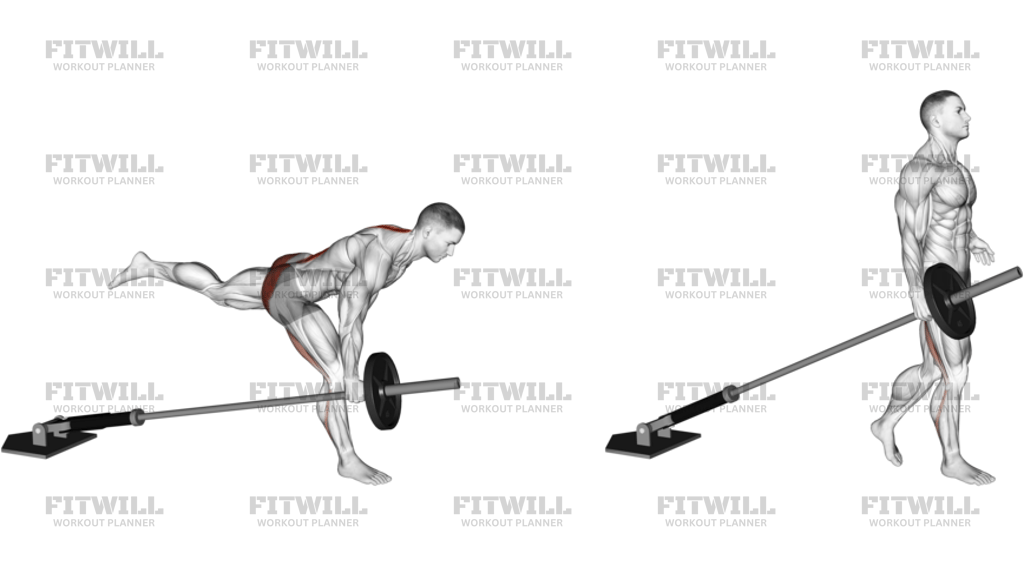
Instructions
- Anchor the landmine and stand facing the sleeve with the bar angled across your body; plant one foot under your hip and hold the bar end with the hand on that side.
- Keep the other foot lightly on the floor behind you or hovering just off the ground so it can act as a counterbalance.
- Set a soft bend in the standing knee, square your hips to the floor, and brace your trunk before the first rep.
- Keep the bar close to the front of the standing leg as you push your hips straight back and tip your torso forward.
- Let the free leg reach behind you as the torso lowers, keeping the standing shin nearly vertical and the spine long.
- Lower until the standing hamstring feels fully loaded without rounding the lower back or twisting the free hip open.
- Pause briefly at the bottom with tension still on the working leg, then drive through the heel and midfoot to bring the hips forward.
- Stand tall at the top with the glute squeezed, then reset the free leg and the bar path before the next rep.
- Inhale on the way down, exhale as you stand, and set the bar down safely after the last repetition.
Tips & Tricks
- Use a shorter hinge range if the bar starts drifting away from the shin or your lower back wants to round.
- Keep the pelvis pointed toward the floor; if the free-side hip opens, slow the descent and shorten the range.
- Think about reaching the back heel straight behind you instead of lifting the free leg high.
- Hold the sleeve end of the bar rather than reaching farther out on the shaft so the load stays easier to control.
- A light touch of the free hand on a rack upright or wall can help you learn the hinge without turning it into a balance contest.
- Keep the standing knee softly bent; locking it usually shifts stress into the hamstring tendon and makes balance worse.
- Let the bar travel down beside the standing leg instead of swinging out in front of the toes.
- Stop the set when the hips wobble more than the standing leg is working.
Frequently Asked Questions
What muscles does Landmine One Leg Stiff Leg Deadlift work most?
It mainly trains the glutes and hamstrings of the standing leg, with the core and hip stabilizers working hard to keep the pelvis square.
Is Landmine One Leg Stiff Leg Deadlift the same as a single-leg Romanian deadlift?
They are very similar. The landmine gives you a guided bar path, which usually makes balance and bar control a little easier.
Should my standing knee stay locked during Landmine One Leg Stiff Leg Deadlift?
No. Keep a soft bend in the standing knee so the hinge stays in the hip and the hamstrings do not take all the stress at the bottom.
How low should I go in Landmine One Leg Stiff Leg Deadlift?
Lower only as far as you can keep your spine long and your hips square. The right depth is the one that keeps tension on the standing leg instead of the lower back.
Can beginners use Landmine One Leg Stiff Leg Deadlift?
Yes. It is a good way to learn a one-leg hip hinge because the landmine guides the load, but beginners should start light and use a shorter range.
Why does my free-side hip keep opening up?
You are probably reaching too far or dropping too deep. Shorten the hinge and keep both hip bones facing the floor as you lower.
Do I need to touch the floor with the free foot?
No. The free leg is mostly a counterbalance, so let it hover or sweep back without planting it each rep.
How can I make Landmine One Leg Stiff Leg Deadlift easier or harder?
Make it easier with less range or a light support touch, and harder by loading the sleeve more or slowing the lowering phase.