Bodyweight Good Morning
Bodyweight Good Morning is a standing hip-hinge exercise that trains the posterior chain without external load. It places the main emphasis on the hips, glutes, hamstrings, and spinal erectors while still demanding strong trunk control. Because the movement is driven by the hips rather than the knees, it is useful for learning how to fold at the hips, keep the torso organized, and maintain a neutral spine under tension.
The setup matters more here than in many bodyweight drills. A narrow-to-hip-width stance, soft knees, and a tall chest make it easier to shift the hips straight back while the feet stay planted. The hands on the hips position in the image is not just cosmetic; it helps you feel the pelvis moving backward and forward instead of turning the exercise into a squat or a rounded-back reach.
Each rep should look like a controlled hinge, not a bow. As the hips travel back, the torso inclines forward and the shins stay mostly vertical. The lower you go, the more you should feel length through the hamstrings and tension through the glutes and trunk. Stop the descent before the low back starts to round, then stand by driving the hips forward and squeezing the glutes to finish tall without leaning back.
This exercise is commonly used in warm-ups, movement prep, rehab-adjacent work, and accessory sessions where you want to groove hip mechanics before heavier hinging patterns such as Romanian deadlifts, deadlifts, or kettlebell swings. It can also be a good option for beginners because it teaches the hinge with very little complexity, but only if the tempo stays slow enough to keep the ribs, pelvis, and spine stacked.
The main coaching priorities are control, balance, and a clean return to standing. You should feel the stretch build in the backs of the legs and the work shift to the glutes as you come up. If the movement turns into a squat, the knees drift too far forward, or the back rounds at the bottom, shorten the range and reset the hinge pattern before adding volume.
[ Workout Log & Planner ]
Put your next workout in Fitwill
Keep your plan and training log ready when you are.


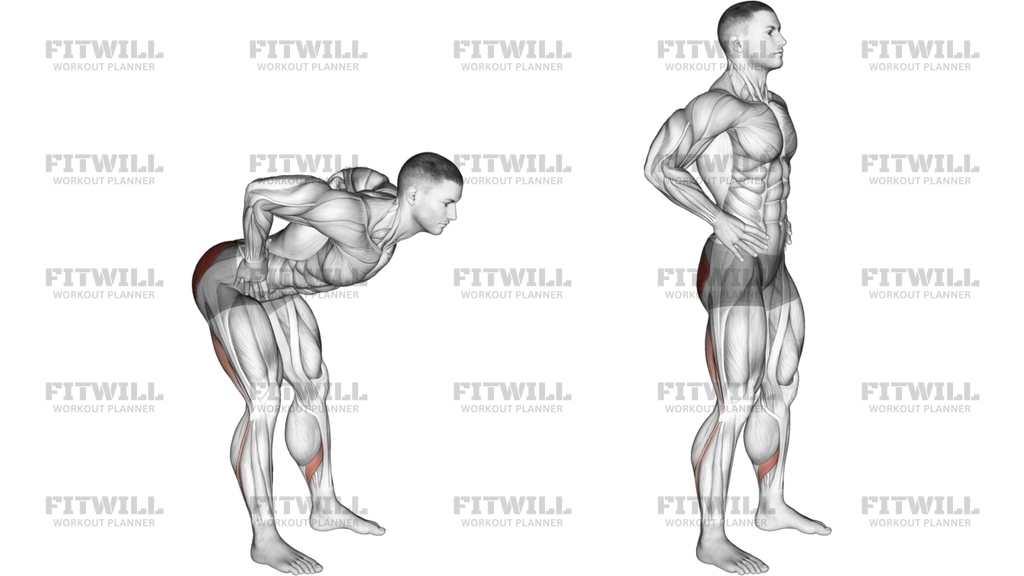
Instructions
- Stand tall with your feet about hip-width apart, toes pointed mostly forward, and your weight balanced through the whole foot.
- Place your hands on your hips or lightly against the sides of your waist so you can feel the pelvis move.
- Keep a soft bend in your knees, lift your chest, and set your ribs over your pelvis before you start.
- Inhale, then push your hips straight back as if closing a car door with your hips.
- Let your torso hinge forward while your shins stay nearly vertical and your back stays long.
- Lower until you feel a strong hamstring stretch or until your torso is about parallel to the floor, whichever comes first.
- Pause briefly at the bottom without rounding your lower back or letting your shoulders collapse forward.
- Exhale and drive your hips forward to stand tall again, finishing with the glutes tight and the ribs stacked over the pelvis.
- Reset your breath at the top before starting the next rep.
Tips & Tricks
- Think "hips back" instead of "chest down" so the hinge starts at the hip crease rather than in the spine.
- Keep a small knee bend throughout the rep; if the knees keep traveling forward, you are drifting into a squat pattern.
- Use the hands-on-hips position to check that the pelvis is moving back on the way down and forward on the way up.
- Stop the descent the moment your lower back wants to round, even if that means a shorter range of motion.
- Keep your neck in line with your torso and avoid craning the chin forward at the bottom.
- Feel the stretch in the hamstrings during the lowering phase and the glutes doing the work as you stand.
- Move slowly enough that you can control both the hinge and the return without bouncing.
- If balance is an issue, set your feet a little wider and reduce the depth before building back up.
Frequently Asked Questions
What muscles does Bodyweight Good Morning work?
It mainly trains the glutes, hamstrings, and spinal erectors, with the core helping you keep the torso stable.
Why do my knees stay slightly bent instead of straight?
A soft knee bend helps you hinge at the hips and keeps tension on the hamstrings instead of locking the knees.
How low should I go on the descent?
Lower only until you feel a strong hamstring stretch and can still keep a neutral spine. Depth is secondary to posture.
Should this feel like a squat?
No. Your hips should move back and your shins should stay mostly vertical, while the torso folds forward from the hip joint.
Where should I feel the stretch in the bottom position?
You should feel it mainly in the hamstrings, with some tension through the glutes and trunk, not sharp pressure in the low back.
Can beginners use this exercise?
Yes. It is a good hinge drill for beginners as long as they keep the movement slow and stop before the spine rounds.
What is the easiest way to keep the movement honest?
Place your hands on your hips and think about pushing the hips back to touch an imaginary wall behind you.
How can I make Bodyweight Good Morning harder without weights?
Slow the lowering phase, add a brief pause in the stretched position, or increase the range only if your back stays neutral.