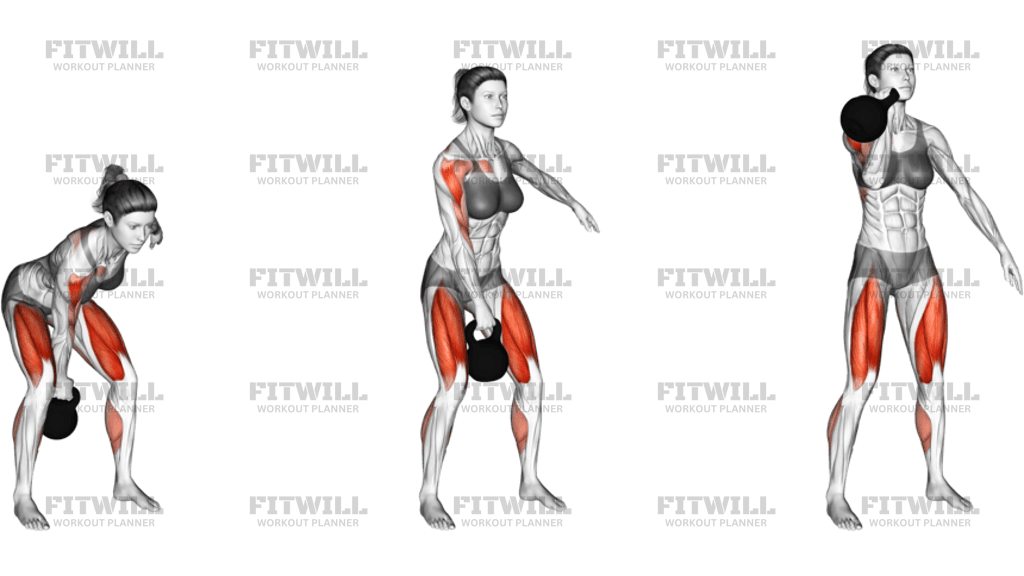
Kettlebell Clean And Press
Kettlebell Clean and Press is a compound kettlebell lift that links a hip-driven clean with an overhead press. It trains coordination, timing, grip strength, shoulder stability, and trunk control in one sequence, so the repetition has to stay crisp from the first hike to the final lockout. It is most useful when you want a movement that builds strength and work capacity without losing the technical demands of a loaded overhead pattern.
The clean portion matters because it places the bell into the rack without crashing into the forearm or pulling the shoulder forward. A good rack position keeps the bell close to the body, the wrist stacked, the elbow tucked, and the torso tall. That position lets you breathe, reset, and press with less wasted effort. If the bell swings too far away or the torso leans back to catch it, the press usually turns into a grind before the set has really started.
The press should finish with the bell directly over the shoulder, ribs controlled, and the arm vertical rather than drifting forward. That overhead finish is where the exercise starts to demand more from the shoulder girdle, obliques, glutes, and upper back. The lift is not just an arm exercise; it is a coordinated transfer of force from the hips into the rack and then into a stable overhead position.
Because the movement is built from two different phases, load selection matters more than with a simpler press or swing. A kettlebell that is easy to clean but sloppy to press is usually too heavy for clean practice. Use a weight that lets you keep the bell path close, the grip secure, and the torso quiet while you repeat several reps on each side. If you are alternating arms, fully finish one side before switching so the rack and overhead position do not get rushed.
Kettlebell Clean and Press fits well in strength sessions, athletic conditioning work, or mixed full-body training when you want a powerful lower-body drive plus a strict upper-body finish. It rewards patience, especially on the descent, because the bell should return to the rack and then back into the swing or dead-stop setup under control. When performed well, it gives you a strong hinge, a stable catch, and a controlled press in one efficient lift.
[ Workout Log & Planner ]
Put your next workout in Fitwill
Keep your plan and training log ready when you are.


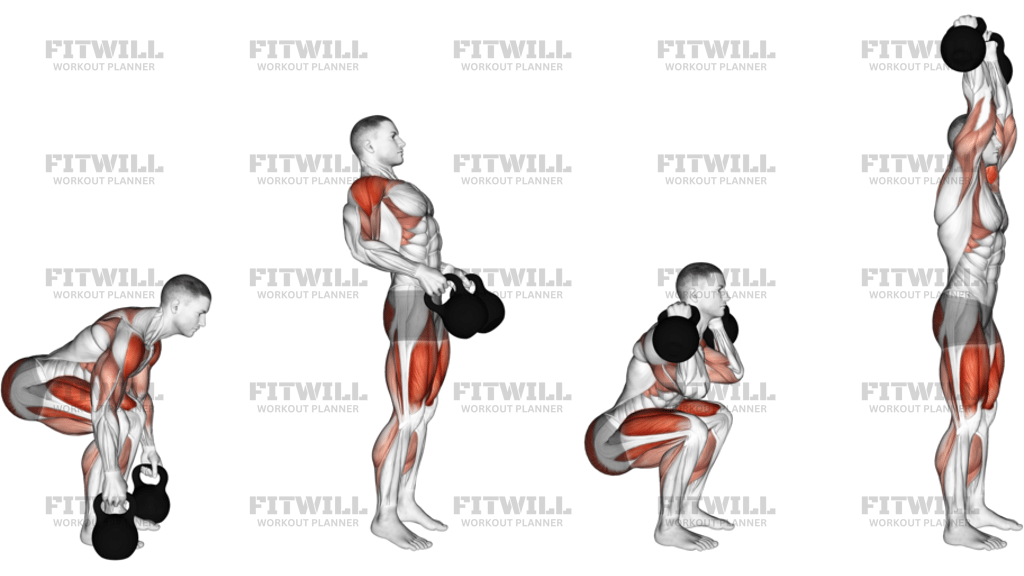
Instructions
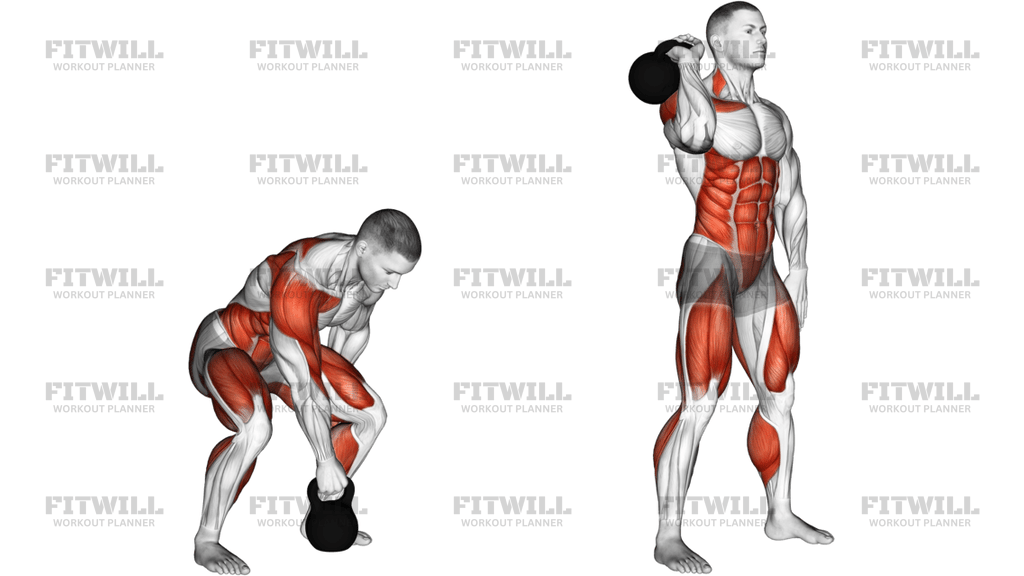
- Stand with your feet about hip-width apart and place the kettlebell on the floor between your feet, slightly in front of you.
- Hinge at the hips, keep your chest proud, and grip the handle with your palm angled toward your body and your shoulders packed.
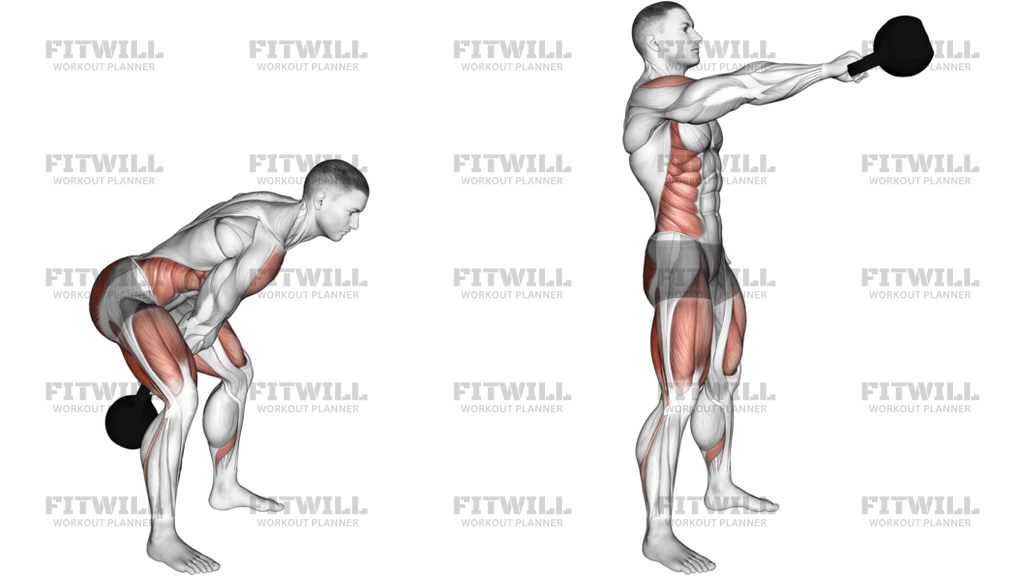
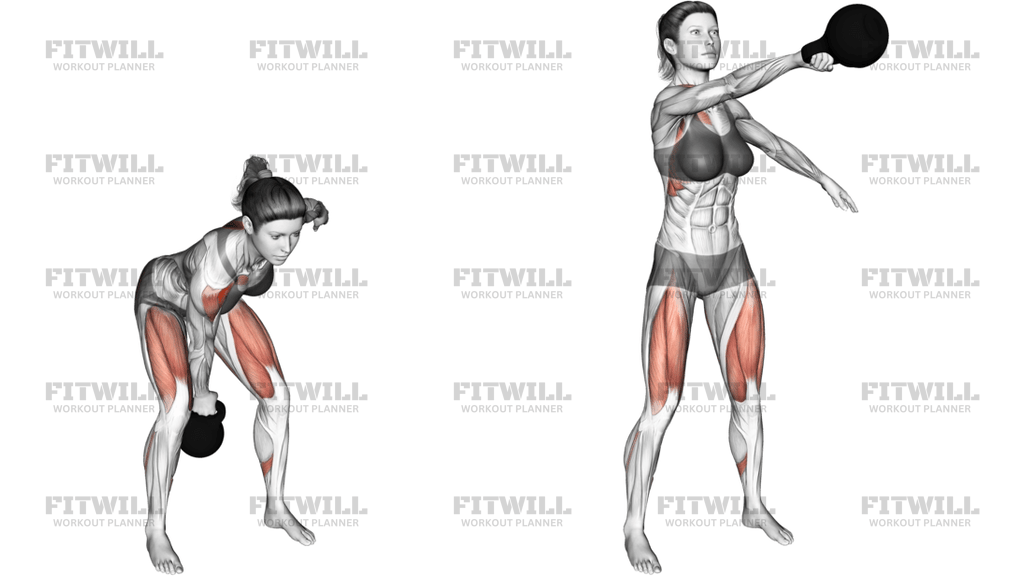
- Hike the bell back between your legs like the start of a kettlebell swing, keeping your back flat and your lats engaged.
- Drive through your hips to stand tall and let the bell float upward close to your body instead of pulling with your arm early.
- Rotate the kettlebell around your hand into the rack so it lands softly on the outside of your forearm near shoulder height.
- Reset your breath in the rack, brace your trunk, and keep your elbow close enough that the bell stays stacked over your midfoot.
- Press the kettlebell straight overhead until your arm is locked out, your biceps are near your ear, and your ribs stay down.
- Lower the bell back to the rack with control, then guide it back into the next hinge or set it down between your feet when the set is finished.
Tips & Tricks
- Keep the clean tight to your body; if the bell loops away from your hip, the rack will feel heavier and noisier.
- Let the hips create the clean, not a hard curl with the biceps.
- Turn your hand around the bell as it travels upward so the handle rolls into the base of your palm instead of slamming the wrist.
- In the rack, the forearm should be vertical and the elbow should sit below the shoulder, not flare wide.
- Press in a mostly straight line, finishing slightly back so the bell ends over the shoulder rather than in front of it.
- Keep your ribs from flaring when you press; the torso should stay stacked, not lean into a backbend.
- Use a bell that feels smooth on both the clean and the press. If one part breaks down first, the weight is probably too heavy.
- If the forearm gets banged up, soften the catch by keeping the bell close and rotating the hand sooner on the way up.
- Exhale under control during the press and take a short brace before each rep from the rack.
- Lower with the same care you used to clean it, because a sloppy drop back into the hinge usually ruins the next rep.
Frequently Asked Questions
What muscles does the kettlebell clean and press work?
It primarily trains the shoulders, triceps, upper back, glutes, and core, with the clean adding grip and hip-drive demand.
Is the clean and press beginner-friendly?
Yes, if the kettlebell is light enough to clean smoothly and you can press it without leaning back or losing the rack position.
Where should the kettlebell sit in the rack position?
The bell should rest on the outside of your forearm with the elbow tucked near the ribs and the wrist stacked, not bent backward.
How do I keep the clean from slamming my forearm?
Keep the bell close, rotate your hand around the handle earlier, and catch it softly in the rack instead of letting it flip over late.
Should I use one kettlebell or two?
Most clean and press variations use one kettlebell at a time. If you train both sides, complete the reps on one side before switching.
What is the biggest mistake people make on the press?
They flare the ribs and turn the press into a backbend. Keep the torso stacked and press the bell overhead without leaning away from it.
How heavy should the kettlebell be?
Choose a load you can clean quietly and press with full control. If the clean is solid but the press becomes a grind, the bell is too heavy for this drill.
Can I do this as part of a conditioning workout?
Yes, it works well in strength circuits or intervals as long as the rack and overhead position stay crisp under fatigue.
What should I do if my shoulder does not like overhead pressing?
Keep the clean and stop at the rack, or switch to a lighter bell and a more vertical press path. Pain at lockout is a sign to scale the movement.