Crab Walk
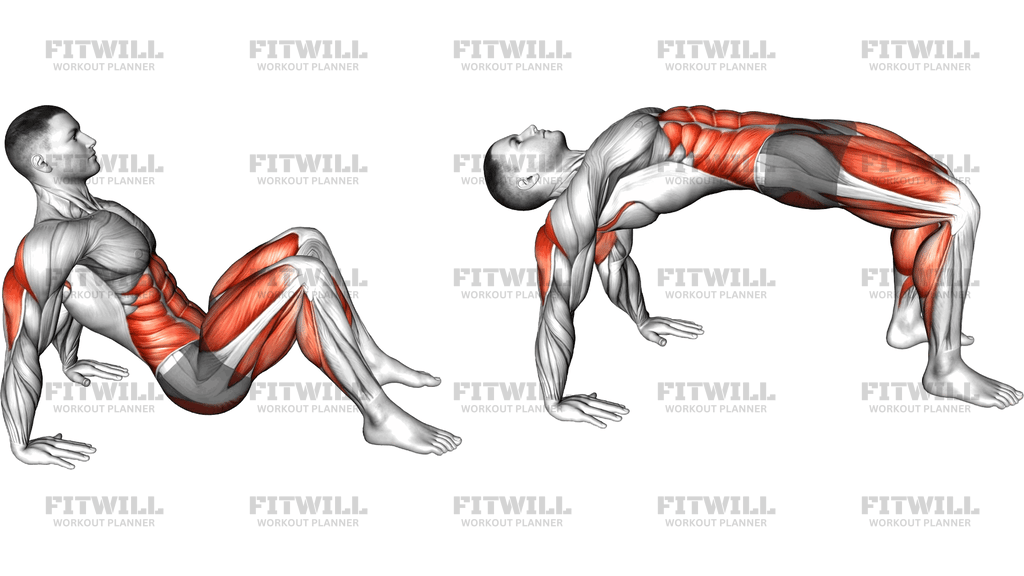
Crab Walk is a bodyweight floor drill that teaches you to move while supporting your body with your hands and feet. Unlike a stationary bridge, this version asks you to keep the hips lifted while you travel, so the shoulders, triceps, glutes, hamstrings, and core all have to stay organized. It is useful as a warmup, a coordination drill, or a low-load conditioning exercise when you want controlled movement instead of heavy resistance.
The setup matters because the exercise starts in a reverse-tabletop position, not a relaxed sit. With the hands placed behind the hips and the feet flat, you create a stable base that lets the hips stay high and the chest stay open. If the hands are too close to the body or the feet are too far away, the shoulders and low back usually take over before the core and hips do their job.
A good Crab Walk is smooth and quiet. Lift into the supported bridge, then travel with small alternating steps so one hand and the opposite foot move, followed by the other side. The goal is to keep the pelvis level and the torso from twisting as you cover space, whether you are moving forward, backward, or on a diagonal.
Keep the movement controlled enough that you can breathe without holding tension in your neck. The more your hips sag, the more the load shifts into the wrists and lower back, so it is better to shorten the step than to reach too far. If you are using Crab Walk in a circuit, treat it as a quality drill: every step should look similar, and every reset should put you back into the same strong support position.
This exercise is also easy to scale. Beginners can stay in a smaller range with short steps, while more advanced lifters can cover more distance or move more slowly to increase time under tension. It works well before lower-body training, athletic drills, or any session where you want the hips, shoulders, and trunk to cooperate without a machine or external load.
[ Workout Log & Planner ]
Put your next workout in Fitwill
Keep your plan and training log ready when you are.


Instructions
- Sit on the floor with your hands behind your hips, fingers turned slightly outward or toward your feet, knees bent, and feet flat about hip width apart.
- Shift your weight onto your palms and heels, then press your hips up until your torso is supported and your chest stays open.
- Tighten your midsection and keep your head in line with your spine before you take the first step.
- Move one hand and the opposite foot together in a short, controlled step across the floor.
- Follow with the other hand and opposite foot, keeping your hips from dropping or rotating.
- Keep your steps small enough that your shoulders stay stacked and your weight remains spread between hands and feet.
- Breathe out as you move, then inhale briefly as you stabilize each position.
- Lower your hips to the floor, reset your hands and feet, and repeat for the planned distance or time.
Tips & Tricks
- Turn your fingers slightly outward if shoulder extension feels tight in the crab position.
- If your wrists complain, place your hands on low blocks or a bench to reduce extension.
- Keep the steps short; long reaches usually make the pelvis twist and the hips sag.
- Press through the whole palm, not just the heel of the hand, to keep the support stable.
- Keep the heels down so the lower body stays in the crab position instead of turning into a crawl.
- If your hamstrings cramp, bring your feet a little closer to your hips.
- Use a slow, even pace; this drill works better when every step looks the same.
- Stop the set when your hips start dropping or your low back starts taking over.
Frequently Asked Questions
What does Crab Walk train?
It trains shoulder support, triceps, glutes, hamstrings, and core control while you move across the floor.
Is Crab Walk good for beginners?
Yes, beginners can do it with short steps and a smaller travel distance. The main goal is to keep the hips lifted and the movement controlled.
How should my hands be placed in Crab Walk?
Put your hands behind your hips with the palms flat and the fingers turned slightly outward or toward your feet. That position gives you a stronger base in the reverse-tabletop start.
How high should my hips stay during Crab Walk?
High enough to keep the torso supported and the chest open, but not so high that the shoulders and glutes lose tension. If the hips sag, shorten the step.
What is the biggest mistake in Crab Walk?
Taking steps that are too long. That usually twists the pelvis, drops the hips, and puts too much stress on the wrists and lower back.
Can I make Crab Walk harder without weights?
Yes. Cover a longer distance, slow the pace down, or pause for a beat in each supported step while keeping the hips level.
Should Crab Walk hurt my wrists or lower back?
No. If either area feels strained, shorten the step, slightly turn the hands out, or raise the hands on a low support.
Is Crab Walk the same as a bear crawl?
No. Crab Walk is performed face-up with your hands behind you, while a bear crawl is face-down on your hands and feet.
Which direction should I move in Crab Walk?
You can travel forward, backward, or on a diagonal as long as the steps stay alternating and the hips remain lifted.