Safety Bar Good Morning
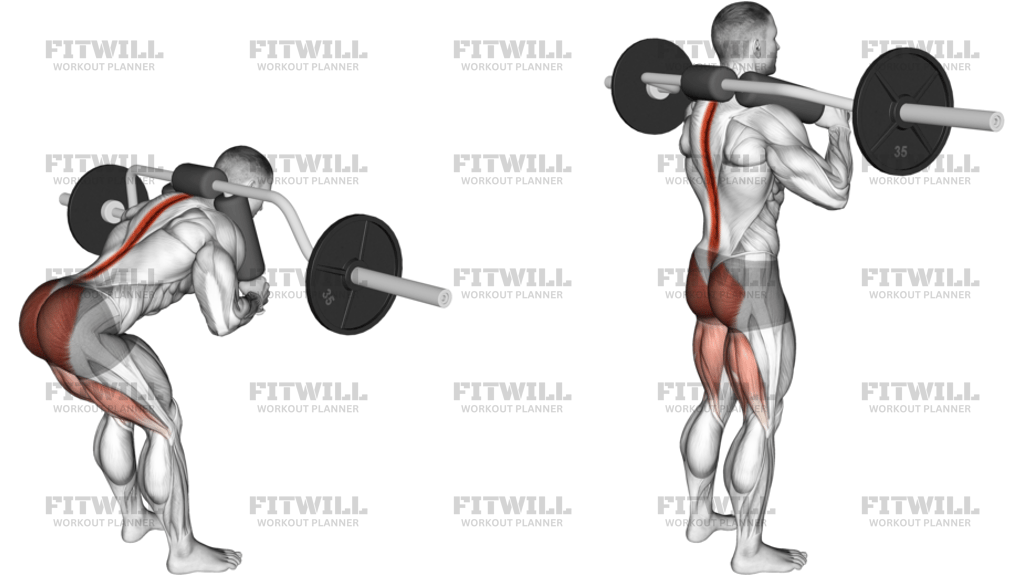
Safety Bar Good Morning is a loaded hip hinge performed with the safety bar resting across the upper back and the hands holding the front handles. The image shows a classic good morning pattern: the hips travel back, the torso inclines forward, and the spine stays long while the knees remain only slightly bent. That setup lets you train the posterior chain without needing to support a straight bar in the hands, which can make the exercise feel more stable and easier to repeat with good posture.
This movement primarily challenges the hamstrings, glutes, and spinal erectors, with the core working hard to keep the rib cage and pelvis organized. Because the load sits high on the back, the exercise strongly rewards a neutral neck, a steady brace, and a controlled hinge. If you let the bar drift, the back round, or the knees keep bending, the movement turns into a squat-like pattern and the target tension shifts away from the hips.
The repetition begins with the bar locked across the traps and the feet set about hip width. From there, keep a soft knee bend and push the hips straight back until the torso reaches the forward lean you can control without losing spinal position. The goal is not to fold lower at all costs. It is to feel a long hamstring stretch, maintain balance through the whole foot, and then drive the hips forward to stand tall again.
Safety bar good mornings are useful for teaching a stronger hinge, building posterior-chain strength, and reinforcing back position for squats, deadlifts, and athletic lifting. They are also a good option when you want to train hip extension with less bar discomfort on the shoulders than a straight bar version. The exercise is effective with moderate loads and deliberate tempo, and it becomes less useful the moment the rep turns into a bounce or a rushed descent.
Use this lift when you want targeted hinge work with a clear top-to-bottom rhythm and enough stability to focus on position. Keep the brace firm before every rep, control the lowering phase, and stop the set if the bar starts pulling you out of alignment. A well-executed set should feel like the hips and hamstrings are doing the work while the trunk holds the shape.
[ Workout Log & Planner ]
Put your next workout in Fitwill
Keep your plan and training log ready when you are.


Instructions
- Load the safety bar and place it across your upper back, with the pads sitting on the traps and your hands holding the front handles.
- Stand with your feet about hip width, keep a soft bend in the knees, and set your weight evenly through the whole foot.
- Lift your chest slightly, keep your neck neutral, and brace your core before the first rep.
- Push your hips straight back while letting your torso hinge forward, keeping the shins nearly vertical and the bar fixed in place.
- Lower only as far as you can keep your back long and your balance centered over midfoot.
- Pause briefly when you feel a strong hamstring stretch and the torso angle is controlled.
- Drive the hips forward to stand back up, squeezing the glutes without leaning back at the top.
- Reset your brace at the top, then repeat for the planned number of reps.
Tips & Tricks
- Treat the hinge as a hip movement, not a bend at the waist; the pelvis should move back while the chest stays proud.
- Keep the bar pinned to your upper back with your hands only guiding the handles, not pulling you upright.
- A slight knee bend is enough; if the knees keep drifting forward, the exercise starts to look like a squat.
- Stop the descent when your spine wants to round or your balance shifts into your toes.
- Use a controlled lowering phase so the hamstrings load gradually instead of catching a sudden drop.
- Exhale as you drive the hips through and re-brace before the next rep.
- Choose a load that lets you keep the same torso angle on every repetition.
- If the bar feels unstable on the shoulders, reduce the load and shorten the range before forcing depth.
Frequently Asked Questions
What muscles do safety bar good mornings work?
They heavily train the hamstrings, glutes, and spinal erectors, with the core helping to keep the trunk braced.
Why use a safety bar instead of a straight bar?
The safety bar rests more comfortably on the upper back and the front handles make it easier to keep the torso organized during the hinge.
How far should I hinge forward?
Go only as far as you can keep a long spine, steady balance, and a clear hamstring stretch without losing position.
Should my knees stay bent the whole time?
Yes, keep a small knee bend and hold it fairly constant so the movement stays a hip hinge instead of turning into a squat.
Can beginners do this exercise?
Yes, if the load is light and the range is shortened until they can keep the bar stable and the spine neutral.
Where should I feel the exercise?
You should feel the stretch and work mostly in the hamstrings and glutes, with the lower back working isometrically to hold position.
What is the biggest form mistake?
Rounding the back or turning the descent into a fast drop are the two most common ways the movement breaks down.
How should I breathe during the rep?
Brace before you hinge, then exhale as you drive back to standing and reset your brace at the top.
Is it okay to go deep if I am flexible?
Only if you can keep the same spinal position and foot balance; depth is useful only when the hinge stays clean.