Dot Drill
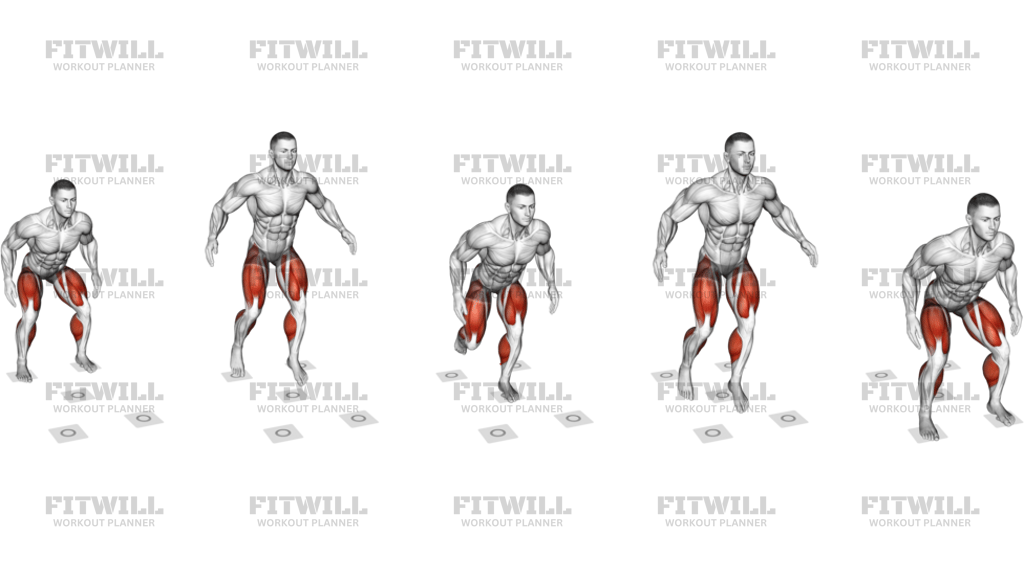
Dot Drill is a body-weight agility and plyometric drill performed on a five-dot pattern, usually with one center marker and four outer markers. It is designed to sharpen quick footwork, coordination, ankle stiffness, and the ability to change direction without losing body control. The drill is fast and reactive, but the real goal is not to jump high; it is to move cleanly between the dots and land in a balanced, repeatable stance.
The setup matters because the center dot is the reset point for every rep. Start in a small athletic stance over the middle marker with your feet about hip-width apart, knees soft, chest slightly forward, and eyes on the pattern. From there, you should be ready to spring or step to each surrounding dot without needing a long wind-up. A stable setup makes the footwork crisp and keeps the drill from turning into random bouncing.
During the drill, move in the classic dot pattern shown in the image, hopping or stepping between the front, back, and side markers while returning through center as needed. Keep each contact short, quiet, and under control. Land with your knees tracking over your toes, hips level, and weight centered over the balls of your feet so you can reverse direction quickly instead of sinking into each landing.
Dot Drill is most useful in warm-ups, speed sessions, field-sport conditioning, and plyometric work where you want fast feet and better landing mechanics. Beginners can start by stepping through the pattern instead of hopping, then build up to low two-foot jumps and quicker transitions. More advanced athletes can increase speed, work time, or add single-leg variations, but the pattern should always stay tidy and organized.
Because this is a reactive drill, fatigue shows up fast as noisy landings, sloppy foot placement, and drifting away from the markers. Use a surface with good traction and enough space around the dots so you can reset safely. If your knees cave inward, your heels slam down, or your feet stop hitting the intended markers, slow the pace or end the set before technique breaks down.
[ Workout Log & Planner ]
Put your next workout in Fitwill
Keep your plan and training log ready when you are.


Instructions
- Stand just behind the center dot in a small athletic stance, with your feet about hip-width apart, knees soft, chest slightly forward, and eyes on the marker pattern.
- Lower into a shallow quarter squat and keep your weight over the midfoot so you can spring in any direction without rocking backward.
- On the first rep, hop or step quickly to one outer dot, landing softly on the balls of both feet with your knees tracking over your toes.
- Return through the center dot and continue to the next dot in the pattern shown, keeping the contacts short and the path compact.
- Keep your hips level and your torso steady as you move so the drill stays fast without turning into a bounce or shuffle.
- Use your arms for rhythm, but let the legs do the work and avoid swinging so hard that it pulls your body off the dots.
- Land quietly on each marker, absorb with the ankles, knees, and hips, and avoid letting your heels crash into the floor.
- Continue for the planned number of reps or seconds, then slow down, step clear of the pattern, and reset before the next round.
Tips & Tricks
- Treat the drill as fast footwork, not a jumping contest; the hops should stay low and springy.
- Make the landings quiet. Loud contacts usually mean you are collapsing into the floor instead of staying reactive.
- Keep your knees pointed in the same direction as your toes so the pattern stays clean and the ankles and knees stay organized.
- Use the center dot as a reset point. Re-stack your posture there instead of letting each rep drift wider.
- If your feet start missing the markers, slow the tempo before you increase speed again.
- On a slippery floor, step through the pattern first or switch to a better surface before adding hop speed.
- Let the arms move naturally at your sides, but do not let them whip across your body and throw off your balance.
- Stop the set when your hips rise too high, your heels slap down, or your footwork gets noisy and uncontrolled.
Frequently Asked Questions
What does Dot Drill train the most?
It mainly trains foot speed, coordination, ankle reactivity, and the ability to land and redirect quickly on a five-dot pattern.
Can beginners perform this exercise?
Yes. Beginners should start by stepping between the dots instead of hopping, then progress to small two-foot jumps once the pattern feels stable.
Do I need special equipment for Dot Drill?
No. A flat non-slip floor and five visible markers such as tape, floor dots, or small cones are enough.
Should I hop or step between the dots?
Both work. Stepping is the easiest version, while quick two-foot hops are the standard plyometric version shown in the image.
What is the most common mistake in the dot pattern?
Most people either hop too high or land too loud, which slows the drill and makes the foot placement sloppy.
Where should my knees point during the landings?
Your knees should track over the toes on each marker instead of collapsing inward as you change direction.
When is Dot Drill best used in a workout?
It fits best in a warm-up, agility block, or plyometric session before fatigue makes the footwork less precise.
How do I make Dot Drill harder?
Increase the speed of the pattern, shorten the ground contact time, add more rounds, or progress to single-leg variations.