L Drill
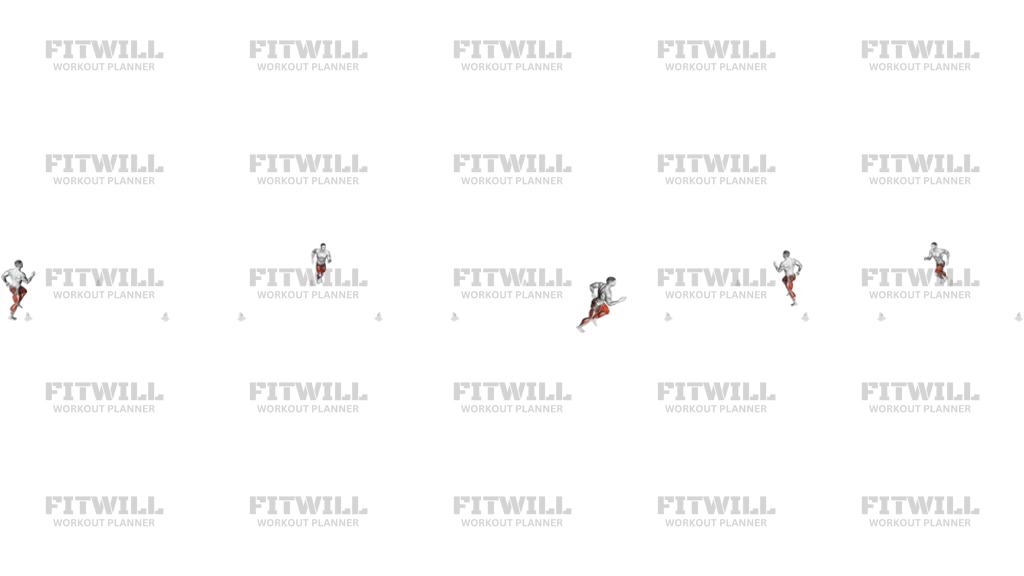
L Drill is a bodyweight agility drill built around three cones arranged in an L shape. It teaches you to accelerate straight ahead, change direction under control, shuffle laterally, and backpedal without losing balance or posture. The value of the drill is not just speed; it is the ability to move quickly while keeping your hips organized, your feet under you, and your turns sharp.
This movement is commonly used for field and court sports because it blends the three patterns athletes need most: forward sprinting, side-to-side movement, and controlled deceleration. The drill challenges the quads, glutes, calves, hamstrings, and trunk as stabilizers, but the real goal is clean footwork and efficient body angles. If the body gets tall or the feet start crossing over too much, the drill stops being an L Drill and turns into a sloppy run.
Setup matters more than people expect. Place the base cone, the top cone straight ahead, and the side cone to make the "L" with enough space to move fast without clipping a cone. Start in an athletic stance, then drive forward to the top cone, lower into a shuffle across the second leg, and backpedal to the start with short, controlled steps. Use the cones as precise checkpoints so each rep has the same path.
L Drill works well in a warm-up, conditioning block, or speed session when you want crisp repetitions instead of fatigue-based grinding. The best reps feel explosive but controlled, with each turn happening early enough that you do not have to panic or overreach. Beginners can simplify the drill by shortening the cone spacing and moving at a moderate pace first, then building speed only after the pattern is consistent.
Fitwill
Log Workouts, Track Progress & Build Strength.
Achieve more with Fitwill: explore over 9600 exercises with images and videos, access built-in and custom workouts, perfect for both gym and home sessions, and see real results.
Start your journey. Download today!




Instructions
- Place three cones in an L shape: one start cone, one cone straight ahead, and one cone to the side of the top cone.
- Stand at the base cone in an athletic stance with your knees bent, chest up, and weight on the balls of your feet.
- Sprint straight to the top cone with short, fast steps and a slight forward lean.
- Plant under control at the top cone, drop your hips, and turn into a lateral shuffle down the second leg of the L.
- Keep your feet from crossing during the shuffle and keep your shoulders as square as you can to the direction of travel.
- At the far cone, plant again, turn smoothly, and backpedal down the first leg of the drill.
- Use quick, light steps on the way back and slow down before you reach the start cone.
- Reset your stance, breathe, and repeat for the planned number of reps or switch directions on the next set.
Tips & Tricks
- Keep the cone spacing honest; if the spaces are too tight, the drill becomes choppy, and if they are too wide, your turns get sloppy.
- Accelerate out of each cone with a strong first step instead of popping upright too early.
- During the shuffle, stay low enough that your feet can move quickly without your hips bouncing.
- Plant the outside foot first when you turn so the change of direction feels sharp and stable.
- Backpedal with short, quick steps rather than reaching the feet far behind you.
- Use your arms to help rhythm and balance, but do not swing so hard that your torso twists.
- If your feet start crossing during the lateral leg, slow the pace and clean up the footwork.
- Stop the set when your turns become noisy, late, or out of control.
Frequently Asked Questions
What does L Drill train?
It trains acceleration, deceleration, lateral shuffle control, backpedaling, and quick direction changes.
How do I set up the cones for the L Drill?
Use three cones: one start cone, one cone straight ahead, and one cone off to the side so the layout forms an L.
Which muscles work hardest during the drill?
The quads, glutes, calves, hamstrings, and core all work to drive and stabilize the movement.
Should I cross my feet during the side shuffle?
No. Keep the shuffle controlled and mostly step-side-step so the hips stay organized and the turn stays clean.
How fast should the L Drill be performed?
Fast enough to be athletic, but not so fast that you miss the cone turns or lose body control.
Is this drill good for beginners?
Yes, if the cone spacing is shortened and the athlete learns the pattern before trying to move at full speed.
What is the most common mistake in the L Drill?
Standing too tall and turning too late are the biggest issues because both make the footwork less efficient.
How many reps should I do?
Use a small number of high-quality reps, such as a few passes per side, and stop once the footwork starts to fade.