Ladder Drill
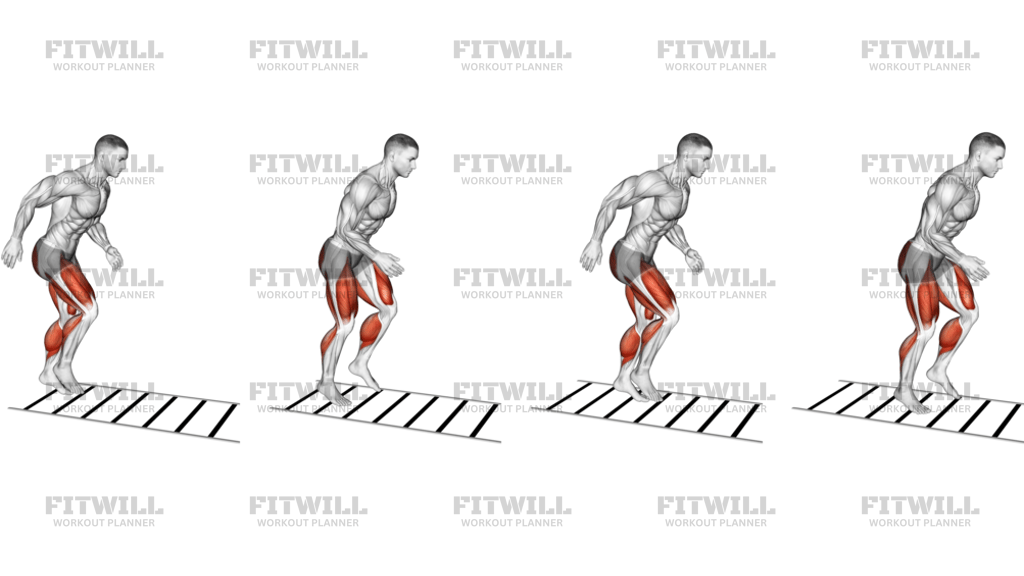
Ladder Drill is a body-weight agility exercise performed on a flat speed ladder. It is used to build quick feet, coordination, rhythm, and lower-body reactivity without turning the set into a heavy strength effort. The goal is to move cleanly through each square with short ground contacts and consistent spacing from the first step to the last.
The ladder itself sets the timing of the drill, so setup matters. Lay it flat, make sure the rungs are straight, and stand at the start with a slight athletic lean, soft knees, and your weight balanced over the balls of your feet. The torso should stay quiet while the legs do the work, which helps each step land in the right place instead of wandering across the rungs.
The movement is usually a repeated footwork pattern, such as quick two-feet-in steps, in-and-out steps, or one-foot-per-square running contacts. Whatever pattern you choose, the rhythm should stay crisp and repeatable. Place the feet quickly, keep the hips level, and let the arms help set the pace instead of swinging wildly or forcing extra speed.
Ladder work fits well in a warm-up, speed session, conditioning block, or plyometric circuit. It is especially useful when you want to rehearse foot placement, change of cadence, and light reactive contacts before faster running, jumping, or field work. It can also be a good low-load option for athletes who need coordination work without much joint stress.
The main form rule is to stay precise. If your feet start clipping the rungs, your posture gets stiff, or your contacts become noisy, the drill is too fast for that pattern. Slow down, simplify the footwork, and keep each rep clean. Done well, Ladder Drill builds quick, efficient movement that carries over to sprinting, cutting, and sport-specific footwork.
[ Workout Log & Planner ]
Put your next workout in Fitwill
Keep your plan and training log ready when you are.


Instructions
- Lay the agility ladder flat on a non-slip surface with enough space to move in and out of the pattern.
- Stand at the start square with your feet hip-width apart, knees softly bent, and your torso slightly leaned forward.
- Choose the footwork pattern for the set, such as two feet in each square or one foot per square, and keep it consistent.
- Drive the first foot into the opening, then place the second foot quickly without stomping the rung.
- Move one square at a time with short, quick contacts instead of long strides or big jumps.
- Keep your hips level and your chest quiet while your arms swing naturally to match the rhythm.
- Land lightly on the balls of your feet and let the ankles absorb each contact before the next step.
- Step cleanly out of the final square, reset your position, and repeat for the planned distance or time.
Tips & Tricks
- Treat the ladder like a timing drill, not a sprint lane; the best reps are quick and precise, not wide and rushed.
- If your shoes keep clipping the rungs, slow the pattern down before trying to speed it up.
- Keep your knees tracking over your toes so each landing stays balanced and centered over the square.
- Stay tall through the ribcage and avoid folding forward at the waist when the drill gets faster.
- Look ahead to the next square instead of staring at your feet for the entire set.
- Use a light arm drive to keep cadence smooth, especially on faster footwork patterns.
- Pick a pattern you can repeat perfectly for the full set before you progress to a harder ladder sequence.
- Stop the set when the contacts get loud, sloppy, or uneven; that is the point where coordination breaks down.
Frequently Asked Questions
What does Ladder Drill train most?
It mainly trains foot speed, rhythm, coordination, and lower-body reactivity.
Is Ladder Drill a strength exercise?
No. It is mainly an agility and plyometric drill used to improve quickness and movement quality.
Should I hop or step through the ladder?
Either works, depending on the pattern. The important part is quick, clean foot placement with short ground contact.
How should my feet land on the rungs?
Land lightly on the balls of your feet and keep the contacts controlled so you can move to the next square smoothly.
Can beginners use an agility ladder?
Yes. Beginners should start with simple two-feet-in patterns and slower pace before trying faster or more complex footwork.
What is the most common mistake during Ladder Drill?
Rushing the pattern until the feet clip the rungs or the torso gets stiff and off balance.
What surface is best for this drill?
Use a flat, non-slip surface so the ladder stays straight and your foot placement stays consistent.
How do I progress Ladder Drill over time?
Progress by increasing speed, using more complex patterns, or extending the work interval while keeping the footwork clean.