Lateral Ladder Drill
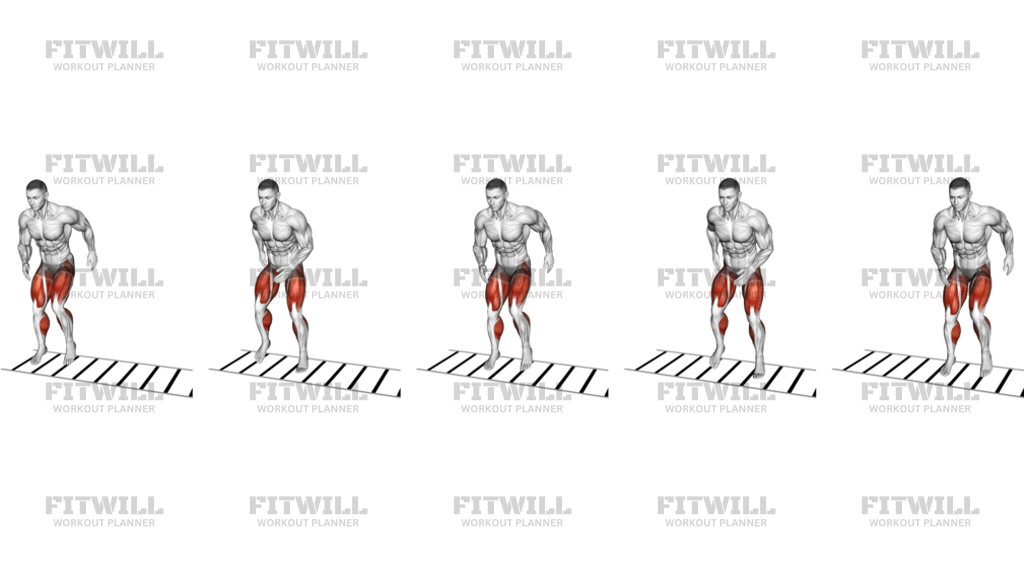
Lateral Ladder Drill is a bodyweight agility and plyometric drill that uses an agility ladder to train quick side-to-side footwork, foot placement, and repeatable rhythm. The value of the drill is not big jumps or hard impacts. It is the ability to place the feet quickly, stay balanced through each square, and keep the body organized while the pace rises.
The movement is driven mostly by the lower body, with the calves, quads, glutes, hip stabilizers, and ankles doing most of the work. The core and upper body help you stay quiet and centered so the feet can move fast without turning the drill into a scramble. That makes the exercise useful for athletes who need sharper change-of-direction mechanics as well as for general conditioning.
Setup matters because the ladder gives you a clear target for each step. Place the ladder flat on a non-slip surface, stand at one end, and take an athletic stance with soft knees, a slight hip hinge, and your chest tall. Keep your eyes forward instead of staring straight down the whole time. The goal is to stay low enough to move quickly while still keeping the hips level and the knees tracking cleanly over the toes.
During each pass, step laterally through the rungs with short, quick contacts and quiet landings. In the common two-feet-per-box pattern shown here, place the lead foot into the square, bring the second foot in, then push off the outside foot into the next box. Keep the steps light and precise so you do not clip the rails or overreach with the feet. Let the arms pump naturally for rhythm, but avoid twisting the torso or swinging wildly to create speed.
Use the drill as a warm-up, speed block, or conditioning finisher before sprinting, court work, field work, or lower-body training. It is best when the feet stay crisp and the ladder pattern stays clean from the first square to the last. If the contacts get noisy, the knees cave in, or the ladder starts moving around, slow the drill down and rebuild the rhythm before chasing more speed.
[ Workout Log & Planner ]
Put your next workout in Fitwill
Keep your plan and training log ready when you are.


Instructions
- Place an agility ladder flat on a non-slip surface and stand at one end with the ladder running across your path.
- Take an athletic stance with your knees softly bent, hips slightly back, chest tall, and eyes looking ahead.
- Start with one foot just outside the first square and the other ready to follow so you can step laterally into the ladder.
- Step the lead foot into the first square, then bring the second foot in so both feet land cleanly inside the same box.
- Push off the outside foot and move sideways into the next square with short, quick steps instead of long reaches.
- Keep your feet under your hips, your torso quiet, and your landings soft enough that the ladder does not bounce or slide.
- Let your arms pump naturally for rhythm, but do not let them twist your shoulders or pull you off line.
- Continue across the ladder at a controlled pace, keeping each contact crisp and precise from the first box to the last.
- Step clear of the ladder at the end, reset your stance, and repeat for the planned distance or number of passes.
Tips & Tricks
- Stay light on the balls of your feet so each contact sounds quick instead of heavy.
- Keep the steps short; reaching too far sideways is the fastest way to clip the rungs.
- If you are using the two-feet-per-box pattern, place the second foot down before you rush into the next square.
- Keep your hips level so your head does not bob up and down with every step.
- Drive the movement from the outside leg and use the inside leg to clean up the landing.
- Look ahead most of the time; staring at your feet every second usually slows the rhythm and stiffens the upper body.
- If the ladder shifts on the floor, slow down and reduce force rather than trying to outrun the equipment.
- Use enough rest between passes to keep the next round fast and technically clean.
- Stop the set if your knees cave inward or your feet start landing outside the target square.
Frequently Asked Questions
What does the Lateral Ladder Drill train most?
It trains foot speed, lateral agility, coordination, and quick ground contacts.
What muscles work during this drill?
Your calves, quads, glutes, hip stabilizers, and core help you move quickly and stay balanced.
Do I need an agility ladder for this exercise?
A ladder is ideal because it gives consistent spacing, but taped floor markers can work as a simpler substitute.
Should both feet go into each square?
In the common pattern shown here, yes, both feet land inside each box before you shift to the next square.
How fast should I perform the drill?
Go only as fast as you can keep clean foot placement, soft landings, and a steady torso.
What is the most common mistake?
People usually reach too wide, clip the ladder, or let the upper body twist to create speed.
Is this a beginner-friendly exercise?
Yes. Start slowly, shorten the pattern if needed, and focus on accuracy before chasing speed.
When should I use this in a workout?
It fits well in a warm-up, a speed and agility block, or a light conditioning finisher.