High Hurdle Jump To Sprint And Cut
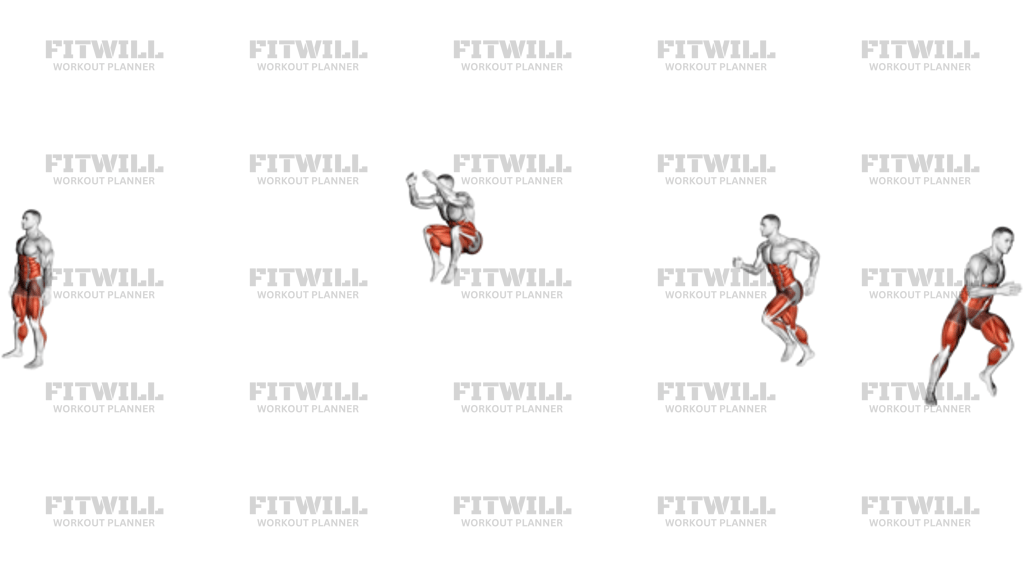
High Hurdle Jump To Sprint And Cut is a bodyweight plyometric drill built for athletes who need to produce force, land cleanly, and change direction without wasting time. The sequence combines a powerful hurdle jump, a short acceleration phase, and a sharp cut, so the rep teaches you how to organize your body while it is moving fast. That makes it useful for field sports, court sports, and any program that wants more reactive lower-body power.
The jump phase emphasizes hip extension, knee drive, and ankle stiffness, while the landing and transition challenge your deceleration mechanics and trunk control. Because the drill immediately flows into a sprint and cut, the supporting muscles around the hips, knees, ankles, and core have to keep alignment tight as speed rises. If the setup is sloppy or the hurdle is too high, the rep turns into a jump for height instead of a crisp power-and-agility drill.
Set the hurdle or obstacle at a height you can clear without tucking so aggressively that your landing becomes unstable. Start with a controlled athletic stance, then explode over the hurdle and prepare to absorb the landing on the balls of the feet with a soft knee bend. The sprint step should come out of that landing, not after a long pause, so the drill teaches you to redirect force quickly instead of sinking into the ground.
The cut is the key skill in this movement. After the short sprint, plant with the foot that matches your chosen direction, drop your hips slightly, and drive the body out of the plant at an angle rather than spinning upright. A good rep looks fast but organized: jump, land, accelerate, plant, cut. That sequence is exactly why the drill is popular in preseason work, warmups for change-of-direction sessions, and training blocks that want more elastic power without external load.
Use High Hurdle Jump To Sprint And Cut when you want a high-skill plyometric drill that rewards coordination as much as explosiveness. It is not meant to be a fatigue-based conditioning rep or a max-height jump contest. Quality, spacing, and sharp footwork matter more than volume, and the safest reps are the ones where the landing, sprint, and cut all look clean and repeatable.
Fitwill
Log Workouts, Track Progress & Build Strength.
Achieve more with Fitwill: explore over 9600 exercises with images and videos, access built-in and custom workouts, perfect for both gym and home sessions, and see real results.
Start your journey. Download today!




Instructions
- Place a hurdle or low plyometric barrier in front of you and stand in an athletic stance with your feet about hip-width apart.
- Face the hurdle squarely, keep your chest tall, and load your hips with a small counter-movement before you jump.
- Swing your arms and jump explosively over the hurdle, driving the knees up just enough to clear the obstacle cleanly.
- Land softly on the forefeet with your knees tracking over your toes and your hips slightly back to absorb force.
- Take the first sprint step immediately out of the landing and accelerate for a short distance with quick, powerful strides.
- Lower your center of mass as you approach the cut and plant the foot that will redirect you.
- Push off the planted foot and cut sharply into the new direction without letting your torso twist ahead of your hips.
- Reset with control after the cut, regain your stance, and breathe before the next repetition.
- Repeat for the planned number of reps with the same hurdle height, sprint distance, and cutting angle.
Tips & Tricks
- Pick a hurdle height that you can clear without folding at the hips or reaching for the landing.
- Think of the landing as a quick preload, not a dead stop; you want to rebound into the sprint step.
- Keep the first sprint steps short and violent instead of overstriding after the hurdle.
- If your knees cave inward on the landing, lower the hurdle and shorten the jump distance.
- Match the cut angle to your sport or goal; a 45-degree cut is often cleaner than trying to turn too sharply.
- Keep your torso stacked over your hips during the plant so the cut comes from the legs, not a twisting upper body.
- Use low rep counts so every jump, sprint, and cut stays crisp.
- Stop the set when the landing gets loud or the plant foot starts slipping.
Frequently Asked Questions
What does High Hurdle Jump To Sprint And Cut train?
It trains lower-body power, landing control, sprint acceleration, and change-of-direction mechanics in one drill.
Is High Hurdle Jump To Sprint And Cut suitable for beginners?
Yes, if the hurdle is low and the sprint and cut are kept short. Beginners should focus on clean landings before chasing speed.
How high should the hurdle be for High Hurdle Jump To Sprint And Cut?
Use a height that lets you clear the barrier with a controlled jump and stable landing. If you have to tuck excessively or lose posture, it is too high.
What is the most common mistake in the cut phase?
A common error is staying too upright and spinning through the turn. Drop the hips slightly and push off the plant foot at an angle instead.
Should I pause after the hurdle landing?
No, the drill works best when the landing flows quickly into the sprint step. Only slow down enough to keep the landing controlled.
What muscles are working during High Hurdle Jump To Sprint And Cut?
The glutes, quads, hamstrings, calves, and core all contribute, with the hips and legs doing most of the explosive work.
Can I use High Hurdle Jump To Sprint And Cut before sport practice?
Yes, it fits well in a warmup or primer block as long as the volume stays low and each rep stays sharp.
How do I progress High Hurdle Jump To Sprint And Cut?
Progress by slightly increasing hurdle height, sprint distance, or cut sharpness one variable at a time while keeping the landing quiet and stable.