Lying Frog Kick
Lying Frog Kick is a bodyweight lower-body drill performed face down on a mat with the legs turned out and the feet kept together in a frog-like position. It is useful when you want a simple movement that asks the glutes, hamstrings, and core to work together without heavy loading. The exercise is especially good for learning how to control the hips while keeping the pelvis and lower back quiet.
The setup matters more here than most people expect. When the chest, hips, and legs are arranged correctly, the kick becomes a smooth hip-driven action instead of a fast leg swing. That makes Lying Frog Kick a practical option for warm-ups, activation work, or light accessory sets before bigger lower-body training. It also helps you notice whether one hip is shifting more than the other before you move into harder leg work.
During each rep, the goal is to lift the legs just enough to create tension, then kick the legs outward and bring them back together without losing pressure through the hips. The movement should feel compact and controlled, with the core helping to stop the torso from rolling or arching. If the lower back is taking over, the range is probably too large or the tempo is too fast. A small pause in the open position can make the hips do more of the work.
Lying Frog Kick can also be used to reinforce hip mobility and body awareness in a way that is easy to repeat. The exercise does not need speed or force to be effective. Short, clean repetitions with a steady rhythm usually do more for the target muscles than big, sloppy kicks. For most people, it works best as a light primer, a controlled accessory drill, or a finisher when the hips need focused work without spinal loading.
Keep the motion smooth, the neck relaxed, and the breathing steady so the set stays organized from start to finish. A softer surface or mat makes the prone position more comfortable, especially when the hips stay close to the floor. If the movement starts to feel cramped in the lower back, reduce the kick size and focus on the squeeze through the glutes and inner thighs instead of chasing a bigger range. When the set stays tidy, the exercise becomes a useful way to build lower-body control without overcomplicating the session.
Fitwill
Log Workouts, Track Progress & Build Strength.
Achieve more with Fitwill: explore over 9600 exercises with images and videos, access built-in and custom workouts, perfect for both gym and home sessions, and see real results.
Start your journey. Download today!




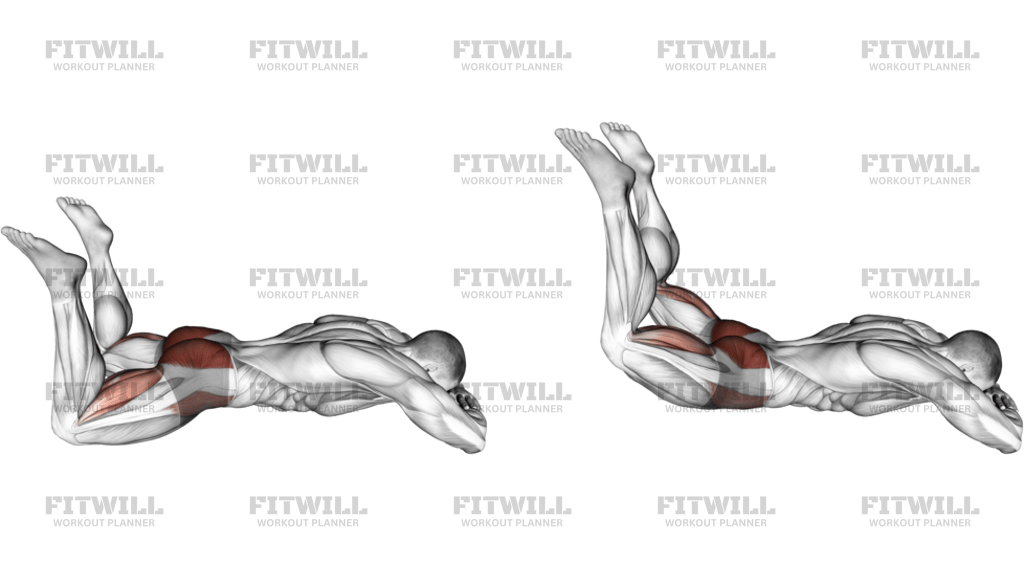
Instructions
- Lie face down on a mat with your legs extended behind you, knees slightly bent, and the inside edges of your feet touching in a frog position.
- Place your forearms on the floor or reach your arms forward, then keep your chest heavy and your neck long so your head stays in line with your spine.
- Set your hips square to the mat and gently brace your core before the first kick so your lower back does not take over.
- Lift your legs just off the floor, keeping the feet together and the knees turned out enough to hold the frog shape.
- Kick your legs outward in a short, controlled arc while squeezing the glutes and inner thighs to keep the movement deliberate.
- Bring the legs back together under control, maintaining tension instead of letting them drop or slam into the mat.
- Breathe out during the outward kick and breathe in as you return to the starting position, keeping the rhythm steady.
- Repeat for the planned number of reps, then lower your legs and rest with the hips relaxed before the next set.
Tips & Tricks
- Keep the kicks small enough that your hips stay pressed into the mat; if your lower back arches, the range is too big.
- The exercise should feel like the legs open and close from the hips, not like the knees are swinging wildly from momentum.
- Use a mat or folded towel under your pelvis if the prone position feels uncomfortable on the hips or pubic bone.
- A slow outward kick and a slightly slower return will make the glutes and hamstrings do more of the work.
- If your knees drift apart too far, shorten the range and keep the frog shape compact so the inner thighs stay involved.
- Do not crank the head up to watch the movement; keep your gaze down and your neck neutral so the upper back stays relaxed.
- Think about squeezing the glutes before each kick instead of trying to force a bigger leg swing.
- Stop the set when the pelvis starts rocking side to side or the legs begin landing with a slap instead of tension.
Frequently Asked Questions
What muscles does Lying Frog Kick work?
It primarily trains the glutes, hamstrings, and core, with the inner thighs helping to control the frog position and the return phase.
How do I set up the feet for Lying Frog Kick?
Lie face down with your knees slightly bent and the inside edges of your feet touching. Keep that frog shape as you lift and kick so the tension stays in the hips instead of the lower back.
Should my hips stay on the mat during Lying Frog Kick?
Yes. Keep the hips heavy against the mat as much as possible so the movement stays focused on the glutes and hamstrings rather than turning into a back extension.
Is Lying Frog Kick beginner friendly?
Yes. It is a good bodyweight drill for beginners because the range can be kept small and the tempo can be slowed down until the pattern feels smooth.
What is the most common mistake with Lying Frog Kick?
The biggest mistake is kicking too high and arching the lower back. Keep the lift modest and focus on a controlled open-and-close action through the hips.
Do I need any equipment for Lying Frog Kick?
No equipment is required, but a mat or soft surface makes the prone position more comfortable for the hips and torso.
Can I make Lying Frog Kick harder?
Yes. Slow the tempo, pause briefly at the widest part of the kick, or add a light resistance band if you want more tension without changing the movement pattern.
Where should I feel Lying Frog Kick working?
You should feel the glutes and hamstrings doing most of the work, with some inner-thigh and core effort to keep the legs organized and the pelvis steady.