Lying Scissors Cross
Lying Scissors Cross is a body-weight floor exercise performed on your back with both legs lifted and alternately crossing past each other in a controlled scissor pattern. The movement trains the lower abs, hip flexors, and deep trunk stabilizers while the adductors and glutes help keep the legs organized. Because the lever is long and the pelvis wants to rock, the quality of the rep depends on keeping the torso quiet rather than trying to swing the legs faster.
The setup is simple but important. Lie on a mat with your back flat, ribs down, and your head relaxed. Support your torso with your arms at your sides or lightly under your hips if that helps you keep the low back stable. Raise both legs to a height you can control with straight or nearly straight knees. If your lower back arches as soon as the legs lower, the range is too big or the legs are too low.
Each rep should look smooth and deliberate. Open the legs slightly into a split, then cross one leg over the other and alternate sides without jerking. Keep the movement coming from the hips and abs, not from momentum. Breathe out as the legs pass through the hardest part of the rep, then inhale as you reset the split. The goal is to keep constant tension through the midsection while the pelvis stays pinned to the floor.
This exercise works well as a core accessory, warm-up drill, or finisher in body-weight workouts, Pilates-style sessions, and athletic conditioning circuits. It is useful when you want abdominal work that emphasizes control, coordination, and pelvic stability more than spinal flexion. Use a smaller range or higher leg angle for more control, and stop the set as soon as the low back starts to lift or the motion turns into swinging.
Clean reps are the standard here: straight lines, even rhythm, and a stable trunk from the first rep to the last. If the neck tenses, the legs drop too far, or the hips start to rock side to side, the set is no longer serving the exercise. Keep the motion compact, repeatable, and precise.
Fitwill
Log Workouts, Track Progress & Build Strength.
Achieve more with Fitwill: explore over 9600 exercises with images and videos, access built-in and custom workouts, perfect for both gym and home sessions, and see real results.
Start your journey. Download today!




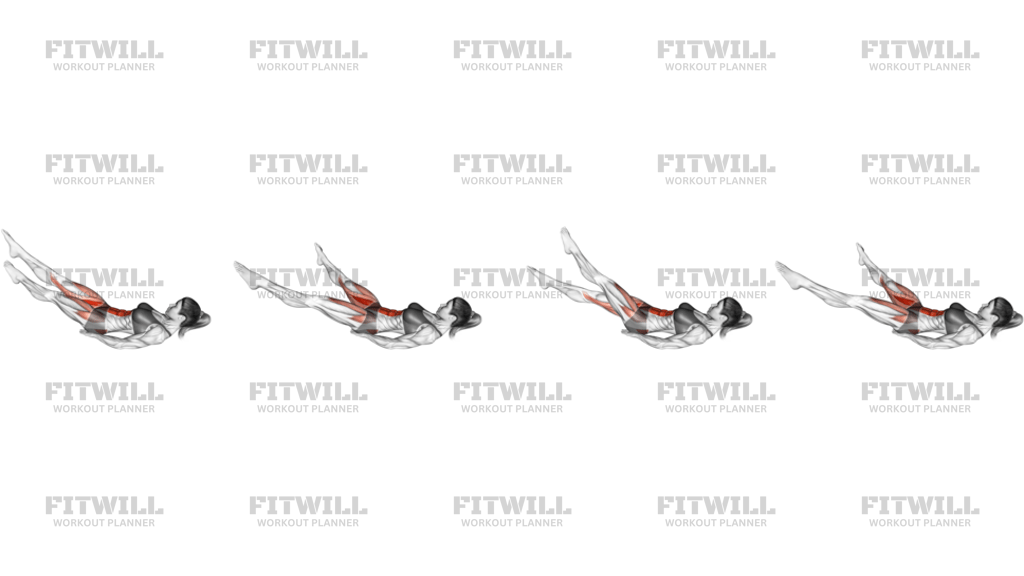
Instructions
- Lie on a mat with your back flat, your head relaxed, and your hands at your sides or under your hips for support.
- Lift both legs off the floor and hold them straight or nearly straight at a height you can control without arching your lower back.
- Press your ribs down and brace your abs before the first rep so the pelvis stays steady.
- Open the legs slightly into a split position to create room for the scissor motion.
- Cross one leg over the other in a smooth, controlled path, then alternate sides.
- Keep the motion small enough that your hips do not roll or your low back lift off the mat.
- Breathe out as the legs pass each other and inhale as you return to the split position.
- Continue for the planned reps or time, then lower the legs to the floor with control.
Tips & Tricks
- Keep the leg angle high enough that your low back stays glued to the floor; lower the legs only as far as you can control.
- A small scissor is better than a big one if the larger range makes your hips rock.
- If your hip flexors take over, bend the knees slightly or raise the legs a little higher to shorten the lever.
- Think about reaching long through the heels instead of kicking the legs quickly.
- Keep the neck soft and the shoulders heavy so the effort stays in the trunk, not the upper body.
- Use a steady tempo; this drill gets harder when you rush the cross and lose position.
- Stop the set as soon as the lower back arches or the pelvis starts tilting side to side.
- If you need extra support, slide your hands under your hips before starting the set.
Frequently Asked Questions
What muscles does Lying Scissors Cross work?
It mainly challenges the lower abs and hip flexors, with the adductors, glutes, and deep core muscles helping control the leg path.
Can beginners perform this exercise?
Yes, beginners can do it if they keep the legs higher, use a smaller range, and focus on keeping the lower back on the floor.
Where should I feel Lying Scissors Cross most?
You should feel it mostly in the lower abs and hip flexors, with the thighs working to keep the crossing motion controlled.
Why does my lower back lift off the floor?
Usually the legs are too low or the range is too large. Raise the legs a little higher and shorten the scissor until your pelvis stays still.
Should my knees stay straight during the scissor?
Keep them straight or only slightly soft if that helps control the motion. Bending too much turns the drill into a different hip movement.
Is this the same as flutter kicks?
No. Flutter kicks move the legs up and down, while Lying Scissors Cross focuses on crossing one leg over the other with the torso held quiet.
Can I put my hands under my hips?
Yes. That can help if your pelvis tips forward, but the goal is still to keep the trunk braced rather than using the hands to push through the set.
How long should I do this exercise?
Most people use it for a set number of controlled reps or a short time interval, stopping before the lower back starts to arch or the movement becomes sloppy.