Dumbbell Rollout
Dumbbell Rollout is a kneeling anti-extension exercise that uses two dumbbells as rolling handles. It trains the deep abdominals, rectus abdominis, lats, shoulders, and hip flexors to resist spinal extension while the arms travel far in front of the body. The movement looks simple, but the setup matters: if the dumbbells are too far apart, the rollout feels unstable; if they are too close together, the wrists and shoulders tend to drift inward and the path becomes sloppy.
This version starts from the knees with the dumbbells on the floor under the shoulders. From there, you roll the weights forward and let the torso lengthen only as far as you can keep the ribs down and the pelvis tucked. The goal is not to collapse into the low back. The goal is to hold a long lever with tension through the trunk, then pull the dumbbells back underneath you without losing that brace.
Because the load is moving away from the body, Dumbbell Rollout is more about control than brute force. A clean rep keeps the neck neutral, the elbows straight, and the hips from sagging. The shoulders should move freely, but the lumbar spine should stay quiet. If the lower back starts to arch or the rollout turns into a dip at the hips, the range is too long or the dumbbells are too heavy.
Use this exercise as an accessory core movement on days when you want direct anti-extension work without a machine. It fits well after main lifts, in trunk-focused sessions, or as part of a short abdominal circuit. Beginners can use it with a shorter range and a padded kneeling position, while stronger lifters can extend farther or slow the return to increase the challenge. Keep every repetition controlled and stop the set when the torso can no longer stay rigid and stacked over the knees.
Fitwill
Log Workouts, Track Progress & Build Strength.
Achieve more with Fitwill: explore over 9600 exercises with images and videos, access built-in and custom workouts, perfect for both gym and home sessions, and see real results.
Start your journey. Download today!




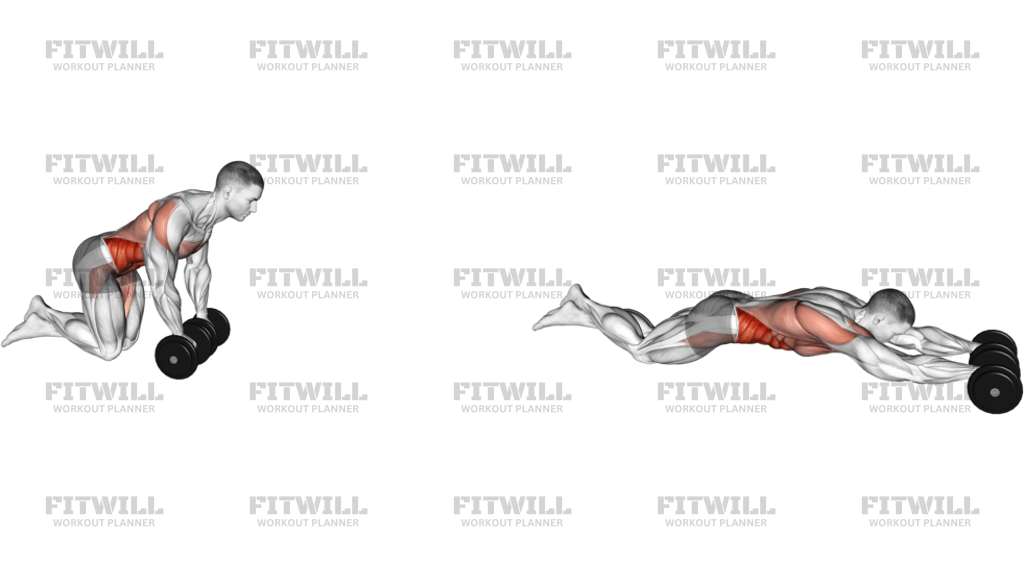
Instructions
- Place two dumbbells on the floor shoulder-width apart and kneel on a pad behind them with your knees under your hips.
- Grip the dumbbell handles with straight arms, set your shoulders down, and keep your ribs stacked over a lightly tucked pelvis.
- Brace your abs before you move so your torso stays firm instead of collapsing through the low back.
- Roll both dumbbells forward together by reaching your hands out in front of your shoulders while your hips travel slightly forward.
- Keep the elbows locked and the neck neutral as far as you can go without losing tension through the midsection.
- Pause briefly at the longest position you can control without letting the lower back arch or the shoulders shrug up.
- Pull the dumbbells back toward your knees by contracting the abs and lats, keeping the movement smooth rather than jerky.
- Finish each rep back under the shoulders, reset your brace, and repeat for the planned number of controlled repetitions.
Tips & Tricks
- A pair of round-headed dumbbells rolls more smoothly than hex heads; if the weights catch or wobble, shorten the range.
- Keep the dumbbells close enough that your wrists stay stacked over the handles instead of drifting wide.
- Think about pulling the sternum away from the floor on the way out, but do not let the ribs flare.
- Squeeze the glutes lightly so the pelvis stays tucked and the low back does not take over the rep.
- If your shoulders feel jammed, stop before the fully extended position and own that shorter lever first.
- Exhale as the dumbbells roll forward, then take a quiet brace before pulling them back in.
- Use a pad or folded mat under the knees because the set gets much less stable if you shift to protect sore knees.
- End the set when the return becomes slower than the rollout; that is usually the point where form starts to break.
Frequently Asked Questions
What does the dumbbell rollout train most?
It mainly trains the abs to resist low-back arching, with strong help from the lats, shoulders, and hip flexors.
How is this different from an ab wheel rollout?
The pattern is similar, but dumbbells are usually less stable and can feel more awkward if they are too close together or the floor is slick.
Where should the dumbbells sit at the start?
Set them shoulder-width apart directly in front of your knees so your wrists stay under your shoulders before you roll forward.
How far should I roll out?
Go only until you can keep your ribs down, your pelvis tucked, and your elbows straight without your low back sagging.
Why do my shoulders feel overloaded?
The shoulders are supporting a long lever, so some fatigue is normal. If the front of the shoulders pinches, shorten the range and keep the dumbbells closer together.
Can beginners do the dumbbell rollout safely?
Yes, but they should start with a very short rollout, a kneeling pad, and light dumbbells that roll smoothly.
What is the most common form mistake?
Letting the lower back arch and turning the movement into a hip hinge instead of a rigid trunk hold.
How can I make the exercise harder?
Use a longer reach, slow the return, or choose dumbbells that roll more freely while still letting you keep perfect trunk position.