Dumbbell Standing Alternate Reverse Curl
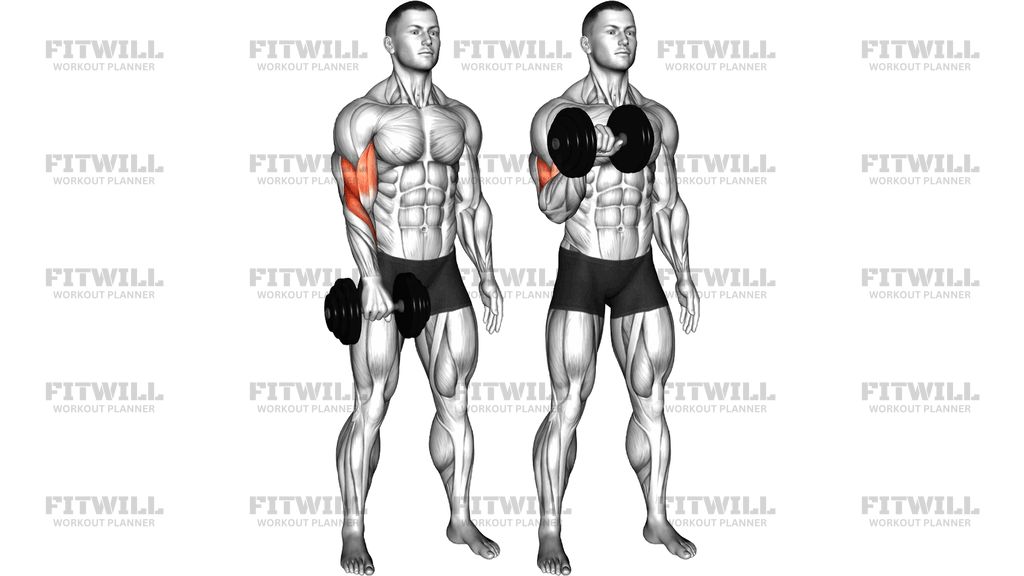
Dumbbell Standing Alternate Reverse Curl is a standing arm exercise performed with an overhand grip and one dumbbell curling at a time. The movement is aimed at the forearms, especially the brachioradialis and other elbow flexors that help build thickness through the top of the forearm. Because the wrists stay pronated, the exercise usually feels different from a standard curl: the biceps still assist, but the forearms and grip have to work harder to keep the dumbbell path clean.
The setup matters because this lift gets sloppy fast if the torso starts helping. Stand tall with the dumbbells hanging at your sides, feet about hip-width apart, ribs stacked over the pelvis, and the shoulders relaxed instead of rolled forward. Keep the elbows close to the ribs and the wrists straight before the first rep begins. That position lets the elbow do the work instead of turning the set into a shoulder raise or a body swing.
Each repetition should travel in a simple arc: curl one dumbbell by bending the elbow, keep the palm facing down, and bring the weight toward the front of the shoulder without letting the elbow drift forward. The upper arm should stay mostly still while the forearm rotates through the lift. Lower the dumbbell under control to full extension, then repeat on the other side. Alternating arms helps reduce momentum and makes it easier to feel whether each side is moving with the same control.
This exercise fits well in arm day, pulling-volume work, or any session where forearm strength and elbow control matter. It is especially useful for lifters who want more lower-arm development, stronger grip support, or a curl variation that is less biceps-dominant than a palm-up dumbbell curl. The load does not need to be heavy; in fact, lighter dumbbells usually give the best training effect because they make it easier to keep the wrist fixed, the torso quiet, and the lowering phase slow.
Treat the set as a test of clean mechanics rather than a race for reps. If the dumbbell starts swinging, the wrist bends back, or the shoulder lifts to finish the curl, the set is too heavy or the rep count is too high. Done well, the reverse curl gives a direct forearm stimulus with a very clear setup, a short controlled path, and a stable finish on every repetition.
[ Workout Log & Planner ]
Put your next workout in Fitwill
Keep your plan and training log ready when you are.


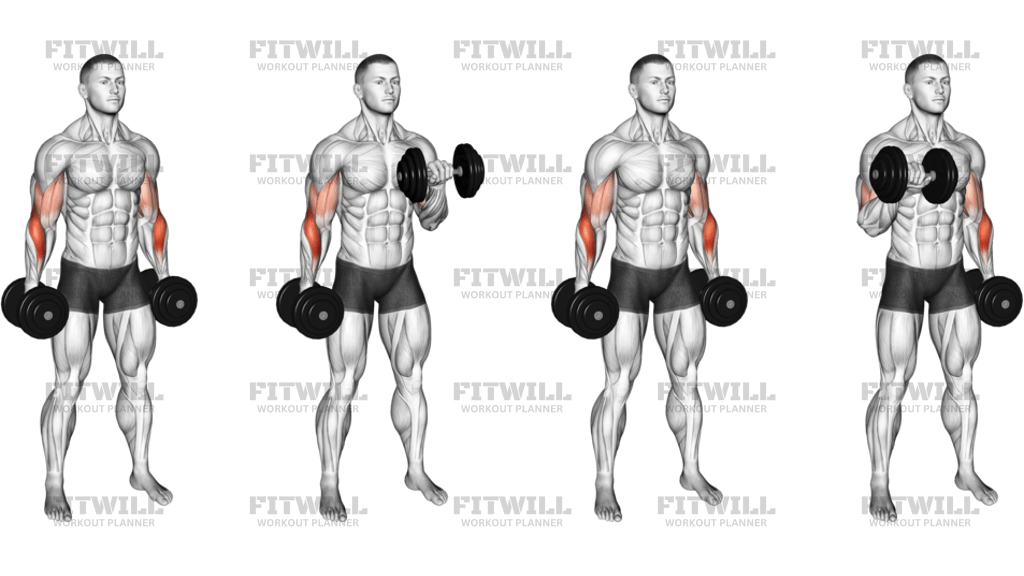
Instructions
- Stand tall with your feet about hip-width apart and let both dumbbells hang at your sides with an overhand grip, palms facing your thighs.
- Stack your ribs over your pelvis, keep your chest tall, and let your shoulders stay down instead of creeping toward your ears.
- Pin both elbows close to your ribs before you start the first rep so the upper arms stay quiet.
- Curl one dumbbell by bending the elbow and keep the palm facing down the entire time.
- Bring the weight up toward the front of the shoulder without letting the elbow drift far forward or the torso lean back.
- Squeeze briefly at the top when the forearm is near vertical and the wrist is still straight.
- Lower the dumbbell slowly until the arm is almost straight again, keeping tension on the forearm instead of dropping the weight.
- Repeat on the other arm, alternating sides for the planned number of reps while breathing out on the curl and in on the lower.
Tips & Tricks
- Keep the knuckles pointed forward and down; if the palm starts turning up, the reverse-curl emphasis is gone.
- Think about bending at the elbow only. If the shoulder is helping, the dumbbell is probably too heavy.
- Use a lighter load than you would for a regular dumbbell curl because the overhand grip makes the forearm work harder.
- Keep the wrist stacked over the forearm so the dumbbell does not pull it backward at the bottom.
- Let the non-working arm stay still at your side instead of bracing, swinging, or drifting across the body.
- Lower each rep slowly enough that you can feel the forearm controlling the descent instead of just dropping the weight.
- Stop the set when you have to lean back, shrug, or kick the weight into position.
- If your grip is failing before the forearms are tired, shorten the set and keep the last reps clean.
Frequently Asked Questions
What muscle does Dumbbell Standing Alternate Reverse Curl target most?
It mainly targets the forearms, especially the brachioradialis, with the brachialis and biceps helping as elbow flexors.
Why use an overhand grip instead of a regular curl grip?
The pronated grip shifts more work to the forearms and changes the feel of the curl, so it is a good choice for forearm-focused arm work.
Should both dumbbells move at the same time?
No. This variation alternates one arm at a time, which helps keep the torso quiet and makes it easier to control each rep.
How high should the dumbbell come up?
Bring it toward the front of the shoulder or until the forearm is nearly vertical, then lower it without shrugging the shoulder.
Can beginners do this reverse curl safely?
Yes, as long as they start light and keep the wrists straight, elbows close, and torso still.
What is the most common mistake with the dumbbells?
Swinging the weight or letting the wrists bend back usually turns the set into a momentum drill instead of a forearm exercise.
Is this exercise good for grip strength too?
Yes. The alternating overhand hold challenges the grip, especially when the set is long enough to create forearm fatigue.
Where does this fit best in a workout?
It works well as accessory work on arm day or after pulling exercises when you want extra forearm volume without a lot of systemic fatigue.