Basic To Cross Donkey Kick
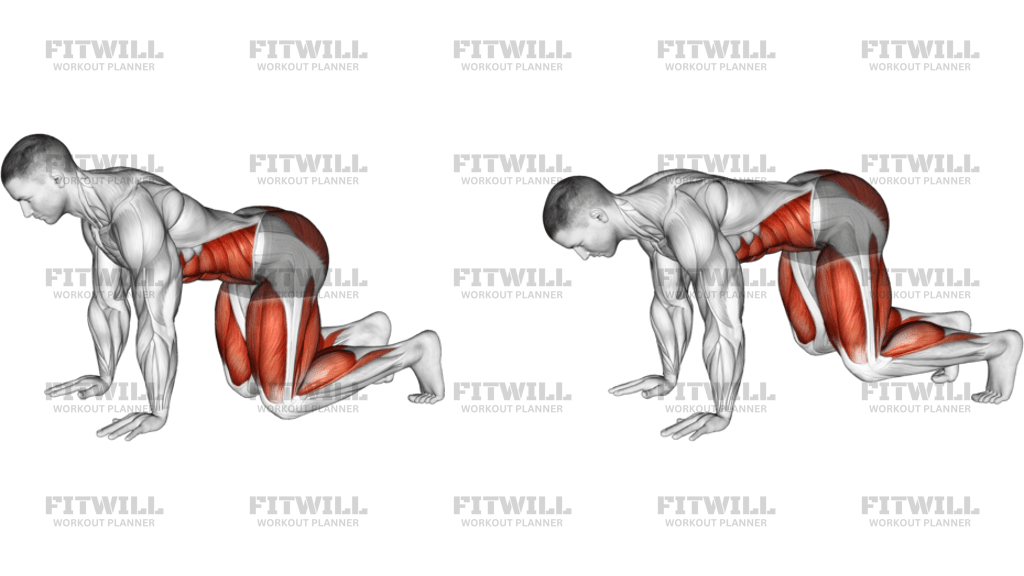
Basic to Cross Donkey Kick is a bodyweight floor exercise that trains the glutes and hips through two related actions: a classic donkey kick and a cross-body sweep. From a hands-and-knees position, you lift one bent leg behind you, then arc it across the body instead of only driving it straight up. That change in path asks the working hip to control extension, slight rotation, and lateral movement while the trunk stays quiet.
The setup matters because the pelvis tends to twist when the leg crosses under the body. Stack your shoulders over your hands, place your knees under your hips, and spread your fingers so the upper body can stay stable. A small brace through the abdomen helps keep the low back from taking over when the leg leaves the floor. If the torso shifts side to side, the repetition turns into momentum instead of hip work.
Each rep should feel deliberate. Start with the knee bent roughly 90 degrees and the foot flexed or pointed in a position you can keep consistent. Drive the heel up for the basic donkey-kick portion, then sweep the thigh across the midline in a controlled arc without collapsing into the supporting shoulder. Keep the hips as level as possible, and lower the knee back under the hip with the same control you used to lift it.
This pattern is useful in glute activation work, warm-ups, accessory blocks, and home workouts when you want a low-load movement that still challenges coordination and pelvic control. Because the range is small, the quality of the line matters more than height. A cleaner rep with a stable spine and quiet rib cage will usually train the glutes better than a bigger swing.
Use the exercise to build awareness of hip position, not to chase speed. If the low back pinches, the ribs flare, or the planted knee and shoulder start to shift, shorten the range and slow the tempo. The best version of Basic to Cross Donkey Kick leaves you feeling the outer and upper glute working while the trunk remains braced and steady throughout the sweep.
Fitwill
Log Workouts, Track Progress & Build Strength.
Achieve more with Fitwill: explore over 9600 exercises with images and videos, access built-in and custom workouts, perfect for both gym and home sessions, and see real results.
Start your journey. Download today!




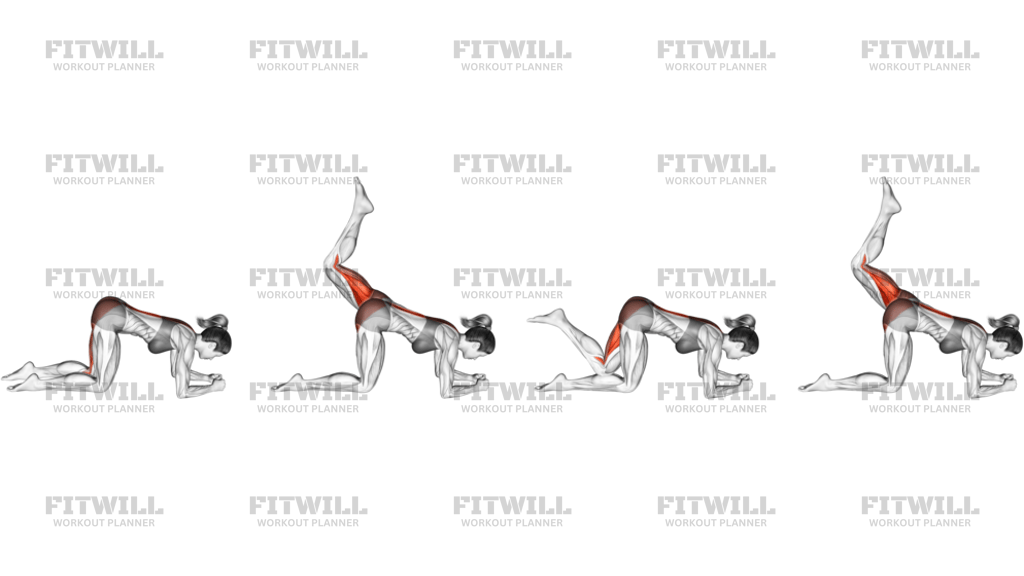
Instructions
- Start on all fours on a mat with your hands under your shoulders and your knees under your hips.
- Keep your arms straight, fingers spread, and your spine neutral before you lift either leg.
- Brace your abs lightly so your ribs stay down and your lower back does not arch.
- Bend one knee to about 90 degrees and lift that thigh behind you for the basic donkey-kick position.
- Drive the heel upward until the thigh is in line with or slightly above your torso without shifting your shoulders.
- From the top, sweep the bent leg across your body in a controlled arc toward the opposite side.
- Pause briefly when the knee reaches the cross-body position and keep both hips as level as possible.
- Lower the knee back under the hip with control, then return to the start without letting the torso twist.
- Complete all reps on one side, then switch legs.
Tips & Tricks
- Keep pressure even through both palms so the working leg does not drag your chest toward one side.
- If your low back takes over, lift the leg a little lower and make the cross-body sweep smaller.
- Flexing the foot can help some people feel the glute better during the upward drive.
- Do not let the knee open far out to the side on the lift; keep the thigh path controlled and deliberate.
- Think about moving the heel and knee as one unit so the bent leg stays organized through the arc.
- Exhale as the leg lifts and sweeps across, then inhale as you return to the start.
- A slower lowering phase usually reveals whether the hip is doing the work or momentum is.
- If your shoulders feel unstable, widen your hands slightly and reduce the height of the kick.
- Stop each rep before the pelvis rolls hard or the rib cage flares open.
Frequently Asked Questions
What muscles does Basic to Cross Donkey Kick train most?
It primarily targets the glutes and hip muscles, with the core and shoulder stabilizers helping keep the body square.
What is the difference between the basic kick and the cross-body part?
The basic kick drives the bent leg straight up behind you, while the cross-body phase sweeps that same bent leg across the midline toward the opposite side.
Should my knee stay bent the whole time?
Yes. Keeping the knee bent around 90 degrees makes the movement easier to control and keeps the work centered on the hip.
How high should the leg go?
High enough to challenge the glute, but not so high that your lower back arches or your hips rotate off the floor.
Can beginners do this exercise?
Yes. Beginners can learn it easily on a mat because it uses bodyweight and a short, controlled range.
Why do my hips twist when I sweep the leg across?
The cross-body path challenges pelvic control, so twisting usually means the range is too big or the movement is too fast.
Is this more of a strength move or an activation drill?
It can be used as either. Light, precise reps work well for activation, while slower, higher-quality sets make it a useful accessory exercise.
What is a common mistake to avoid?
The biggest mistake is swinging the leg and letting the low back or torso take over instead of keeping the hips controlled.