Bent-Over Shoulder Pendulum
Bent-Over Shoulder Pendulum is a supported shoulder-control drill performed with one hand on a bench and the torso hinged forward. It is built to let the working arm hang freely so the shoulder can move through small, relaxed arcs without the body stealing the work. The exercise looks simple, but the setup matters: if the torso is too upright or the support hand is unstable, the swing turns into a whole-body cheat.
Use it when you want a low-load way to wake up the shoulder, upper back, and scapular stabilizers before pressing, pulling, or overhead work. The goal is not to force a big range or chase fatigue. Instead, the arm should feel lightly suspended while the shoulder joint makes smooth pendulum-like motion and the trunk stays quiet.
To perform it well, hinge until your back is nearly parallel to the floor, plant the support hand under the shoulder, and let the working arm hang straight down. From there, create a small front-to-back swing or tiny circle from the shoulder, keeping the elbow soft and the neck relaxed. The movement should stay controlled enough that you could stop it at any point without needing to brace against momentum.
Because this drill is bodyweight-supported, it is useful for beginners, warm-ups, and shoulder prep on days when heavy loading is not appropriate. It can also work as accessory volume between harder sets if you want to keep the shoulder moving without adding much fatigue. If the pendulum pulls into the neck or front of the shoulder, shorten the arc and slow the tempo immediately.
Treat the exercise as a smooth reset for the shoulder rather than a power move. A clean rep leaves the torso steady, the support arm stacked under the shoulder, and the working arm swinging like a loose pendulum instead of being whipped around. That control is what makes the drill useful: it builds comfort, awareness, and coordination in the exact positions where many lifters lose stability. On days when the shoulder feels stiff, start with the smallest arc that feels natural and only increase the swing if it stays quiet and smooth.
Fitwill
Log Workouts, Track Progress & Build Strength.
Achieve more with Fitwill: explore over 9600 exercises with images and videos, access built-in and custom workouts, perfect for both gym and home sessions, and see real results.
Start your journey. Download today!




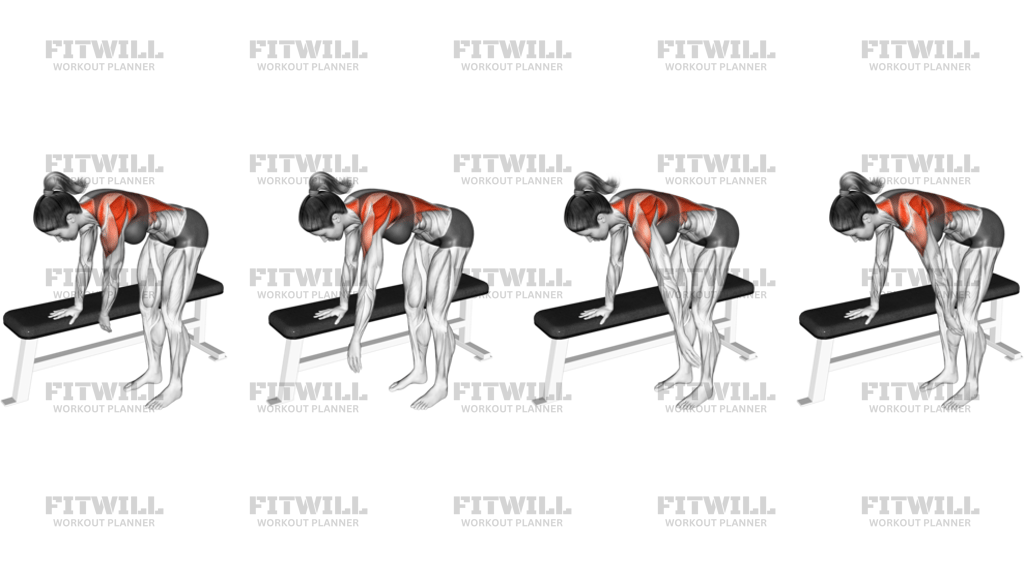
Instructions
- Stand beside a flat bench, hinge forward until your torso is close to parallel with the floor, and place one hand flat on the bench under your shoulder.
- Keep your feet about hip-width apart, bend both knees slightly, and let the working arm hang straight down from the shoulder.
- Relax the hanging hand, keep a soft elbow, and set your neck in line with your spine instead of looking forward.
- Shift only enough weight into the bench hand to stay steady, then let the hanging arm start to swing in a small arc.
- Move the arm with a gentle front-to-back pendulum motion, keeping the torso quiet and the swing driven by the shoulder.
- Keep the arc small and smooth; if you make circles, trace tiny circles without shrugging the shoulder up.
- Breathe steadily and keep the support shoulder stable without locking the elbow hard.
- Slow the swing to a stop, place the free hand back under control, and stand up before switching sides.
Tips & Tricks
- Set the bench height so you can hinge flat without rounding your low back.
- Keep the swing small; if your ribcage twists, the range is too big.
- Stack the support hand under the shoulder so the torso does not rotate to fake motion.
- Let the working elbow stay soft so the arm swings like a pendulum instead of a straight lever.
- If the front of the shoulder pinches, shorten the arc and keep the hand slightly farther under your body.
- Use this as a warm-up or shoulder prep drill, not as a fatigue set.
- Keep your neck long and avoid shrugging the working shoulder toward the ear.
- Let the arm slow down on each pass instead of snapping it back to center.
- If your hamstrings limit the hinge, bend your knees more instead of rounding your spine.
Frequently Asked Questions
What does Bent-Over Shoulder Pendulum work?
It mainly trains shoulder mobility and control, with help from the upper back, rotator cuff, and scapular stabilizers.
Is Bent-Over Shoulder Pendulum a strength exercise?
It is mostly a low-load shoulder prep and control drill rather than a heavy strength movement.
Do I keep my arm straight during Bent-Over Shoulder Pendulum?
Keep it long with a soft elbow. A tiny bend is fine as long as the arm hangs relaxed and does not lock out rigidly.
How big should the pendulum swing be?
Small and smooth. You should feel the shoulder moving without needing to rock your torso or shrug the support shoulder.
Can I make circles instead of front-to-back swings?
Yes, tiny circles are fine if they stay relaxed and do not turn into a jerky shoulder shrug.
Should I feel Bent-Over Shoulder Pendulum in my neck or low back?
No. Those areas should stay quiet; reduce the arc or bend your knees more if they start taking over.
Is Bent-Over Shoulder Pendulum good before bench press or overhead work?
Yes, it can help warm up the shoulder and upper back before pressing, but it should not replace your actual ramp-up sets.
Can beginners do Bent-Over Shoulder Pendulum?
Yes. The bench support makes it accessible, and the main focus is control rather than strength.