Bosu Ball Step Up High Knee
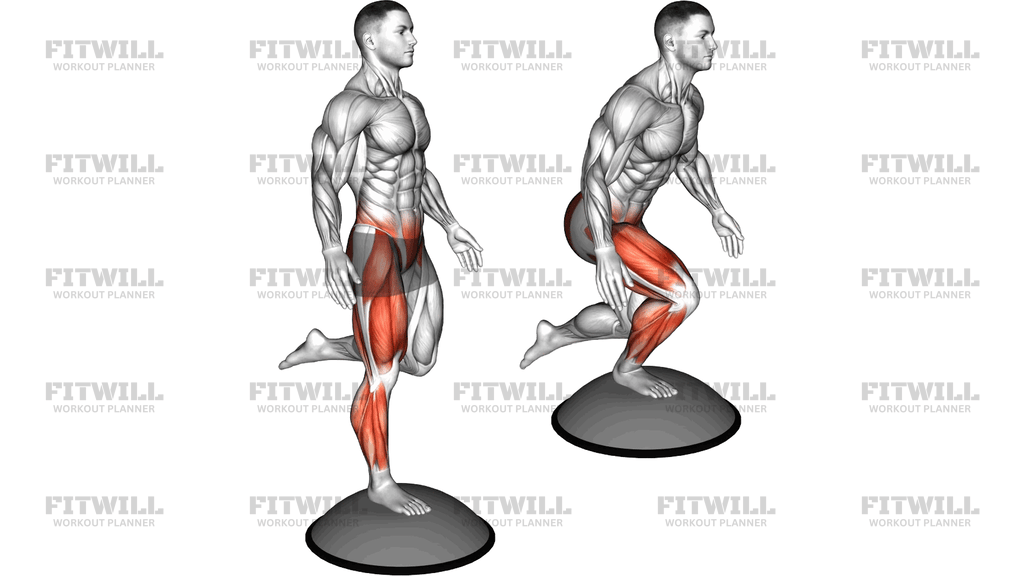
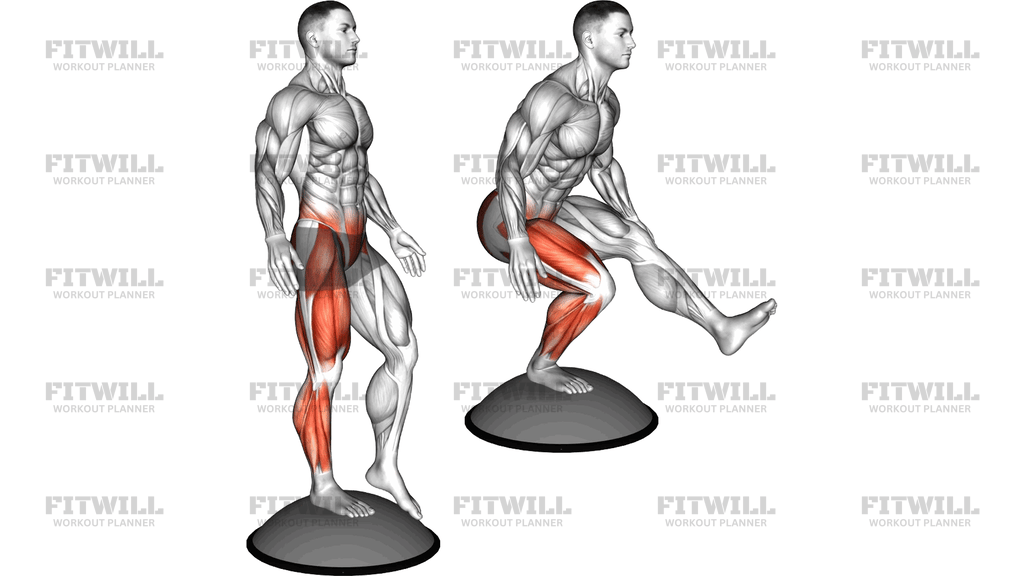
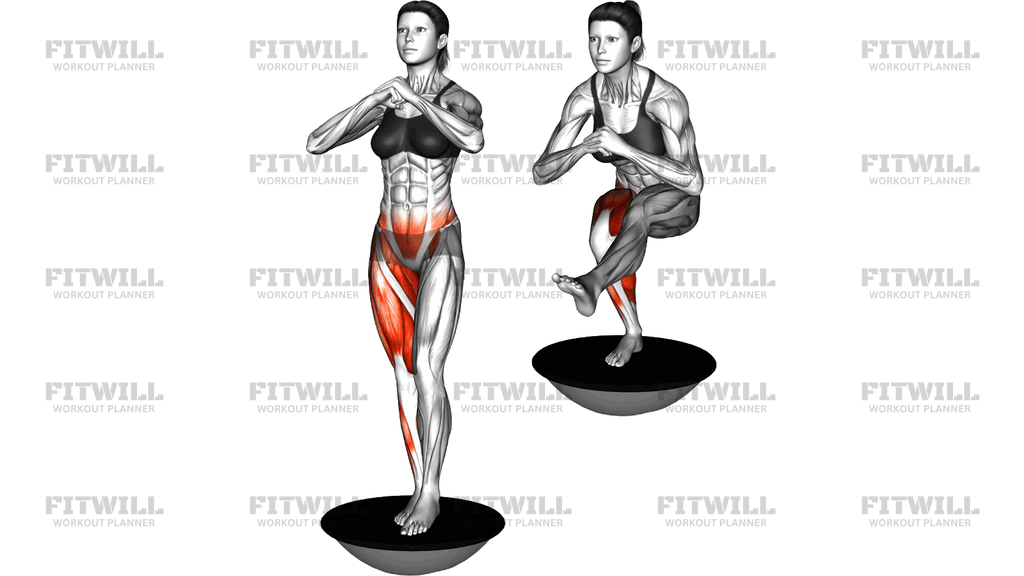
The Bosu Ball Step Up High Knee combines two demanding elements into one movement: stepping onto the unstable, domed surface of a Bosu ball, then driving the trailing knee up to hip height while balanced on that same surface. It looks simple from the outside, but the moment your lead foot lands on the dome, your ankles, knees, and hips all have to work together to keep you upright. That makes this a genuine full lower-body exercise rather than just a step-up variation.
The primary work comes from the quads of the lead leg, which push your body up onto the ball, and the glutes, which extend the hip at the top. The high knee adds a strong hip flexor contraction and forces the standing leg to stabilize on one foot over a moving surface. Your calves and the small muscles around the ankles fire constantly to correct your balance, and your core stays engaged to keep your torso tall throughout.
This exercise suits anyone who has mastered regular step-ups and wants to challenge balance and single-leg control at the same time. It is popular in functional training, lower-body conditioning circuits, and rehab-informed programming where the goal is to rebuild confidence and stability after time away from single-leg work. Because it raises the heart rate as well, it also works well as a low-impact conditioning drill.
Setup matters more here than with most step-up variations. Place the Bosu ball with the dome facing up on a non-slip floor, and give yourself a little clearance on all sides. Stand facing the ball close enough that your lead foot can land near the center of the dome without lunging forward. Keep your arms free at your sides so you can use them for balance.
To execute well, place one foot firmly in the middle of the dome, press through that foot to stand tall, and pull the opposite knee up toward hip height without leaning back. Pause briefly at the top, then lower the knee with control and step the same foot back down to the floor before switching legs. Moving slowly is the point; rushing turns a balance exercise into a hopping mess.
A few practical safety points: start by holding a wall or sturdy support until you trust your footing on the dome, wear flat-soled shoes or go barefoot for better feel, and stop if your ankle starts wobbling uncontrollably. The Bosu ball can slide on smooth floors, so check that it stays planted before each set.
[ Workout Log & Planner ]
Put your next workout in Fitwill
Keep your plan and training log ready when you are.


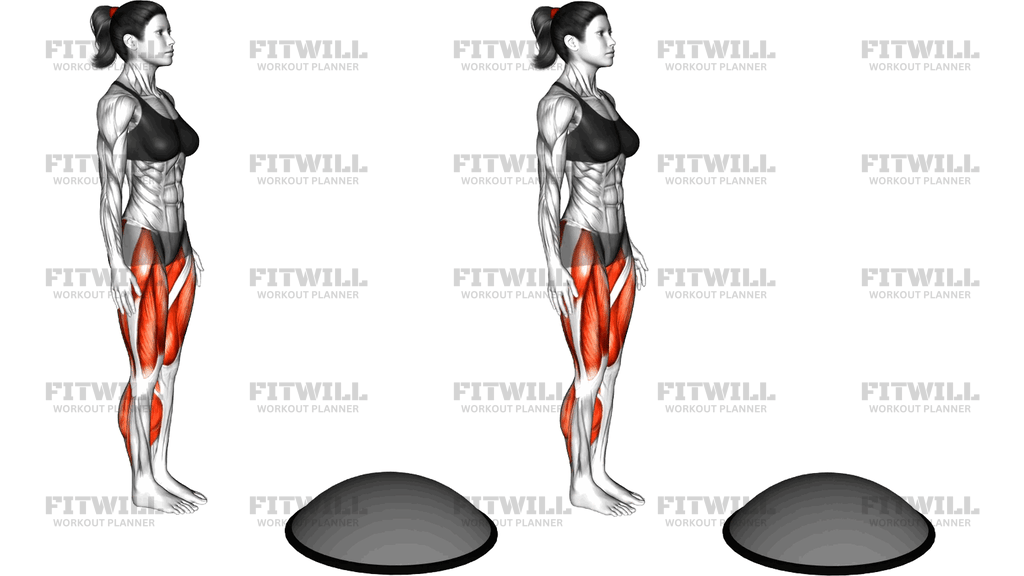
Instructions
- Place a Bosu ball on a non-slip floor with the domed side facing up, leaving clear space around it.
- Stand facing the ball about one step away, feet hip-width apart, arms relaxed at your sides.
- Brace your core lightly and keep your chest tall, eyes fixed on a point straight ahead.
- Place one foot in the center of the dome, with your whole foot in contact with the surface.
- Press through the lead foot to stand fully upright on top of the ball.
- At the top, drive the trailing knee up to roughly hip height, balancing on the standing leg.
- Hold the high-knee position for a brief moment without letting your torso lean back.
- Lower the knee slowly, then step the same foot back down to the floor with control.
- Exhale as you step up and raise the knee, inhale as you return to the floor.
- Complete all reps on one leg or alternate sides, repositioning the ball between reps if it shifts.
Tips & Tricks
- Aim your foot for the exact center of the dome every time; landing near the edge is the most common reason the ball tips or you lose balance.
- If your standing knee caves inward at the top, imagine spreading the floor with your foot and keep the kneecap tracking over your second toe.
- Do not swing the knee up with momentum; a slow, deliberate drive works the hip flexors and challenges the standing leg far more.
- Keep your gaze on a fixed point at eye level rather than looking down at your feet; this noticeably steadies the balance component.
- Start near a wall and hover a hand over it for support during your first few sessions on the dome.
- If you lean your torso back as the knee rises, squeeze the glute of the standing leg and shorten the knee lift until you can stay upright.
- Control the step down as much as the step up; dropping off the dome abruptly removes most of the quad and calf work on the way down.
- Barefoot or in flat shoes gives better sensory feedback on the dome than cushioned running shoes.
- If the ball slides on a smooth floor, place it on a rubber mat before you begin.
Frequently Asked Questions
What muscles does the Bosu Ball Step Up High Knee work?
The quads and glutes of the stepping leg do the main pushing work, while the hip flexors lift the knee. Calves, ankle stabilizers, and the core work continuously to keep you balanced on the dome.
Is the Bosu Ball Step Up High Knee suitable for beginners?
Yes, but beginners should practice a plain step-up onto the dome first and keep a wall or sturdy object within reach. Once stepping up feels secure, add the high knee.
Should the foot land in the center of the Bosu ball dome?
Yes. Placing the whole foot near the center of the dome keeps the ball from tipping and gives the ankle the most stable platform. Edge landings are the most common setup mistake.
How high should I raise the knee at the top?
Aim for roughly hip height, or slightly lower if you cannot stay upright. Only lift as high as you can manage without leaning your torso backward.
Why do I wobble so much on the Bosu Ball Step Up High Knee?
Some wobble is normal because the dome forces your ankles and hips to correct constantly. If it is excessive, slow the tempo down, fix your eyes on one spot, and master the step-up without the knee lift before combining them.
Can I substitute a regular step-up if I do not have a Bosu ball?
A step-up with a high knee on a stable step or bench trains similar muscles but removes the balance challenge. A balance board or a folded firm mat can approximate some of the instability.
Should I alternate legs or do all reps on one side?
Both work. Alternating keeps the heart rate higher and suits conditioning circuits, while completing all reps on one leg before switching makes it easier to notice and correct left-right differences in balance.
Is it safe for my knees and ankles?
When done with control and a foot placed in the center of the dome, it is generally well tolerated. If you have an active ankle sprain or significant knee pain, stick to stable-surface step-ups until your balance and comfort return.
How many reps of the Bosu Ball Step Up High Knee should I do?
Start with 6 to 10 controlled reps per leg, focusing on quality over speed. Once balance is consistent, you can add reps or use the exercise as part of a timed circuit.
Should I hold weights during this exercise?
Not at first. Your arms play a real role in balancing on the dome, and adding load before your footing is solid increases the risk of a misstep. Add light dumbbells only once you can perform every rep without wobble.