Dumbbell Bosu Ball Goblet Squat
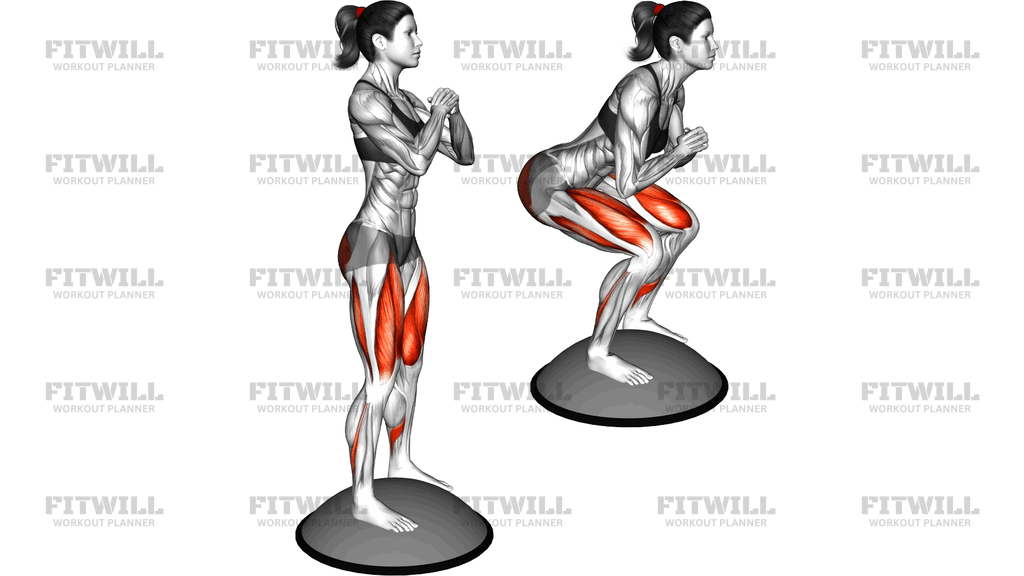
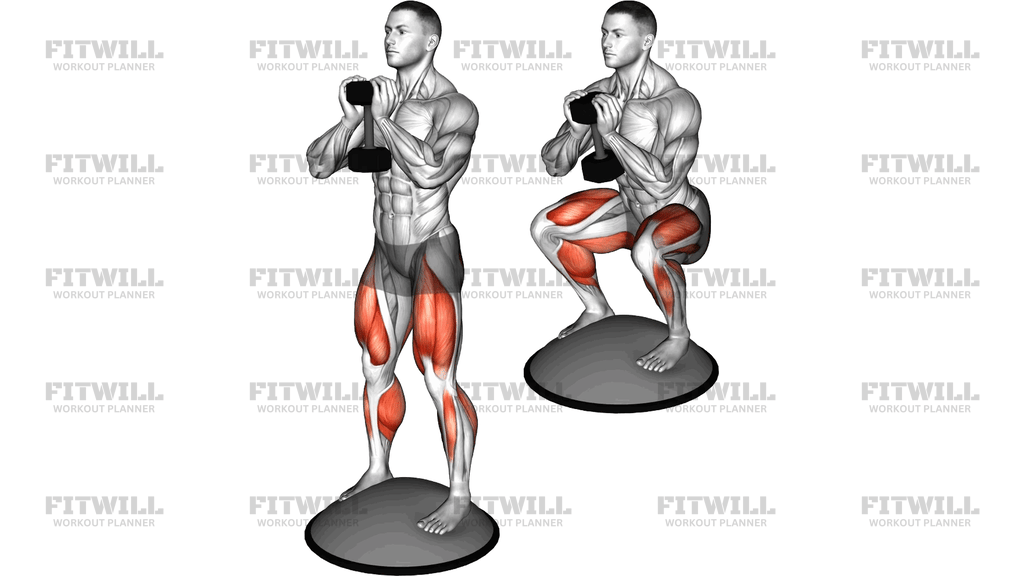
The Dumbbell Bosu Ball Goblet Squat combines two challenges into one movement: the goblet squat pattern and the instability of standing on a Bosu ball with the dome side up. You hold a single dumbbell vertically against your chest with both hands cupping the upper head, then squat down and stand back up while your feet balance on the curved, shifting surface. The image shows the two key positions clearly: a tall standing setup with the weight tucked at the sternum, and a deep bottom position where the knees track forward over the feet and the torso stays upright.
This exercise is best thought of as a stability-focused squat rather than a pure strength builder. The quads, glutes, and calves work to move and control your bodyweight plus the dumbbell, but a large share of the demand goes to the ankle stabilizers and deep core, which have to constantly correct your balance on the unstable dome. Because the load stays light and held close to your chest, the movement is surprisingly joint-friendly while still being demanding in ways a regular goblet squat is not.
The setup matters more than it might seem. Standing on the dome raises your center of gravity over a smaller, less predictable base, so foot placement — roughly shoulder-width with the arch of each foot centered on the dome — determines how much wobble you have to fight. Holding the dumbbell in the goblet position at the chest acts as a counterweight: it helps shift your hips back and down and encourages an upright torso, which is exactly what you want when your ankles are busy making small corrections under you.
To execute it well, think about descending slowly and keeping the dumbbell glued to your chest. A fast drop onto an unstable surface almost always ends with a loss of balance, so control is the whole game. Push through the middle of each foot, let the knees travel naturally over the toes, and only go as deep as you can while keeping the dome from tilting to one side. Exhale as you drive back up to standing.
This variation shows up most often in general fitness and lower-body stability work: as a warm-up progression before heavier squatting, as a balance challenge for athletes who need reactive ankle and hip control, or as a way for intermediate lifters to build squat depth and torso position with a light load. It is also a common next step for people who have mastered bodyweight squats and goblet squats on the floor and want a new stimulus without adding much weight.
A few practical points before you start. Learn the movement without the dumbbell first, or step off onto a firm surface if your balance breaks down mid-set. Use a light dumbbell — somewhere in the 10 to 25 pound range is plenty for most people — and keep your eyes on a fixed point ahead of you rather than looking down at your feet. If you have a history of ankle injuries, approach this one gradually and keep something sturdy nearby for support.
[ Workout Log & Planner ]
Put your next workout in Fitwill
Keep your plan and training log ready when you are.


Instructions
- Place a Bosu ball on the floor with the dome side facing up and set a single dumbbell on the floor next to it where you can reach it easily.
- Step onto the dome one foot at a time and position your feet about shoulder-width apart, with each arch centered over the middle of the dome so the surface stays level.
- Pick up the dumbbell and hold it vertically against your chest in the goblet position, with both hands cupping the upper head and your elbows pointing down close to your ribs.
- Stand tall, take a breath into your belly, and brace your core while keeping your gaze fixed on a point straight ahead at eye level.
- Begin the descent by pushing your hips back slightly and bending your knees, lowering your body in a slow, controlled arc toward the dome.
- Keep the dumbbell in contact with your chest the entire way down and let your knees travel forward over your toes without letting them cave inward.
- Lower until your thighs reach a depth you can control while the dome stays flat — usually thighs at or just below parallel if your balance allows.
- Drive through the middle of both feet to stand back up, exhaling as you extend your hips and knees to a full standing position.
- Pause briefly at the top to reset your balance and re-brace before starting the next repetition.
- When the set is finished, step off the Bosu ball one foot at a time and set the dumbbell down on the floor.
Tips & Tricks
- Master a bodyweight squat on the dome before adding the dumbbell; the balance demand is significant on its own and the weight only makes wobble harder to manage.
- If the dome tips toward one side during the descent, slow down even more — the tilt almost always means one leg is loading faster than the other, not that the surface is the problem.
- Squeezing the dumbbell hard against your chest does more than hold it in place; the upper-body tension steadies your torso and makes balancing on the dome noticeably easier.
- A common mistake is looking down at your feet. Keep your eyes on a fixed spot ahead of you, since a dropping gaze tends to pull your chest forward and tip your balance.
- Keep your whole foot in contact with the dome rather than rising onto your toes; if your heels lift as you descend, your ankle mobility or stance width needs adjusting.
- Do not chase depth at the cost of control — a half squat you can repeat cleanly on the dome builds more stability than a deep squat that ends in a stumble.
- Bare feet or flat, thin-soled shoes work better than thick, cushioned running shoes, which add another layer of instability between your feet and the dome.
- Place the Bosu ball on a non-slip surface or mat and keep it away from furniture edges, since a tipped-over dome or a missed step can send you off balance quickly.
- If you lose your balance mid-rep, step off the dome deliberately instead of lunging or twisting to save the rep; controlled exits are part of training this exercise safely.
Frequently Asked Questions
What muscles does the Dumbbell Bosu Ball Goblet Squat work?
The quads, glutes, and calves drive the squat itself, while the ankle stabilizers and deep core work hard to keep you balanced on the dome. The upper back and shoulders also contribute isometrically to hold the dumbbell against your chest.
Is the Dumbbell Bosu Ball Goblet Squat suitable for beginners?
It can be, as long as the load stays light and depth stays modest. Beginners should first be comfortable with bodyweight squats on the floor, then practice balancing and squatting on the Bosu ball without weight before adding the dumbbell.
Should I stand on the dome side or the flat side of the Bosu ball?
For this exercise the dome faces up and you stand on the curved surface, which is what creates the balance challenge. Standing on the flat side is a separate, harder variation and is not the setup shown here.
How heavy should the dumbbell be for this exercise?
Much lighter than a floor-based goblet squat — most people do well with a dumbbell they could comfortably hold for 20 or more reps. The instability, not the load, provides the training stimulus, and too much weight makes balancing unsafe.
How deep should I squat on the Bosu ball?
Go as deep as you can while keeping the dome level, the dumbbell at your chest, and your heels down. For many people that means thighs at or slightly above parallel, which is a perfectly productive range for this variation.
Why do my calves and ankles burn during the Dumbbell Bosu Ball Goblet Squat?
That is expected, since the small muscles around your ankles constantly contract to correct your position on the shifting dome. If the burn becomes cramping, step off and rest briefly between reps or reduce your set length.
Can I do this exercise if I have ankle instability or a previous ankle injury?
Approach it cautiously and get clearance from a health professional first. Start with bodyweight squats on the floor, then shallow squats on the dome near a wall or rack you can touch for support, and only progress if the ankle feels secure.
What can I substitute if I do not have a Bosu ball?
A regular Dumbbell Goblet Squat trains the same primary muscles without the balance demand, or you can use a folded balance pad or stability disc for a milder unstable surface. Slow-tempo goblet squats are another way to challenge control without equipment.
How many reps and sets should I do?
Because balance tends to deteriorate with fatigue, moderate sets of 8 to 12 controlled reps for 2 to 3 sets work well. Stop the set when your form gets wobbly rather than pushing to muscular failure.