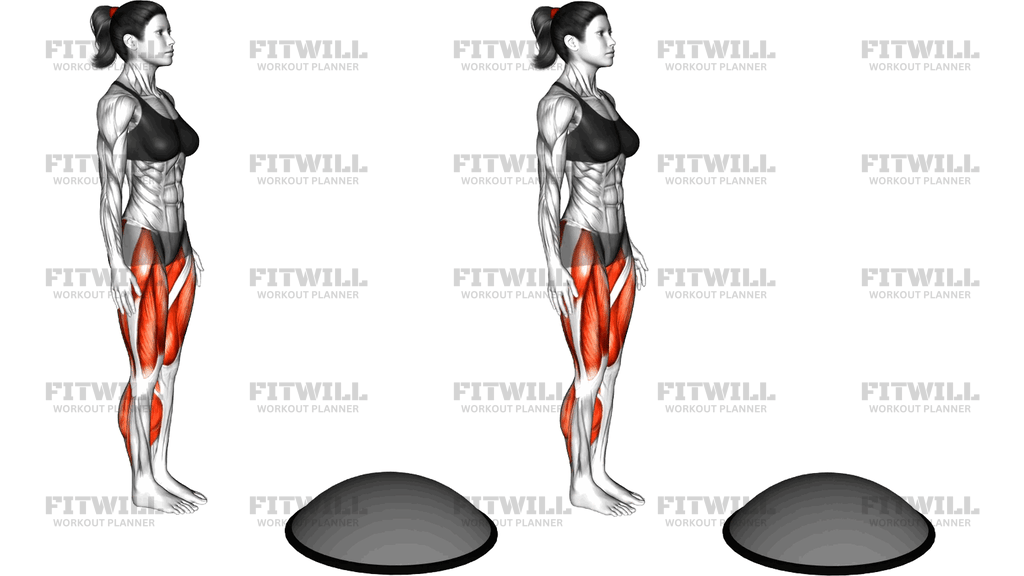
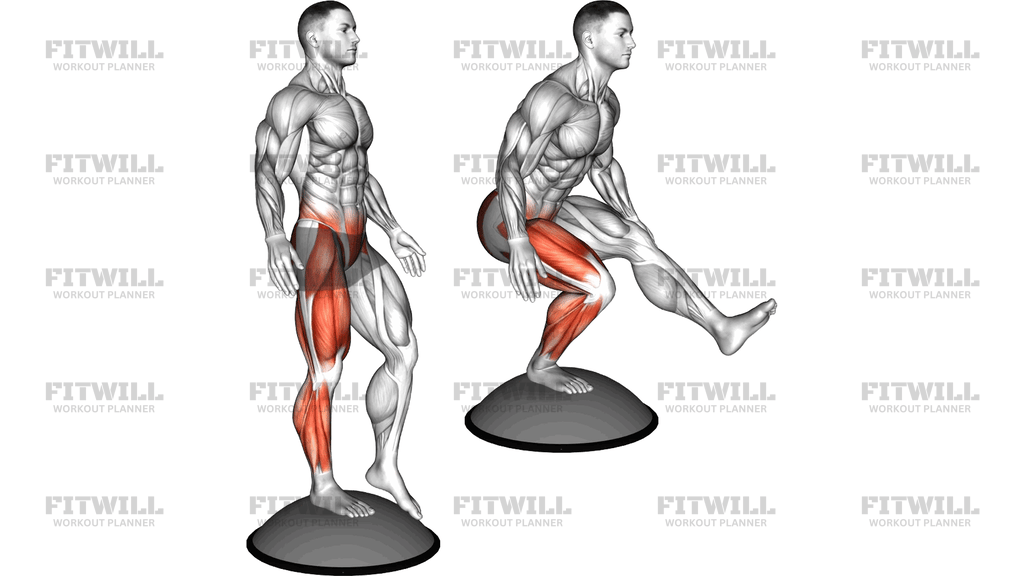
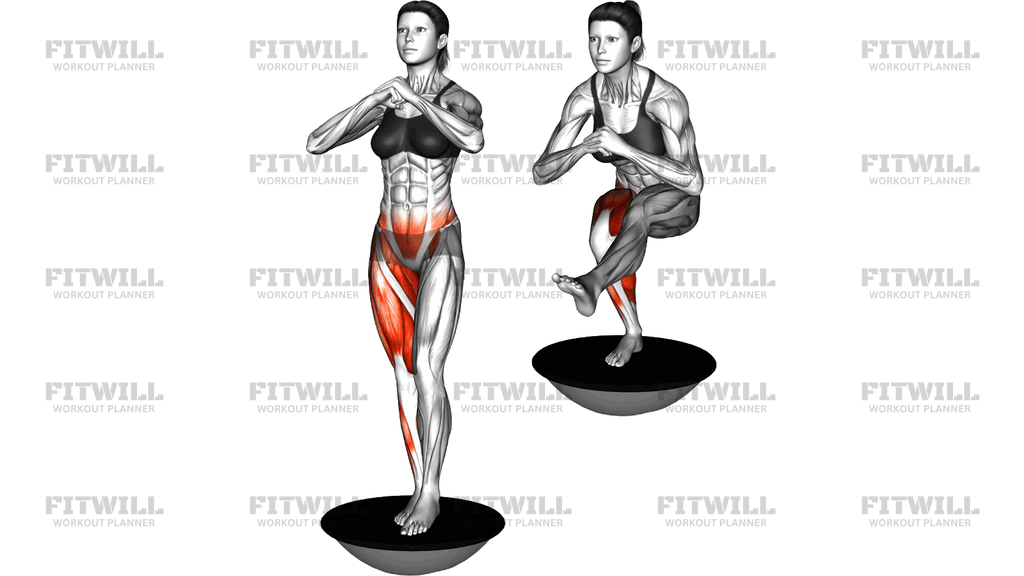
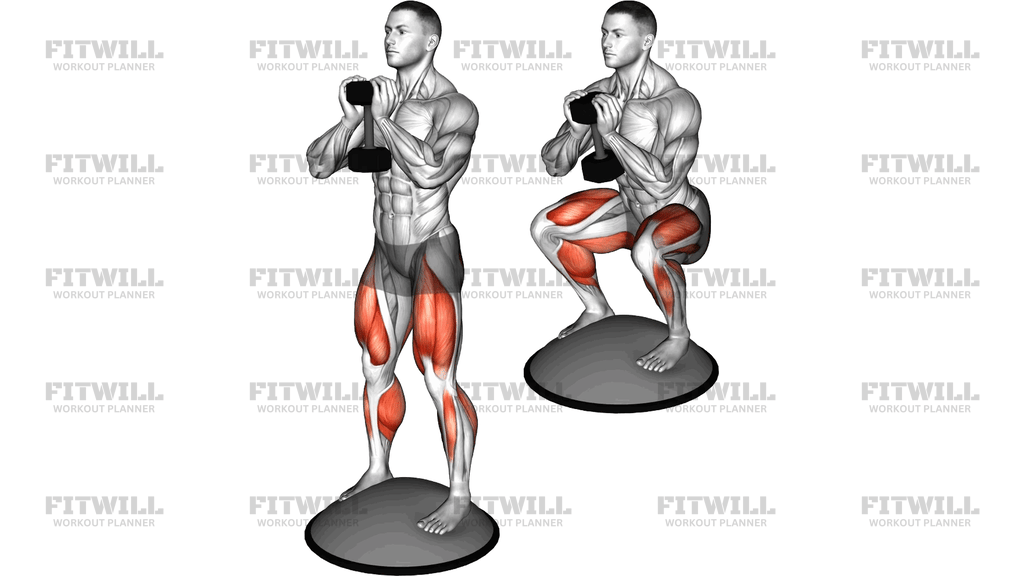
Resistance Band Bosu Ball Single Leg Balance
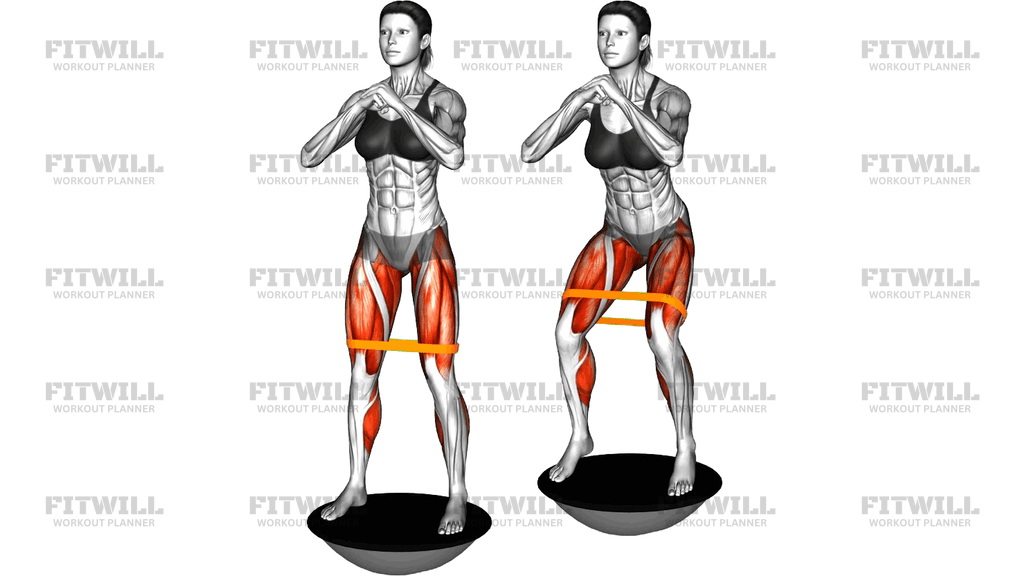
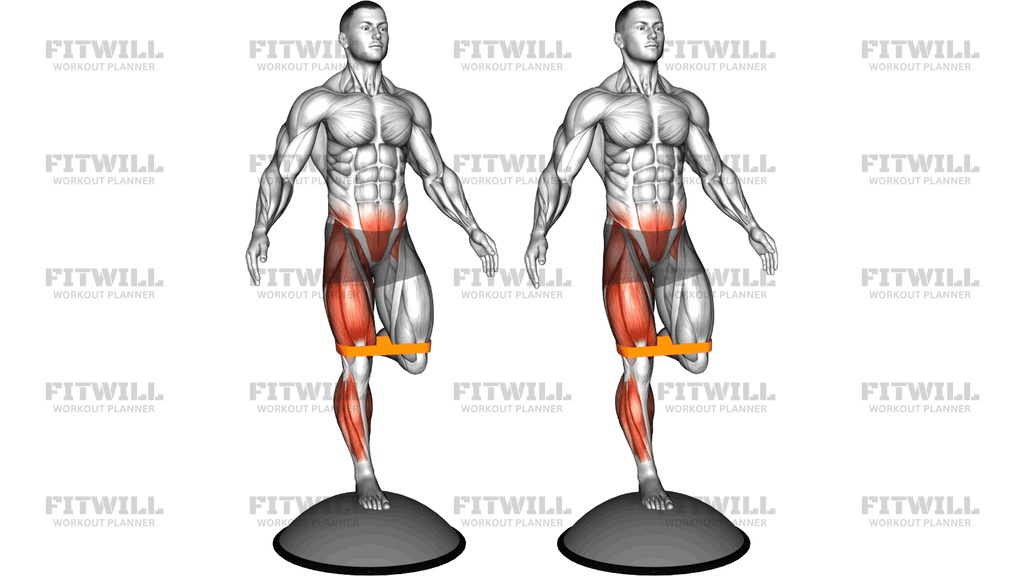
Resistance Band Bosu Ball Single Leg Balance is a stability drill that combines three balance challenges at once: standing on one leg, standing on the unstable dome of a Bosu ball, and resisting a band that pulls your knees toward each other. The band is looped around both thighs just above the knees, so your outer hip muscles have to stay active the entire time to keep the standing knee tracking straight. The result is a deceptively simple-looking hold that lights up the ankles, hips, and midsection in a way few static exercises can.
This movement is most useful for people who want better single-leg control for running, hiking, court sports, or lower-body strength work. If your squats and lunges are strong but you wobble on one leg, this drill targets the gap. It trains the small stabilizers around the ankle, the gluteus medius on the outside of the hip, and the deep core muscles that keep your ribs stacked over your pelvis while the ground beneath you shifts.
The setup matters more than it looks. Where you place your foot on the dome changes the difficulty dramatically: centering your foot on the crown of the Bosu gives the most movement underfoot, while placing it closer to the flat base edge gives you a more stable platform to start from. The band should sit snugly above both knees with enough tension that you feel gentle inward pull the moment you lift one foot off. Too loose and it does nothing; too tight and it will drag your standing knee into a valgus position you have to fight constantly.
To execute it well, stand tall on the dome with one foot, lift the other knee up in front to roughly hip height or hold the free foot behind you in a bent-knee position, and find your balance before you try to do anything else. Press your big toe, little toe, and heel into the dome, soften the standing knee slightly, and brace your midsection as if bracing for a light push. Your arms can hang at your sides or move out slightly for counterbalance. Hold for time, breathing steadily, then switch legs.
Common use cases include warm-ups before leg day, rehabilitation and prehabilitation programming for ankle and knee stability, and finishers at the end of a lower-body session. Because the load is light, it fits well on days when heavy training is not appropriate but you still want a meaningful stability stimulus.
A few practical points keep this safe and productive. Start beside a wall, rack, or sturdy chair so you can touch it with a fingertip if you lose balance, and step off the Bosu from the edge rather than hopping off mid-wobble. Stop the hold as soon as your standing knee starts diving inward or your torso begins to slump, because practicing that position teaches your body the wrong pattern. Short, high-quality holds beat long, sloppy ones.
[ Workout Log & Planner ]
Put your next workout in Fitwill
Keep your plan and training log ready when you are.


Instructions
- Place a Bosu ball on a flat, non-slip floor with the dome facing up, and loop a resistance band around both legs just above your knees.
- Step onto the crown of the dome with your standing foot, spreading your toes and centering your weight over the middle of the platform before lifting anything.
- Stand tall, soften the standing knee to about a 15-20 degree bend, and set your free leg into a bent-knee position with the foot lifted off the dome.
- Brace your midsection and press slightly out against the band with both knees so the standing knee tracks over your second toe instead of caving inward.
- Keep your gaze fixed on a point at eye level ahead of you and let your arms hang at your sides or drift slightly outward for counterbalance.
- Hold the single-leg position for your target time, making small continuous adjustments through the ankle and hip as the dome shifts beneath you.
- Breathe in a steady, controlled rhythm through your nose and mouth rather than holding your breath while balancing.
- To finish, lower the free foot back onto the dome or floor, settle into a two-foot stance, and carefully step off the Bosu from the base edge.
- Reset the band above your knees, shake out your ankles, and repeat on the other leg for the same duration.
Tips & Tricks
- If the band immediately drags your standing knee inward, the tension is too heavy for your hip strength; switch to a lighter band before practicing, because fighting a losing battle with the band only reinforces poor knee tracking.
- Wobbling at the ankle is normal, but sharp corrections and hopping off the dome mean you are chasing balance instead of controlling it; step down, reset, and start the hold again with a slightly softer knee.
- A common mistake is looking down at the dome; keep your eyes on a fixed point ahead, since dropping your head rounds the upper back and makes the midsection harder to brace.
- Gripping the dome with curled toes is a sign your foot is overloaded; instead, spread the toes and press through the ball of the foot, big toe, and heel to create a stable tripod.
- If you cannot hold 10 seconds on the crown, start with your foot near the base edge of the Bosu or hold a light fingertip contact on a wall, and progress away from support as the hold becomes steady.
- Do not lock the standing knee straight; a small bend keeps the quadriceps, calf, and hip muscles engaged and protects the joint from hard, jarring corrections.
- Keep your pelvis level rather than letting the free-hip side drop; imagine both hip bones pointing forward as you balance.
- Shorter, crisper sets with full resets between legs beat one long hold that degrades into leaning and knee collapse, so stop the set when your form quality drops, not when you finally fall off.
- Place the Bosu on a flat surface away from furniture corners and do the drill barefoot or in flat shoes so your foot can actually feel and react to the dome.
Frequently Asked Questions
What muscles does Resistance Band Bosu Ball Single Leg Balance work?
The primary work comes from the ankle stabilizers, the gluteus medius resisting the band's inward pull, and the deep core muscles that keep you stacked over the standing leg. The quads and calves of the standing leg stay active throughout to control the slightly bent knee and the shifting dome.
Is the Resistance Band Bosu Ball Single Leg Balance suitable for beginners?
Yes, if you scale it down. Start with your foot near the base edge of the Bosu, use a light band, and keep a wall or chair within fingertip reach until you can hold 20-30 seconds with steady knee tracking.
Which direction should my standing knee point during this exercise?
Your standing knee should track over your second toe the entire hold. The band pulls both knees toward each other, so actively pressing outward against it keeps the knee from caving inward.
How long should I hold each rep of the Resistance Band Bosu Ball Single Leg Balance?
Aim for 20-40 seconds per side with clean form, and stop the hold early if your knee starts diving in or your torso slumps. Two to three holds per leg is plenty, since balance quality drops quickly once you fatigue.
Why put the band above the knees instead of at the ankles?
Above the knees, the band directly challenges the hip external rotators and gluteus medius, which control femur position and knee tracking. That is exactly what you want to train for single-leg stability, whereas an ankle placement would mostly shift the challenge toward the outer hips in a different pattern.
What is the most common mistake in this exercise?
Letting the standing knee collapse inward while the torso leans and the arms windmill to compensate. The fix is reducing the band tension or dome difficulty so you can hold the knee over the second toe with a quiet, controlled stance.
Can I substitute the Bosu ball with something else?
Yes. A balance pad, folded exercise mat, or stability cushion offers a similar unstable surface with slightly less range of wobble, and you can progress back to the Bosu dome as your control improves.
Should I do this exercise barefoot or in shoes?
Barefoot or in thin, flat-soled shoes works best, because your toes and foot arch need to feel the dome and make small adjustments. Thick, cushioned running shoes blunt that feedback and make balancing harder than it needs to be.
Is it safe to use a wall for support during the Resistance Band Bosu Ball Single Leg Balance?
Light fingertip contact with a wall or rack is a smart progression tool, not cheating, as long as you are not leaning on it. Reduce the contact gradually until you can hold the position unsupported.
Where should this drill fit into my training session?
It works well near the start of a lower-body workout as a stability primer, or at the end as a controlled finisher. Avoid placing it immediately before heavy squats or deadlifts, since fatigued ankles and hips can make balancing under load feel sketchy.