Dumbbell Banded Hip Thrust
Dumbbell Banded Hip Thrust is a glute-focused bridge variation performed with the upper back supported on a bench, a dumbbell across the hips, and a loop band around the thighs. The bench support lets you load hip extension hard without turning the movement into a lower-back exercise, while the band adds an outward cue that helps you keep the knees tracking in line with the toes. Done well, it is one of the clearest ways to train the glutes through a strong lockout and a controlled lowering phase.
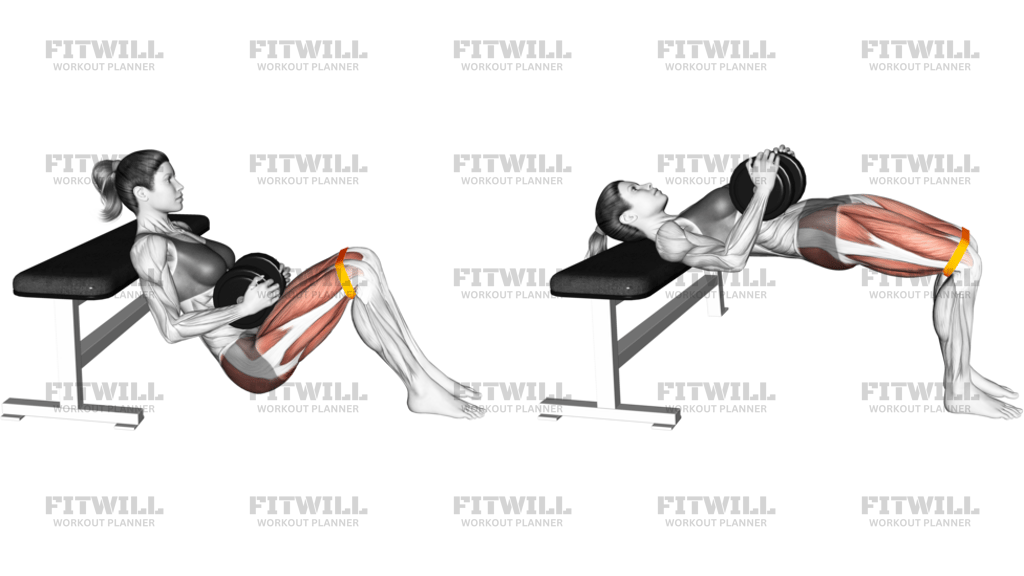
The image shows the classic setup: shoulders and upper back anchored on the bench, feet planted on the floor, dumbbell stabilized on the pelvis, and knees bent at the top so the torso can form a straight line from shoulders to knees. That position matters because a hip thrust is won or lost in the setup. If the feet are too far away, you tend to feel it in the hamstrings and lower back; if they are too close, the knees close in and the top position gets cramped. The band should stay lightly tensioned through the whole set so the knees do not cave inward as the hips rise.
This exercise is primarily used to build stronger, fuller glutes and better hip extension strength. It can also reinforce pelvic control and trunk stiffness because the torso has to stay braced while the pelvis moves through a large range. Compared with a bodyweight bridge, the dumbbell adds direct loading across the hips, and the band makes the glutes work harder to keep the knees out. That combination is useful for strength work, hypertrophy, and accessory training after squats, deadlifts, lunges, or sprint-focused sessions.
Execution should feel like a deliberate hip drive, not a swing. Start with the ribs down, brace, and press through the midfoot and heel to lift the hips. At the top, squeeze the glutes, keep the chin tucked, and finish with the torso and thighs nearly in one line without over-arching the lower back. Lower under control until the hips are just above the floor, then repeat with the same path. The dumbbell should stay centered and steady, and the band should never become a sloppy afterthought.
Use this movement when you want a heavy but controlled glute exercise that is easy to load progressively. It works well for moderate to higher reps, pauses at the top, or slower eccentrics. Keep the setup tidy, choose a load you can stabilize on the pelvis, and stop the set if the knees collapse inward or the pelvis starts to tilt instead of extending cleanly.
[ Workout Log & Planner ]
Put your next workout in Fitwill
Keep your plan and training log ready when you are.


Instructions
- Sit on the floor in front of a flat bench and place the upper edge of the bench just below your shoulder blades when you lean back.
- Loop the band above your knees and place the dumbbell across the crease of your hips, holding it in place with both hands.
- Plant both feet flat on the floor about hip-width apart, with your knees bent and shins close to vertical in the top position.
- Lean your upper back onto the bench, tuck your chin slightly, and brace your ribs down before you start the first rep.
- Drive through your heels and midfoot to lift your hips until your torso is in line with your thighs.
- Press your knees gently outward against the band as you rise, keeping the dumbbell steady over your pelvis.
- Squeeze your glutes at the top for a brief pause without leaning farther back or arching your lower spine.
- Lower your hips under control until they are just above the floor, keeping tension on the band and the dumbbell.
- Reset your breath and repeat for the planned number of repetitions, then lower the weight carefully before standing up.
Tips & Tricks
- Keep the bench edge low enough that it supports the lower part of your shoulder blades, not your mid-back.
- If the dumbbell rolls, use a pad, towel, or the flat side of the hex head to make the load more stable on the hips.
- Set your feet so the top position feels like a vertical shin and a strong heel drive, not a hamstring cramp.
- Push the knees out only enough to keep the band active; forcing a huge outward flare usually tips the pelvis forward.
- Finish the rep with hip extension, not by throwing your ribs up or overextending the lower back.
- A one-second squeeze at the top usually gives better glute tension than bouncing through fast reps.
- Use a slightly lighter dumbbell if you cannot keep the pelvis level and the band tension even from the first rep.
- Keep your hands on the dumbbell only long enough to steady it; do not press down so hard that the hips lose their full range.
- Exhale as the hips drive up, then inhale on the way down while the core stays braced.
- If your knees drift inward before the set is over, stop and reset the band tension rather than finishing with sloppy reps.
Frequently Asked Questions
What does the Dumbbell Banded Hip Thrust work most?
It mainly targets the glutes through strong hip extension, with the band adding extra work for the outer hip muscles that keep the knees from collapsing inward.
Where should the bench sit on my upper back?
The bench should contact the lower part of your shoulder blades when you lean back, so the hips can move freely without the neck or lower back taking over.
How should my feet be placed in the bottom position?
Set your feet flat, about hip-width apart, and adjust them so the top of the rep gives you vertical shins or very close to it.
Do I need to push my knees out hard against the band?
No. Keep enough outward pressure to stop the knees from caving, but do not force such a wide position that the pelvis tilts and the rep turns into a low-back arch.
Should I feel this more in my glutes or hamstrings?
The glutes should be the main driver. If the hamstrings dominate, your feet are probably too far away or you are not fully extending the hips at the top.
How do I keep the dumbbell from sliding on my hips?
Hold the dumbbell with both hands, keep your elbows tucked, and use a stable pad or a hex dumbbell if the load keeps shifting on the pelvis.
Is a pause at the top useful on this exercise?
Yes. A brief squeeze at the top makes the lockout cleaner and keeps the set focused on hip extension instead of bouncing through the bottom.
Can beginners use the band and dumbbell together?
Yes, if the load is light enough to stabilize and the band does not force the knees into an uncomfortable outward position.