Standing Balance Hip Rotation
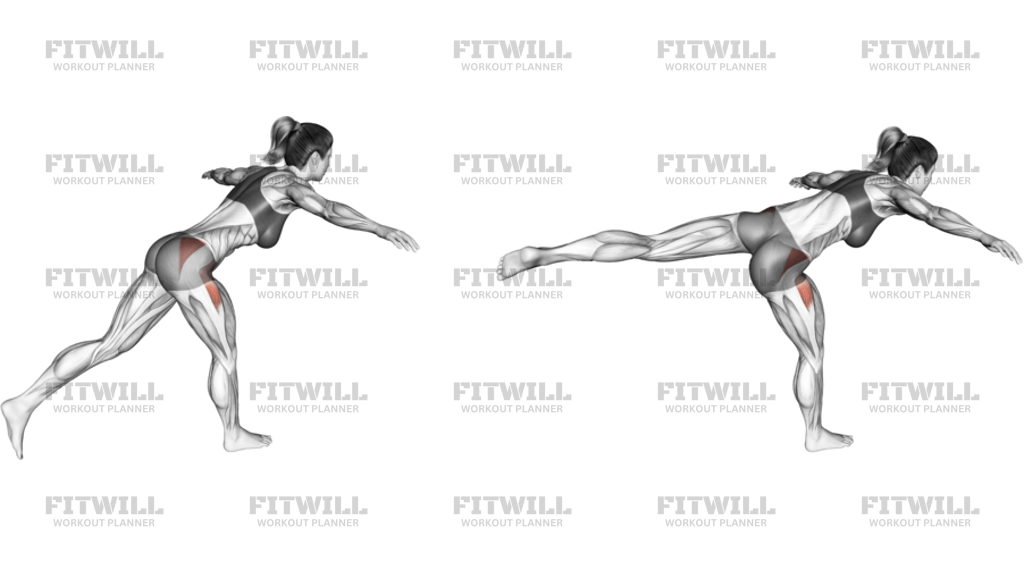
Standing Balance Hip Rotation is a bodyweight balance drill that asks one leg to support your body while the other leg reaches long behind you. It trains hip control, glute engagement, and trunk stability at the same time, so the goal is not speed or height but a clean, steady line from head to heel. When it is done well, the standing side stays organized and the lifted side moves without pulling the pelvis off center.
This exercise is useful for building single-leg control before more demanding hinges, kicks, step work, or running drills. The standing glute and deep core muscles work to keep the torso from tipping or twisting, while the free leg helps you learn to separate hip movement from low-back compensation. That makes Standing Balance Hip Rotation a practical accessory for warmups, activation work, and coordination-focused sessions.
The setup matters because balance exercises become sloppy fast if the standing foot is unstable or the torso is already rotated. Plant the foot firmly, keep a soft knee, and lengthen through the crown of the head before you move. From there, shift into a controlled hip hinge and let the free leg travel behind you as your arms reach forward for counterbalance.
During each repetition, the standing hip should stay square and the movement should come from a controlled reach rather than a swing. Keep the ribs down, the pelvis level, and the standing knee tracking over the middle toes as you lower and rise. If the range gets so large that your low back arches or your hip opens, shorten the movement and keep the rep precise.
Standing Balance Hip Rotation works best as a light, technical drill where quality matters more than load. It is a good option for beginners when they use a wall, rail, or fingertip support, and it also works for experienced lifters who need cleaner single-leg mechanics. Treat each side as its own set, breathe steadily, and stop the set once balance or pelvic control starts to drift.
[ Workout Log & Planner ]
Put your next workout in Fitwill
Keep your plan and training log ready when you are.


Instructions
- Stand tall on one foot with the standing knee softly bent and the other leg lightly unloaded behind you.
- Reach both arms forward at shoulder height and keep your chest long, ribs stacked over your pelvis.
- Spread the toes of the standing foot and feel pressure through the heel, big toe, and little toe before you move.
- Hinge at the standing hip and let your torso tip forward as the free leg reaches straight back.
- Keep your hips square to the floor and your standing knee pointed over the middle toes.
- Lower only until you can keep balance, then pause briefly with the rear leg long and the core braced.
- Drive through the standing glute and hamstring to return to upright without swinging the back leg.
- Exhale as you rise, reset your balance, and repeat for the planned reps before switching sides.
Tips & Tricks
- Keep the standing foot tripod pressure active; if your arch collapses, the hip will usually wobble with it.
- Use a fingertip on a wall or rack if the free leg is pulling you sideways.
- Think "long spine, soft knee" instead of diving your chest toward the floor.
- If your pelvis opens, shorten the back-leg reach before you chase more range.
- Pause for a second at the bottom so you are not using momentum to stand back up.
- Keep the reaching leg active rather than dangling passively; a long heel line helps control the hinge.
- Do not lock the standing knee at the top, or the rep will shift into joint stress instead of hip work.
- Stop the set when you start rotating through the ribs or twisting off the standing foot.
Frequently Asked Questions
What muscles does Standing Balance Hip Rotation work?
It mainly challenges the glutes, hamstrings, and deep core on the standing side while the smaller stabilizers around the hip and ankle keep you upright.
Can beginners do Standing Balance Hip Rotation safely?
Yes, as long as they keep the range small and use a wall or rack for light balance support. The drill should feel controlled, not like a test of how far they can tip forward.
Should the standing knee stay bent or locked out?
Keep a soft bend in the standing knee. Locking it straight usually shifts the work away from the hip and makes balance harder to control.
Why do I feel Standing Balance Hip Rotation in my low back?
That usually means you are hinging too far or arching to fake extra range. Shorten the reach, keep the ribs stacked over the pelvis, and let the glute of the standing leg do the work.
How do I keep from wobbling side to side?
Press evenly through the standing foot and keep the free leg long behind you instead of swinging it. A slower tempo and a fingertip support point also help.
Is Standing Balance Hip Rotation the same as a single-leg deadlift?
It is similar, but this drill is usually lighter and more controlled. The emphasis is on balance and hip stability rather than loading the hinge hard.
What should I do if I cannot balance on one leg?
Reduce the forward hinge, keep the lifted leg lower, and hold onto a stable support with one hand. You can build up to a hands-free set as your control improves.
How can I make Standing Balance Hip Rotation harder?
Remove the hand support, slow the lowering phase, and add a brief pause with the back leg long and the pelvis square. You can also lengthen the reach a little at a time without losing alignment.