Resistance Band Seated Hip Abduction Version 2
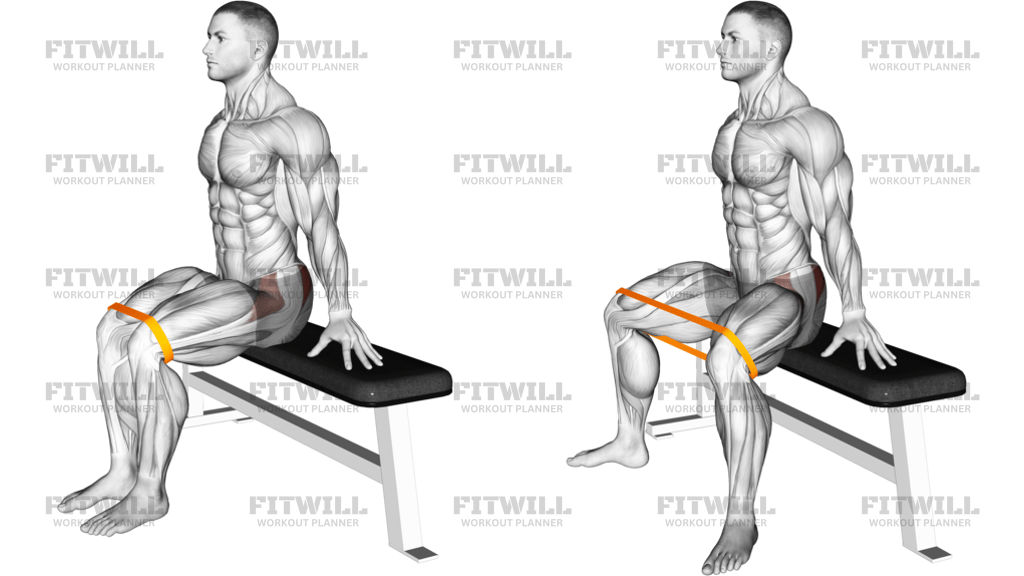
Resistance Band Seated Hip Abduction Version 2 is a seated outer-hip exercise that uses a loop band around the thighs just above the knees. You sit tall on a bench, brace your hands behind you, and open the knees outward against the band while keeping the feet planted. The movement is small, but the training effect is real: it teaches the hips to produce controlled abduction without the pelvis tipping, the low back arching, or the torso swinging for help.
This version is especially useful when you want to isolate the glute medius, glute minimus, and other hip stabilizers in a clean, easy-to-dose pattern. Because you are seated and supported by the bench, the exercise lets you focus on the joint action at the hips rather than balance. That makes it a good choice for warm-ups, activation work, rehabilitation-style training, or accessory sets where you want steady tension instead of heavy loading.
The setup matters because the band position and seated posture determine where the resistance lands. Place the band high enough on the thighs that it stays secure, then position the feet flat and roughly hip-width apart. Keep the knees bent, the chest lifted, and the ribs stacked over the pelvis. From there, gently press the knees out to create tension before starting the rep. The goal is to keep the hips doing the work while the trunk stays quiet and the bench support stays consistent.
On each repetition, drive the knees outward without rolling onto the outside edges of the feet or leaning back to fake a bigger range. Open only as far as you can while maintaining pelvic control, then pause briefly and return slowly against the band. The return should be controlled, not dropped. Smooth breathing helps keep the brace steady, especially if the band gets challenging near the top of the range.
Use Resistance Band Seated Hip Abduction Version 2 when you want a controlled glute-focused accessory that is easy to progress with band tension, tempo, or pause length. It works well for beginners because the load is simple to scale, but it still rewards precise execution. If the knees are swinging open and shut or the lower back is taking over, the band is too heavy or the range is too aggressive. Clean reps with a stable torso are the standard for this movement.
[ Workout Log & Planner ]
Put your next workout in Fitwill
Keep your plan and training log ready when you are.


Instructions
- Sit on a flat bench with a loop band around both thighs just above the knees.
- Plant both feet flat on the floor, about hip-width apart, and bend the knees to roughly 90 degrees.
- Place your hands behind your hips on the bench for support and sit tall with the chest open.
- Before each rep, lightly press the knees outward to take the slack out of the band.
- Keep the feet planted and the pelvis level as you begin the rep.
- Drive both knees outward against the band until you feel the outer hips work.
- Pause briefly at the widest comfortable position without leaning back or rocking.
- Return the knees inward slowly and stop before the band goes completely slack.
- Reset your posture and repeat for the planned number of repetitions.
Tips & Tricks
- Place the band above the knees, not on the knees, so it stays secure and does not roll.
- Keep the feet flat and quiet; if the heels lift or the ankles turn out hard, the hips are losing control.
- Open the knees only as far as you can without tipping the pelvis or rounding the low back.
- A light to moderate band is usually better than a heavy one for this seated version because the range is small.
- Think about pushing the knees apart from the outer hips, not forcing the feet apart.
- Keep the chest tall and the ribs stacked so the trunk does not become a hidden source of momentum.
- Use a one-second pause at the open position if you want more glute medius tension.
- Lower the knees slowly to keep tension on the band instead of letting it snap back in.
Frequently Asked Questions
What does Resistance Band Seated Hip Abduction Version 2 train most?
It mainly trains the outer hips, especially the glute medius and nearby hip stabilizers that move the knees out against the band.
Where should the band sit for this seated version?
Place the band around both thighs just above the knees. That position keeps the band stable and makes the hip abduction path easier to control.
Should my feet move while I open the knees?
No. Keep both feet planted on the floor and let the hips move the knees outward. If the feet spin or slide, the band is probably too heavy.
Can beginners use this exercise?
Yes. It is beginner-friendly because the setup is simple and the resistance is easy to scale with a lighter band.
Why do I feel this in my low back instead of my hips?
Usually the torso is leaning back or the range is too large. Sit taller, keep the ribs stacked, and stop the rep before the pelvis starts to move.
How heavy should the band be?
Choose a band that lets you open and close the knees without jerking, shifting on the bench, or losing the pause at the top.
What is the most common mistake on this movement?
The biggest mistake is turning it into a rocking motion by leaning back and bouncing the knees apart. The torso should stay quiet.
How can I make the exercise harder without changing equipment?
Use a slower return, add a short pause at the open position, or increase the number of controlled reps before you move to a stronger band.