Resistance Band Lying Hyperextension Abduction
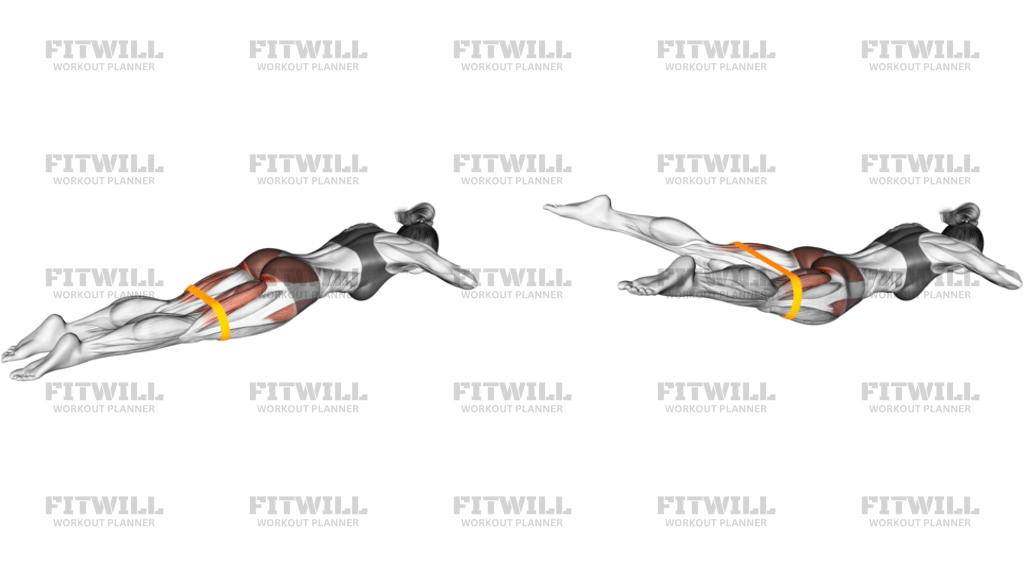
Resistance Band Lying Hyperextension Abduction is a prone floor exercise that combines hip extension with a slight outward abduction against band resistance. The image shows the lifter lying face down with the band around the upper legs and one leg moving away from the floor in a long, controlled arc. That setup makes the drill look simple, but the training effect depends on keeping the pelvis quiet and letting the hip do the work instead of the lower back.
This movement is useful when you want to build glute engagement, hip control, and stable pelvis positioning without loading the spine. It usually feels strongest in the glutes and upper hamstring area, with the core and deep hip stabilizers working to stop the torso from rocking. Because the range is small, the exercise rewards patience: the goal is not to kick the leg high, but to move it just far enough to create tension where you want it.
The band placement matters because it changes how much the hips must resist collapse or drift. Lie prone with the ribs heavy, the abdomen lightly braced, and both hips pointed into the floor before you start. From there, lift one leg only as far as you can keep the low back still, then let it travel back down under control. If the torso arches or the pelvis twists, the movement shifts away from the glutes and into compensation.
Use this exercise in a warm-up, activation block, rehabilitation-style accessory session, or as a low-load finisher for glutes and hips. It is especially helpful when you want to teach a cleaner hip extension pattern or improve side-to-side hip control. Beginners can do it with a very light band or even no band at first, while more advanced lifters can slow the tempo or pause at the top as long as the low back stays quiet.
The safest and most productive version is the one that keeps the movement compact, smooth, and repeatable. Lower the leg with the same control you used to lift it, reset the pelvis if it starts to rotate, and stop the set before you start stealing range from the spine. Done well, the exercise builds better hip awareness and stronger glute recruitment without needing heavy load or aggressive range.
[ Workout Log & Planner ]
Put your next workout in Fitwill
Keep your plan and training log ready when you are.


Instructions
- Lie face down on a mat with a mini-band looped around the upper legs just above the knees, legs straight behind you and forehead or cheek resting lightly on the floor.
- Set both hips square to the floor, tuck the ribs down, and lightly brace the abdomen so the lower back stays long before you move.
- Keep the non-working leg relaxed and in contact with the floor while the working leg starts fully extended and slightly turned in or neutral.
- Exhale and lift the working leg a few inches off the floor, sending it back and slightly out to the side against the band.
- Keep the knee mostly straight, the pelvis level, and the movement coming from the hip instead of the low back.
- Pause briefly at the top when the glute is fully engaged and the leg is still under control.
- Lower the leg slowly until it returns close to the floor without letting the hips roll or the band snap back.
- Reset the pelvis if needed, then repeat all reps on one side before switching or alternate sides if that matches your programming.
Tips & Tricks
- Keep the lift small; if the leg is traveling high, the low back is usually helping too much.
- Think about driving the heel long while the thigh moves slightly outward, not flinging the foot upward.
- Place the band where you can feel tension quickly but not so low that it twists around the knees.
- Hold the pelvis heavy against the mat and resist the urge to open the working hip toward the ceiling.
- Use a slow lower of two to four seconds so the band does not pull you back to the floor.
- If your hamstring cramps, shorten the range and soften the knee slightly instead of forcing more height.
- Keep the non-working leg quiet; it should not lift, slide, or help create momentum.
- Exhale on the lift and inhale as the leg returns so the trunk stays braced without holding your breath.
Frequently Asked Questions
What muscles does Resistance Band Lying Hyperextension Abduction work most?
It mainly trains the glutes, especially the glute max and glute med, with the upper hamstrings and core stabilizers helping keep the pelvis steady.
Where should the band sit for this prone hyperextension abduction?
In the pictured setup, the band sits around the upper legs just above the knees so it resists the hip opening and extension pattern without sliding around the ankles.
How high should I lift my leg?
Only lift until the glute is clearly working and the low back still feels quiet. A small, controlled lift is better than chasing height.
What is the most common mistake with this exercise?
The usual mistake is arching the lower back or twisting the hips open to fake a bigger range. The pelvis should stay heavy and square to the floor.
Is this more of an activation drill or a strength exercise?
It can be both. Use a light band and crisp reps for activation, or use slower tempos and longer pauses for accessory glute work.
Can beginners do this movement safely?
Yes. Beginners usually do best with a light band or no band at first so they can learn to keep the pelvis still and move from the hip.
Why does my hamstring cramp during the lift?
The hamstring may be taking over if the lift is too large or the knee is locked too hard. Shorten the range and think about squeezing the glute first.
How do I make Resistance Band Lying Hyperextension Abduction harder?
Use a stronger band, slow the lowering phase, or add a brief pause at the top, but keep the same small, strict hip motion.