Resistance Band Air Bike Version 2
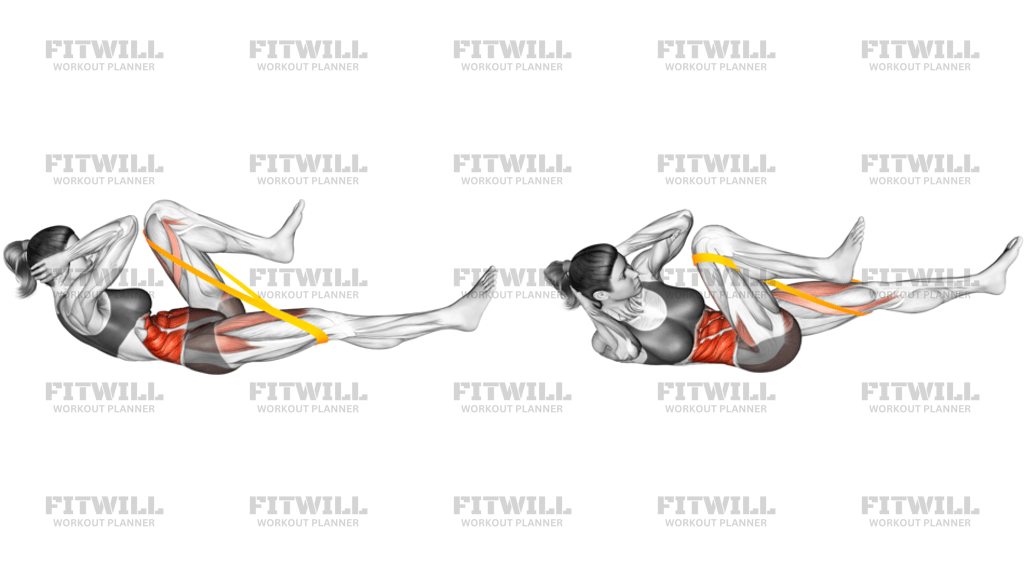
Resistance Band Air Bike Version 2 is a floor-based core exercise that combines a bicycle-crunch pattern with continuous band tension. You lie on your back, keep your shoulders lifted, and alternate the legs in a pedaling motion while the band adds resistance to the lower body. That makes the movement feel more demanding than a bodyweight air bike because every rep has to control both rotation and leg extension.
The exercise is most useful when you want the abs, obliques, and hip flexors to work together without relying on heavy spinal loading. It also asks the deep trunk stabilizers to keep the ribs and pelvis organized while the legs switch sides. The setup matters because once the low back starts arching or the band goes slack, the drill stops being a clean core exercise and turns into a fast leg swing.
Set up on a mat with the band looped around both feet or arches, then bring your hands lightly behind your head without pulling on the neck. Lift the shoulder blades just off the floor and keep the chin softly tucked so the rib cage stays active. From there, one knee draws in as the opposite leg reaches long, and the torso rotates just enough for the opposite elbow to travel toward the lifted knee.
The best repetitions are smooth and repeatable, not big and chaotic. Keep the pelvis quiet as the legs cycle, and let the trunk do the twisting instead of throwing the elbows across the body. A short pause when the crunch is strongest can help you feel the band tension and keep both sides honest before you switch legs and return under control.
Resistance Band Air Bike Version 2 fits well in core circuits, conditioning work, or warmups when you want a dynamic ab drill that still rewards discipline. It is also a good choice when a simple bicycle crunch is too easy and you want more lower-body load without moving to weighted floor work. Stop the set when the neck starts doing the work, the lower back lifts off the floor, or the cadence gets so fast that the band tension no longer feels deliberate.
[ Workout Log & Planner ]
Put your next workout in Fitwill
Keep your plan and training log ready when you are.


Instructions
- Lie on a mat and loop the resistance band around both feet or arches so it stays under light tension as you move.
- Place your hands lightly behind your head, keep your elbows open, and lift your shoulder blades a few inches off the floor.
- Press your lower back gently toward the mat before the first rep so your ribs stay tucked and your pelvis stays quiet.
- Drive one knee toward your chest while the opposite leg reaches long, keeping the band taut through the whole pedal stroke.
- Rotate your rib cage so the opposite shoulder blade and elbow travel toward the lifted knee without pulling your head forward.
- Switch sides in one smooth motion, letting the extended leg become the driving leg while the other knee folds in.
- Exhale through the crunch on each side and inhale as you pass through center or change legs.
- Keep alternating reps with the same leg height and torso curl until the set is complete, then lower your shoulders and release the band with control.
Tips & Tricks
- Keep the band on the arches or midfoot if it slides off the toes during the pedal motion.
- A smaller bicycle range is better if your lower back starts to arch when the extended leg reaches too low.
- Think about curling the ribs toward the opposite hip instead of trying to touch elbow to knee.
- Do not let the elbows collapse inward; open them wide so the neck stays relaxed behind the hands.
- If the hip flexors cramp, raise the extended leg slightly and shorten the lever before you add more reps.
- The band should stay under tension even when one knee is driving in; if it goes slack, adjust the setup or shorten the cycle.
- Use a slower tempo than a normal air bike so each side matches and the torso does not rock side to side.
- Stop the set when the shoulders can no longer stay lifted without the head yanking forward.
- Treat the first few reps as a test of band length and tension, then settle into the rhythm that keeps the pelvis still.
Frequently Asked Questions
What muscles does Resistance Band Air Bike Version 2 work most?
It mainly trains the abs and obliques, with the hip flexors helping drive each leg through the bicycle pattern.
Where should the resistance band sit during Resistance Band Air Bike Version 2?
Loop it around the feet or arches so it stays taut as the legs alternate. If it slips toward the toes, move it slightly lower onto the midfoot.
Do my shoulders stay on the floor in Resistance Band Air Bike Version 2?
No. Keep the shoulder blades lightly lifted so the trunk stays engaged, but do not yank your neck forward to get higher.
Should I touch my elbow to my knee?
No. Rotate toward the opposite knee, but keep the movement clean and controlled rather than forcing contact.
Why does Resistance Band Air Bike Version 2 feel harder than a regular air bike?
The band adds constant resistance to the leg cycle, so the abs and hip flexors have to control more tension on every switch.
Can beginners do Resistance Band Air Bike Version 2?
Yes, if the band is light and the leg reach stays short. Beginners should focus on keeping the low back quiet before trying to increase range or speed.
What is the most common mistake in Resistance Band Air Bike Version 2?
The usual mistake is racing the pedals and letting the torso rock. That shifts the work away from the abs and makes the neck or hips take over.
Can I use this instead of bicycle crunches?
Yes. It is a harder band-resisted version of the same general pattern, so it works well when bodyweight bicycle crunches are too easy.