Resistance Band Split Squat With Horizontal Pallof Hold
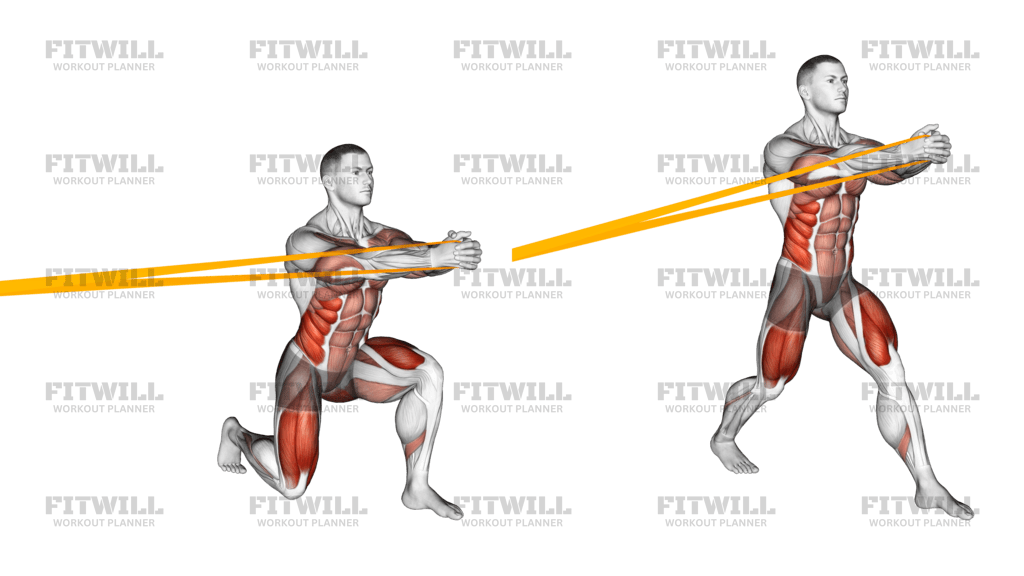
Resistance Band Split Squat With Horizontal Pallof Hold is a split-stance lower-body exercise with an anti-rotation challenge built into the hold. The band pulls from the side while the arms stay extended in front of the chest, so the front leg has to do most of the work while the trunk resists twisting. That combination makes it useful for training thigh strength, hip control, and core stability in the same rep.
The image shows a tall-kneeling-to-split-squat style position with the band anchored off to one side at about chest height. Your torso should stay square to the front while the hands press straight out and hold that line against the band. The band tension is not there to create a big pressing motion; it is there to challenge your ability to stay stacked, centered, and level as you descend and rise.
Because the exercise mixes a unilateral leg pattern with a horizontal Pallof hold, the setup matters more than brute force. If the front foot is too close or too far away, you will lose balance or shift tension away from the thigh and glute. If the band is too heavy, the torso will rotate toward the anchor and the movement stops being a clean split squat. A useful rep feels like the legs lower and drive up while the ribs, pelvis, and hands stay organized in one straight, forward-facing line.
Use a controlled pace and treat the held arm position as part of the rep, not an afterthought. Keep the elbows locked or nearly locked, hold the band at chest height, drop the back knee with control, and rise by pushing through the front foot. The goal is smooth tension through the whole range, not a rushed bounce off the bottom. Breathe behind a firm brace so the trunk stays steady as the legs work.
This exercise fits well in warm-ups, accessory blocks, and athletic strength sessions where you want single-leg strength plus anti-rotation control. It is especially useful when you want to clean up knee tracking, pelvis control, and torso stability under band tension. Beginners can use it if they keep the band light and the stance short enough to balance cleanly, but the set should end the moment the torso starts turning or the front knee collapses inward.
[ Workout Log & Planner ]
Put your next workout in Fitwill
Keep your plan and training log ready when you are.


Instructions
- Anchor a resistance band to the side at about chest height and stand sideways to the anchor with both hands holding the band straight out in front of your sternum.
- Step one foot forward and the other foot back into a split stance, then lower the back knee toward the floor so you start in a staggered lunge position.
- Square your hips and ribs to the front before you move, with your arms still fully extended and the band pulling you sideways.
- Brace your midsection, keep your shoulders level, and keep the hands fixed at chest height instead of letting them drift toward the anchor.
- Lower under control by bending both knees and letting the back knee travel down and slightly forward without twisting your torso.
- Pause briefly near the bottom while the band is still trying to rotate your body, then drive up through the front foot.
- Rise until both legs are extended again while keeping the arms straight and the band line steady across your chest.
- Reset your stance and breathing after each repetition, then repeat for the planned number of reps before switching sides.
Tips & Tricks
- Set the band tension so you can keep your chest square; if the anchor is pulling you into rotation, the band is too heavy.
- Hold the band at chest height with straight arms so the Pallof demand comes from resisting twist, not from pressing forward and back.
- Use a split stance long enough to keep the front heel planted and the front shin reasonably controlled at the bottom.
- Think about lowering the back knee straight down rather than stepping forward into the rep or wobbling side to side.
- Keep your front knee tracking over the middle toes instead of collapsing inward as the band loads the torso.
- Exhale gently as you rise, but keep enough brace that the ribs do not flare or turn toward the anchor.
- If you cannot keep the shoulders and hips level, shorten the range of motion before you add resistance.
- Stop the set when the hold turns into a torso twist or when the front foot starts sliding.
Frequently Asked Questions
What does the horizontal Pallof hold add to the split squat?
It adds anti-rotation work. The band tries to pull your arms and torso sideways while your legs handle the squat pattern.
Which leg should feel the most work?
The front leg should do most of the load. The back leg mainly helps balance and guides the split stance.
Where should the band be anchored?
Anchor it to the side at about chest height so the pull stays horizontal across your body as you hold the arms out.
Should my arms bend during the hold?
Keep the arms straight or nearly straight. Bending the elbows usually turns the exercise into more of a press and reduces the anti-rotation challenge.
What if my torso keeps turning toward the anchor?
Use a lighter band, shorten the stance slightly, and reduce the depth until you can keep the ribs and hips square.
Is this more of a leg exercise or a core exercise?
It is both. The split squat loads the thighs and glutes, while the held band position forces the trunk to resist rotation.
Can I use this instead of a regular split squat?
Yes, if you want extra trunk control and lateral stability. It is not the best choice if you only want the heaviest possible leg loading.
What is the most common mistake with this movement?
Letting the band pull the chest and shoulders out of line. The rep should stay square, level, and controlled from top to bottom.