Resistance Band Standing External Rotation
Resistance Band Standing External Rotation is a simple but highly specific shoulder exercise that trains the rotator cuff to control the arm as it turns outward against band tension. It is useful before pressing, overhead work, throwing, or any session where you want the shoulder joint to feel centered and stable rather than loose and rushed.
The setup matters because the exercise only works well when the upper arms stay quiet. Stand tall with the elbows bent and tucked close to the ribs, then hold the band with the forearms in front of the waist so the starting position already feels organized. If the elbows drift away from the torso or the ribs flare up, the shoulders take over the movement instead of the smaller external rotators doing their job.
From there, rotate the forearms outward while keeping the elbows pinned in place. The hands should travel apart in a smooth arc, and the shoulders should stay down instead of shrugging. The end range is small compared with bigger upper-body lifts, so the goal is not to force a dramatic stretch or a wide sweep; the goal is to feel the shoulder turn cleanly and then return under control.
This movement is often used as a warm-up, accessory drill, or rehab-style strength exercise because it builds control where many lifters are weakest. It is especially helpful for people who press a lot, sit with rounded shoulders, or need better shoulder stability without loading the joint heavily. A light band and precise repetitions usually give more value than a harder band that turns the set into a shrugging or twisting exercise.
Keep the motion smooth, the wrists neutral, and the torso quiet from the first rep to the last. If the neck tightens, the elbows lift, or the hands drift forward, the band is probably too heavy or the setup is off. Done well, Resistance Band Standing External Rotation teaches the shoulder to rotate cleanly while the rest of the body stays stacked and still. That makes it a useful accessory on days when shoulder precision matters more than loading.
[ Workout Log & Planner ]
Put your next workout in Fitwill
Keep your plan and training log ready when you are.


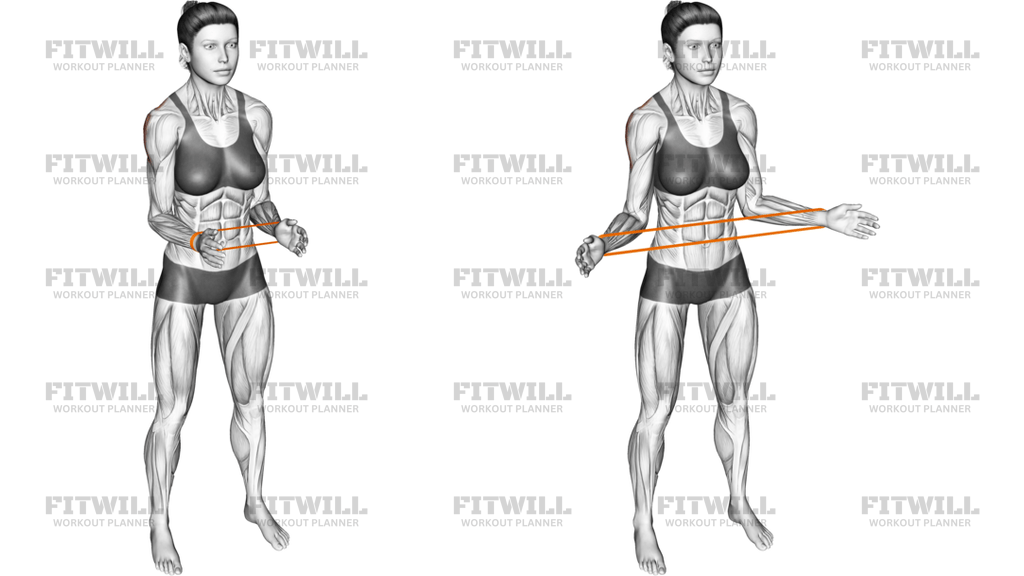
Instructions
- Stand tall with your feet about hip-width apart and hold the resistance band in both hands in front of your lower chest or upper waist.
- Bend both elbows to about 90 degrees and tuck the upper arms against your sides so the elbows stay close to the ribs.
- Keep your wrists straight and set your shoulders down away from your ears before the first rep.
- Start with the forearms close together and the band under light tension across the front of your body.
- Rotate both forearms outward in a smooth arc while keeping the elbows fixed at your sides.
- Stop when the hands have moved apart as far as you can without the elbows drifting or the chest lifting.
- Pause briefly in the open position and keep the neck relaxed.
- Return the forearms to the start slowly, resisting the band on the way back.
- Reset your shoulders and breathe before the next repetition.
Tips & Tricks
- Use the lightest band that still makes the last few reps feel deliberate; this drill is about control, not resistance overload.
- Keep a towel or your own torso as a reference for the elbows so they do not float away from the ribs as the hands open.
- If your wrists bend back or your knuckles rise, reduce tension and keep the forearms aligned with the band instead of cranking through the hands.
- Let the hands travel only as far as the shoulders can rotate without the chest popping up or the lower back arching.
- Think about turning the upper arm bones outward rather than yanking the band apart with the forearms.
- Hold the open position for a split second to feel the rotator cuff work instead of bouncing straight back.
- If you feel the upper traps taking over, lower the shoulders and shorten the range before the next rep.
- Keep the return phase slow so the band does not pull your forearms back together faster than you can control.
- Use higher reps for warm-up work and stop the set as soon as the elbows start to drift or the shoulders shrug.
Frequently Asked Questions
What muscle does Resistance Band Standing External Rotation target most?
It mainly targets the rotator cuff, especially the external rotators that help the shoulder stay centered while the forearms turn outward.
Can beginners perform this exercise?
Yes. Beginners usually do best with a very light band and a short, controlled range so the elbows stay tucked and the shoulders do not shrug.
Where should my elbows stay during Resistance Band Standing External Rotation?
Keep both elbows pressed close to the sides of your ribs. If they drift backward or flare out, the movement stops looking like an external rotation and turns into a loose arm swing.
How far should my hands move apart?
Only as far as you can rotate without the chest lifting, the elbows moving, or the shoulders shrugging. The useful range is small and controlled.
Should I feel this in my neck or upper traps?
No. If the neck or upper traps take over, the band is probably too heavy or the shoulders are creeping upward. Lower the resistance and keep the shoulder blades down.
Is Resistance Band Standing External Rotation good before pressing?
Yes. It is a common warm-up drill before bench press, overhead pressing, or throwing because it reminds the shoulder to rotate cleanly before heavier work.
What is the biggest mistake in this exercise?
Letting the elbows leave the ribs. Once that happens, the movement becomes less about shoulder rotation and more about moving the whole arm.
How many reps should I use for Resistance Band Standing External Rotation?
Higher reps are usually more useful than heavy resistance. Many lifters use this for 10-20 controlled repetitions or as a short warm-up set.
Can I do Resistance Band Standing External Rotation if my shoulders are tight?
Usually yes, as long as the motion stays pain-free and the range remains small. If the front of the shoulder pinches, shorten the arc or stop the set.