Dumbbell Split Stance Biceps Curl
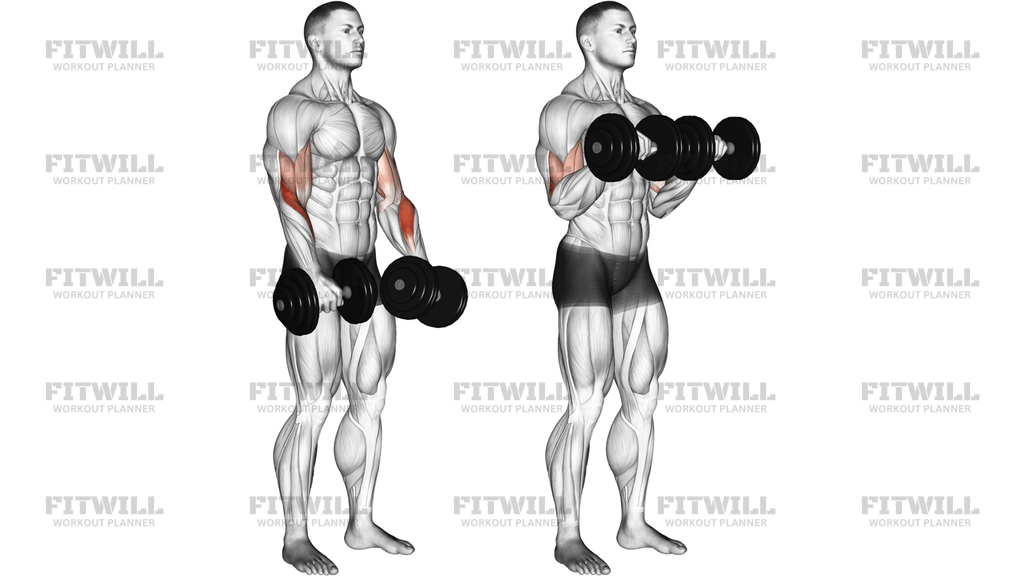
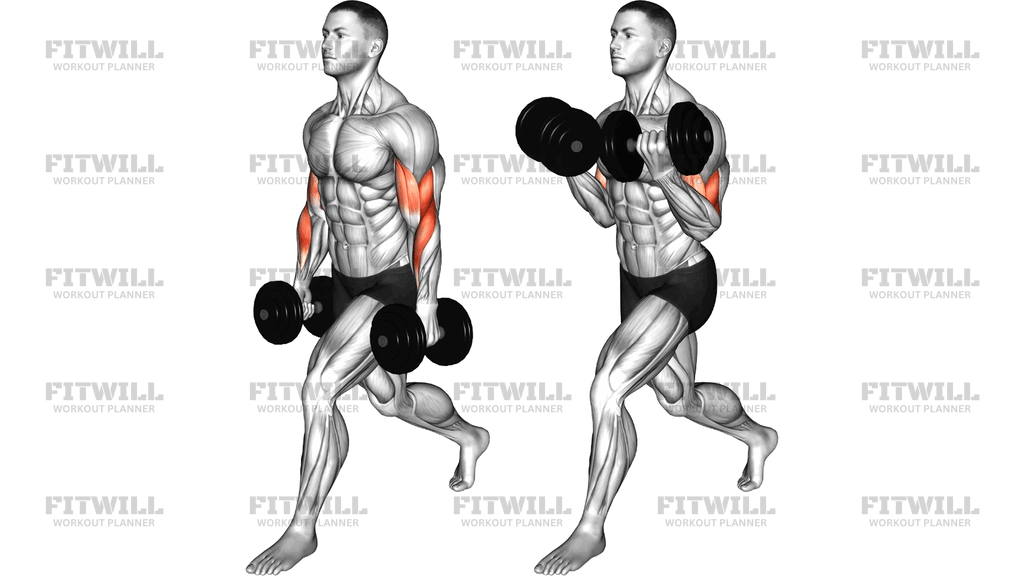
The Dumbbell Split Stance Biceps Curl is a standing curl performed with one foot staggered in front of the other, holding a dumbbell in each hand with your palms facing forward. Instead of bracing with a wide, even stance as in a standard standing curl, you narrow your base and offset your feet, which asks your legs and trunk to stabilize while your biceps do the lifting. The curl itself stays simple: both dumbbells travel from your sides up toward shoulder height, elbows pinned close to the torso.
This variation is useful for lifters who want more out of the same dumbbell weight. Because the split stance reduces your ability to swing and lean, many people find they can't cheat the reps the way they can with a relaxed parallel stance. It's also a practical choice in busy gyms or home setups where preacher benches or curl stations aren't available—your own lower body becomes the support structure.
The primary work falls on the biceps through elbow flexion with the forearm supinated. The brachialis and forearm flexors assist throughout the lift, and the grip works hard to control the dumbbells. Meanwhile, the split stance quietly loads the front leg's quads and glutes and challenges the hip and core stabilizers, since your center of mass shifts forward and back slightly with every rep.
Setup matters more here than in most curl variations. A staggered stance that's too narrow makes balance the limiting factor before your biceps fatigue; one that's too wide turns it into a normal standing curl. Aim for roughly hip-width spacing from left to right, with your back heel lifted and most of your weight distributed between the front foot and the ball of the back foot.
To execute it well, keep your ribs stacked over your pelvis and your elbows fixed at your sides. Curl both dumbbells together until your forearms approach vertical or slightly beyond, pause briefly at the top, and lower under control until your arms are fully extended. If you find yourself rocking forward onto the front foot or swinging the weights, the load is probably too heavy.
You'll see this movement used in arm-focused hypertrophy days, as a finisher after heavier pressing or pulling work, or in minimal-equipment programs where one pair of dumbbells has to cover the whole session. It pairs naturally with split stance or lunge-based leg work, letting you keep a consistent lower body position across exercises.
[ Workout Log & Planner ]
Put your next workout in Fitwill
Keep your plan and training log ready when you are.


Instructions
- Pick a pair of dumbbells you can curl strictly for your target reps and hold one in each hand with a supinated grip, palms facing forward.
- Step one foot forward and one foot back into a staggered stance, feet about hip-width apart from side to side, with your back heel lifted so your weight rests on the ball of that foot.
- Let the dumbbells hang at full arm extension by your sides, elbows close to the torso, and pull your shoulders back and down.
- Brace your core lightly and keep your chest tall, stacking your ribs over your hips so you are not leaning back.
- Curl both dumbbells upward at the same time by bending only at the elbows, keeping the upper arms still and the palms facing up throughout.
- Finish the curl when your forearms are near vertical and the dumbbells are level with or slightly below your shoulders, and squeeze the biceps briefly at the top.
- Lower the dumbbells slowly along the same path until your arms are fully extended and the biceps are stretched at the bottom.
- Exhale as you curl the weights up and inhale as you lower them down.
- Complete your reps with the same stance, then switch which leg is forward for the next set to balance the stabilization demand.
- Set the dumbbells down fully before adjusting your stance or grip between sets.
Tips & Tricks
- If your front knee drifts inward or your torso sways with each rep, widen your front-to-back split slightly or reduce the weight—the balance challenge is often the real limiter early on.
- The most common mistake is turning this into a swing: the split stance tempts people to rock from the back foot into the curl. Keep your weight planted and let the elbows, not momentum, move the dumbbells.
- Keep the back heel lifted for the whole set. Dropping it flat changes your base and usually introduces a forward lean you don't want.
- Stop the curl just past forearm-parallel rather than pulling the dumbbells into your chest; dragging them higher lets the elbows travel forward and shifts tension off the biceps.
- Control the bottom two inches of the descent. Because the split stance limits body English, the stretch position is where strict form pays off most.
- If your wrists collapse backward at the top, grip the dumbbell handles firmly and think about keeping the knuckles aligned with the forearm.
- Alternate the forward leg between sets. Doing every set with the same leg forward creates an uneven stabilization pattern over time.
- Match the pace of the lowering phase to the lifting phase—this variation works best as a tempo-controlled movement rather than a fast pump.
- If your back calf or ankle fatigues before your arms, that's normal at first; build tolerance with lighter sets before pushing the dumbbell weight.
Frequently Asked Questions
What muscles does the Dumbbell Split Stance Biceps Curl work?
The biceps brachii are the prime movers, supported by the brachialis and forearm flexors during elbow flexion. The split stance also engages the quads, glutes, and trunk stabilizers to keep you balanced while you curl.
Why use a split stance instead of standing with feet side by side?
The staggered stance narrows your base and makes swinging much harder, so the biceps have to do the work. It also adds a balance and stability element that a standard standing curl doesn't provide.
Is the Dumbbell Split Stance Biceps Curl suitable for beginners?
Yes, as long as you start with light dumbbells and treat the first few sessions as balance practice as much as arm work. Beginners who struggle with stability can widen the stance slightly while keeping the back heel lifted.
Should both dumbbells curl at the same time or one at a time?
The standard version curls both dumbbells together, which keeps the trunk working symmetrically. Alternating arms is a valid progression because it adds a rotational challenge to the split stance, but learn the bilateral version first.
How far apart should my feet be in the split stance?
Keep the feet roughly hip-width apart from side to side so your balance isn't compromised, with the back foot far enough behind that the heel naturally lifts. If you feel wobbly, shorten the front-to-back distance rather than widening it.
Why do my back calf and ankle burn during this exercise?
Your weight rests on the ball of the back foot for the entire set, so the calf and foot stabilizers work continuously. This is expected and usually settles as you get accustomed to the stance.
What is the most common mistake with this curl variation?
Rocking the torso or shifting weight onto the front foot to help the dumbbells up. If you can't keep your chest tall and elbows fixed at your sides, the dumbbells are too heavy.
Can I substitute the Dumbbell Split Stance Biceps Curl with a regular standing curl?
Yes, a standard dumbbell curl trains the same arm muscles, but you lose the balance demand and the anti-swing effect of the narrow base. Seated curls are another substitute if standing balance is an issue.
How heavy should the dumbbells be for this exercise?
Choose a weight you can curl strictly through a full range with your elbows glued to your sides—typically slightly lighter than what you'd use for a parallel-stance curl, since cheating is harder here.
Is it safe for the lower back?
The exercise is generally low-risk when you keep your torso upright and avoid leaning back at the top of each curl. If you feel your lower back arching or straining, brace your core more firmly and reduce the load.