Dumbbell Bear Crawl Push Up
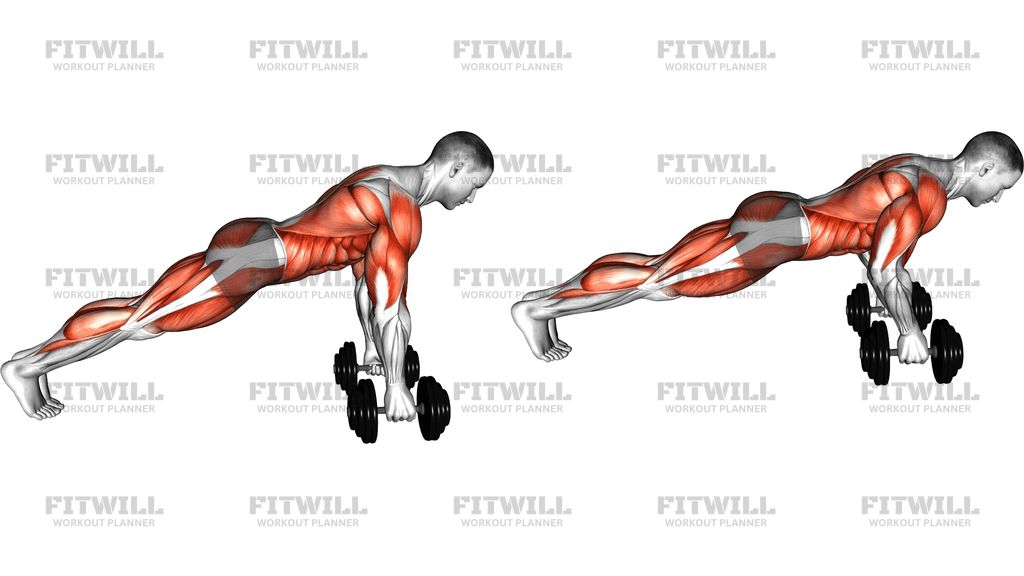
The Dumbbell Bear Crawl Push Up combines two demanding movements into one: a push-up performed with your hands gripping hex dumbbells, and a bear crawl where you travel across the floor while holding that high plank position. Instead of dropping to the ground between efforts, you move with your hands and feet in small, controlled steps, then execute a push-up, then crawl again. The dumbbells act as elevated, neutral-grip handles, which takes pressure off the wrists and gives you a deeper, more comfortable range of motion at the bottom of each push-up.
This movement trains the chest and triceps through the push-up portion, while the crawl segments load the shoulders, core, and hip flexors isometrically. Because your body is constantly shifting as you step, your midsection has to work overtime to keep your hips from swaying or sagging. The front shoulders and stabilizing muscles around the shoulder blades also get steady work as they brace and reposition your weight with every hand placement.
The setup matters more than it might seem. A pair of hex-shaped dumbbells with flat, parallel sides is ideal because they will not roll when you load your weight onto them. Choose a weight light enough that you can press and crawl without the handles tipping, but heavy enough that they stay planted under your hands. A smooth, open stretch of floor gives you room to travel several steps in each direction.
To execute it well, think of your body as one rigid line from head to heels. Grip the dumbbells firmly, brace your abs as if bracing for contact, and keep your hips level with your shoulders throughout. When you crawl, move the opposite hand and foot together in small steps, placing the dumbbell down under control before shifting your weight onto it. When you push up, keep your elbows at roughly a 45-degree angle to your torso rather than flaring straight out to the sides.
This exercise fits well into conditioning circuits, warm-up progressions for push-up strength, or as a finisher when you want to combine upper-body pressing with core and shoulder endurance. It is especially useful for people whose wrists ache during floor push-ups, since the neutral grip keeps the joints stacked and straight.
A few practical points will keep the movement safe and effective. Start with lighter dumbbells than you think you need, because control degrades quickly once fatigue sets in. Keep your knees off the floor during the crawl, but if your form breaks down, it is better to shorten the crawling distance than to let your hips sag. Stop the set when you can no longer hold a straight body line, as a collapsing lower back defeats the purpose of the exercise and puts unnecessary stress on the spine.
[ Workout Log & Planner ]
Put your next workout in Fitwill
Keep your plan and training log ready when you are.


Instructions
- Place a pair of hex dumbbells on the floor roughly shoulder-width apart, with the flat sides parallel so the handles cannot roll.
- Kneel down and grip each dumbbell with a neutral grip, knuckles facing forward, then step your feet back into a high plank with your body forming a straight line from head to heels.
- Set your feet about hip-width apart and brace your abdominal muscles, squeezing your glutes to lock your pelvis in place.
- Bend your elbows to lower your chest toward the floor, keeping the dumbbells vertical and your elbows tracking at about a 45-degree angle from your torso.
- Press firmly through both handles until your arms are straight again, keeping your shoulder blades pressed gently toward your spine rather than letting them wing outward.
- From the top of the push-up, begin crawling forward: move your right hand and left foot a few inches ahead, then your left hand and right foot, keeping your hips low and level.
- Take two to four crawl steps, re-planting each dumbbell squarely under your shoulder before shifting your weight onto it.
- Perform another push-up at the new position, then continue alternating crawl segments and push-ups for the desired distance or repetitions.
- Exhale as you press up from each push-up, and breathe in short, steady breaths during the crawl without letting your belly relax.
- To finish, crawl to your endpoint, walk your feet toward your hands, stand up, and set the dumbbells down on the floor rather than dropping them.
Tips & Tricks
- The most common failure point is hip sag during the crawl; film yourself from the side once to check whether your lower back dips when you move a hand forward.
- If the dumbbells tip inward when you press, your grip is too loose — squeeze the handles hard throughout, which also recruits more upper-body tension.
- Keep your crawl steps short. Long reaches shift weight onto one arm early and make the push-up harder to keep symmetrical.
- Do not let your head drop toward the floor at the bottom of the push-up; keep your neck in line with your spine by looking at a spot on the floor slightly ahead of your hands.
- Hex dumbbells are strongly preferred over round ones here, since a rolling handle mid-push-up can dump you onto the floor.
- If your wrists feel fine but your shoulders ache, narrow your hand placement slightly and focus on pulling your elbows closer to your ribs as you lower.
- A slick floor makes crawling harder than it should be; bare feet or training shoes with grip both work, but avoid socks on hardwood.
- When fatigue causes your push-up depth to shrink, cut the set off rather than doing half-depth reps — shallow pressing with a sagging hip teaches poor patterns.
- Start with a short 5 to 8 meter crawl distance per set; this movement gets much harder once the shoulders fatigue, so progression should come from distance and total push-ups, not heavier dumbbells.
Frequently Asked Questions
What muscles does the Dumbbell Bear Crawl Push Up work?
The push-up portion primarily targets the chest, triceps, and front shoulders. The crawl segments add heavy isometric work for the core, hip flexors, and the stabilizing muscles around the shoulder blades.
Why use dumbbells instead of doing this on the floor?
The dumbbells act as neutral-grip handles, which keeps your wrists straight and often feels much more comfortable than having your palms flat on the floor. They also allow the chest to travel slightly lower for a fuller range of motion.
What weight dumbbells should I use for the Dumbbell Bear Crawl Push Up?
Start light — often 5 to 10 kg per hand is plenty, since the weight only needs to stay stable under your hands. Heavier dumbbells can work once your pressing strength and control are solid, but stability matters more than load here.
Can beginners do the Dumbbell Bear Crawl Push Up?
Yes, with modifications. Beginners can perform the push-ups from the knees or do fewer push-ups between crawl segments, and shorten the crawling distance until the high plank position feels stable.
Should my knees stay off the floor during the crawl?
Yes — the bear crawl position means your knees hover just above the floor while you move, which keeps your core engaged. Letting the knees rest turns it into a different, much easier exercise.
Why do my hips sway side to side when I crawl?
That usually means your core is not braced hard enough or your steps are too long. Slow down, tighten your abs before each hand placement, and take smaller steps so your weight stays centered over your base.
Can I substitute anything if I do not have hex dumbbells?
Push-up handles or a pair of kettlebells set on their sides can work as stable grips. Avoid round dumbbells, since they can roll under your weight and cause a sudden loss of support.
How do I program the Dumbbell Bear Crawl Push Up in a workout?
It works well as a circuit station or a finisher — try 3 to 4 rounds of a 5 to 8 meter crawl with a push-up every 2 to 4 steps. Rest about 60 to 90 seconds between rounds, or pair it with a lower-body exercise.
Is it safe for my wrists and shoulders?
The neutral grip on the dumbbells is generally gentler on the wrists than flat-floor push-ups. Keep the dumbbells vertical, avoid letting your elbows flare wide, and stop if you feel sharp pain in either joint.