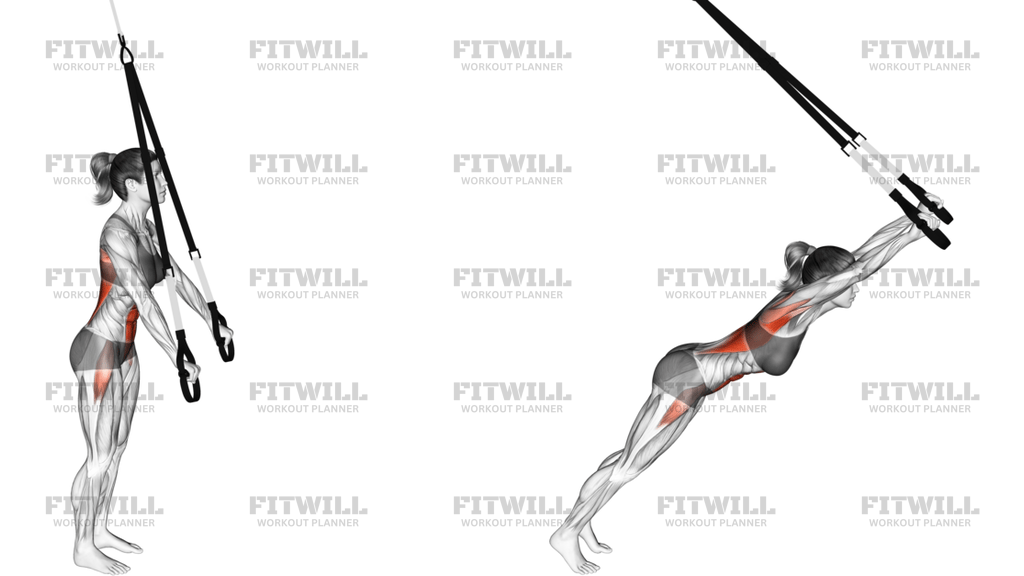
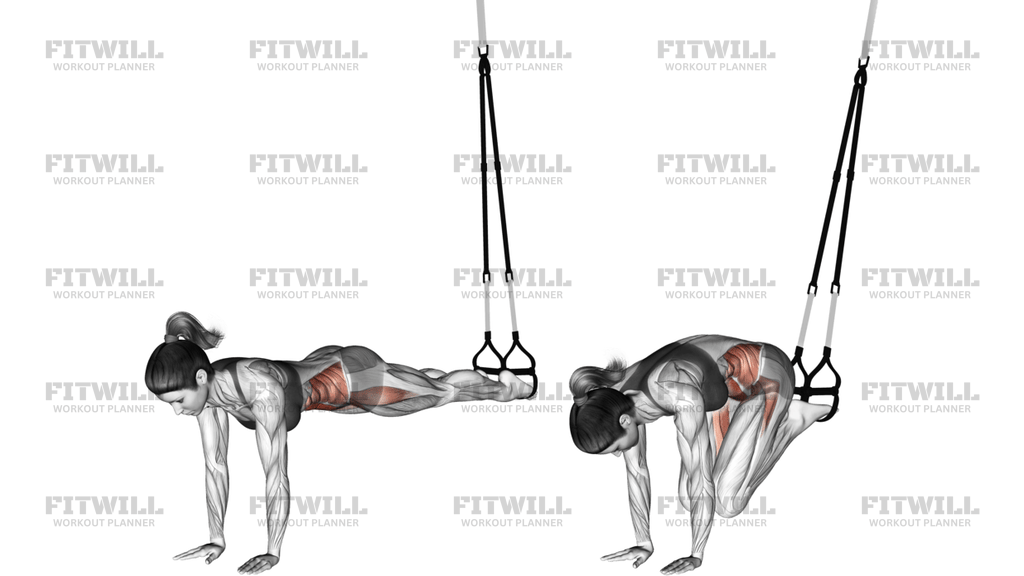
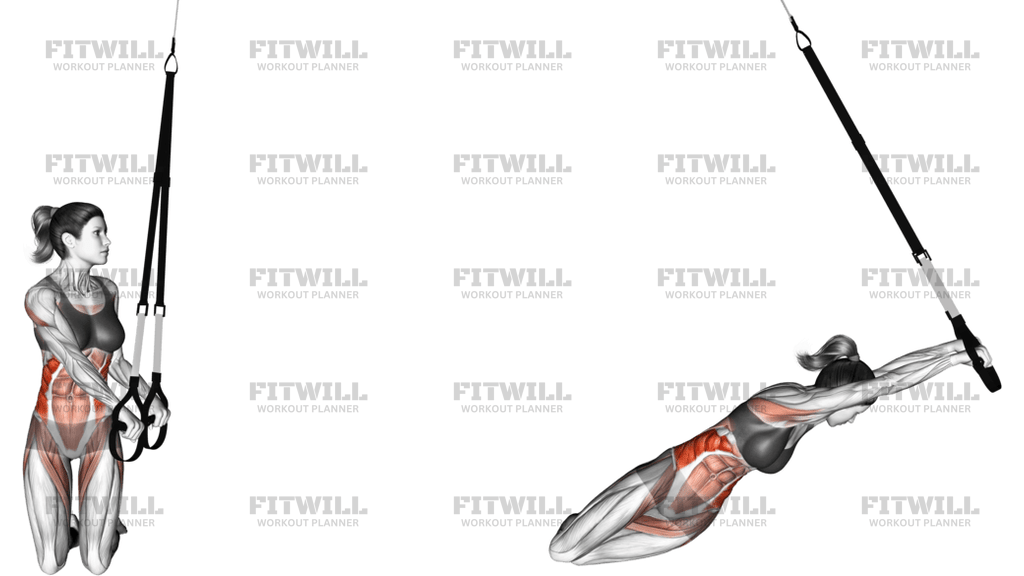
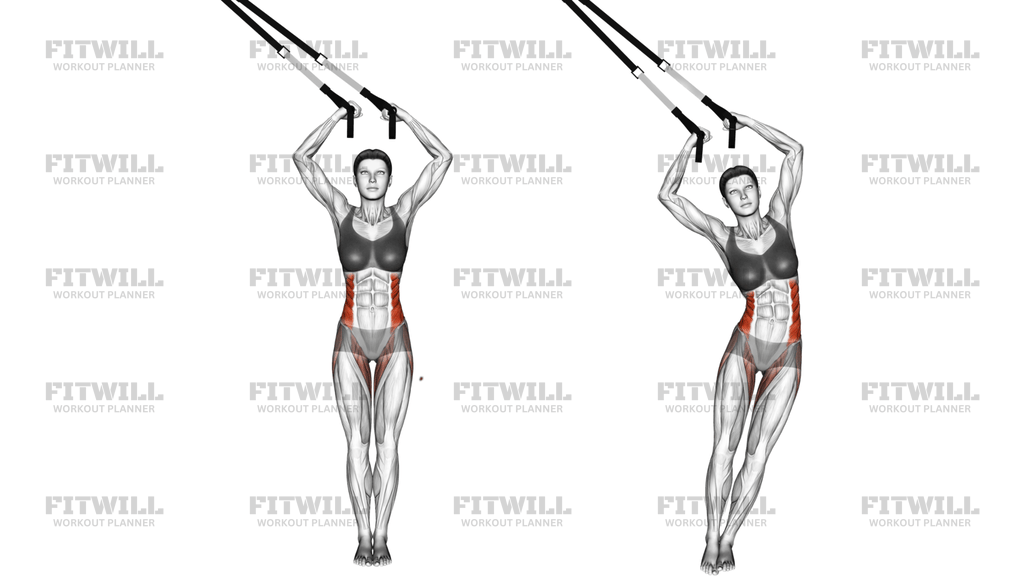
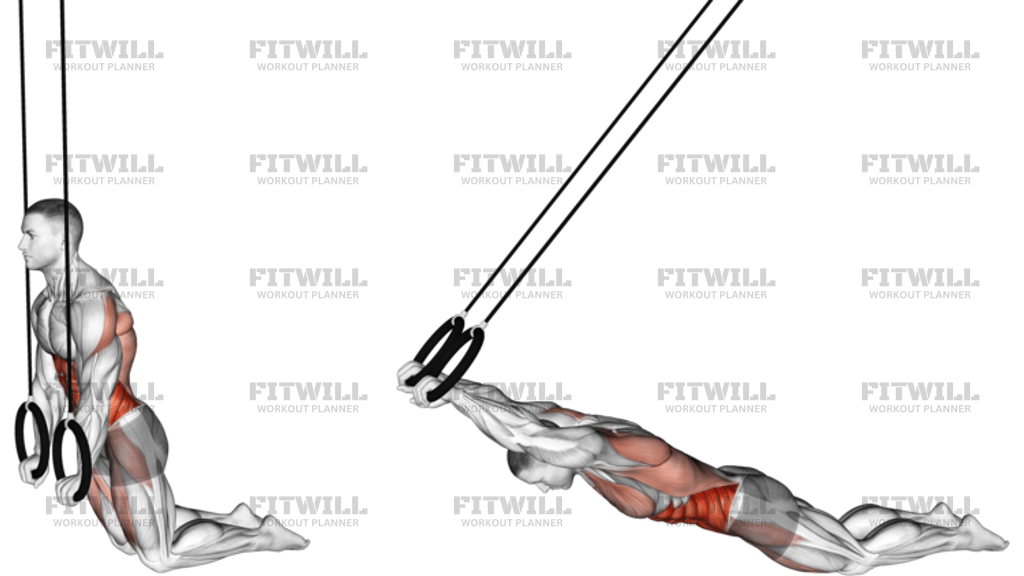
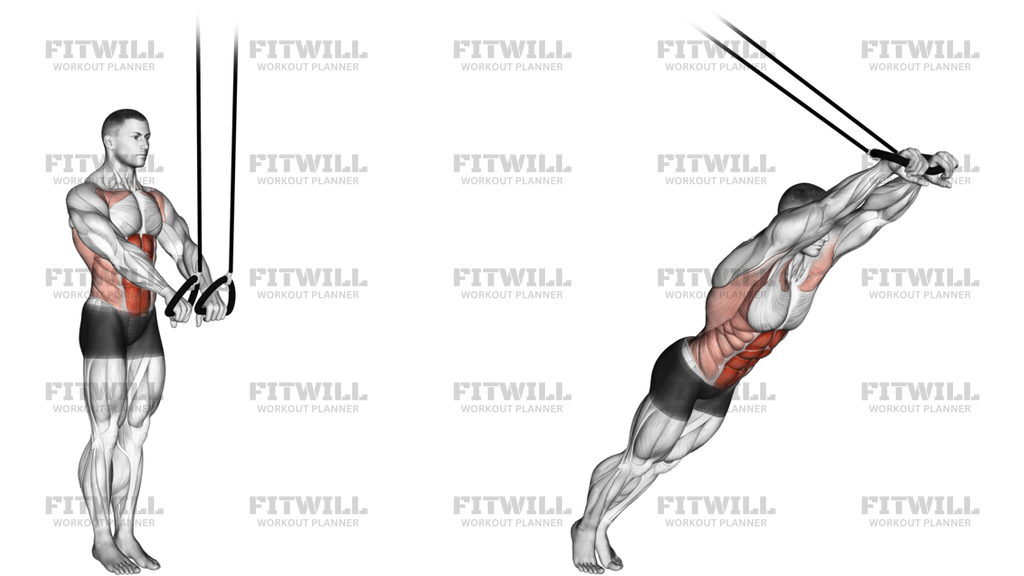
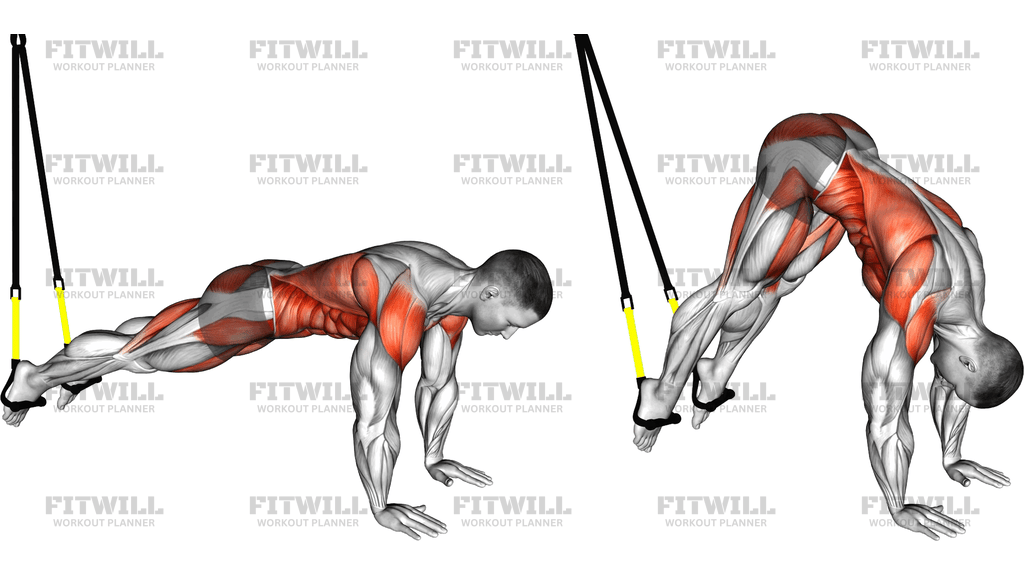
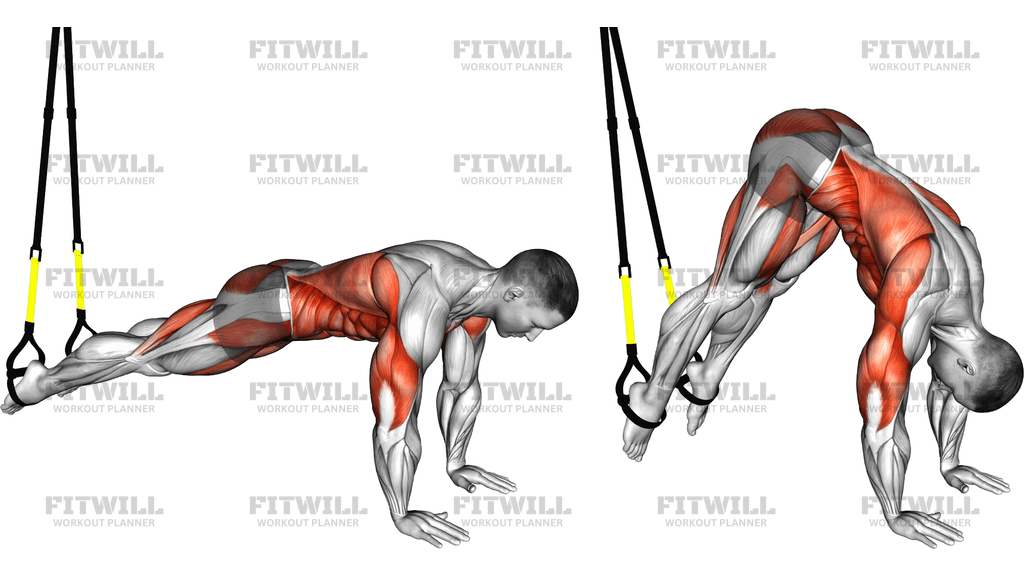
Suspender Prone Ts
The Suspender Prone T is a suspension trainer movement that combines a plank hold with a wide, controlled lower-and-lift pattern. You begin in a prone plank position gripping the suspension handles directly beneath your shoulders, then lower your chest toward the floor while letting your arms travel out wide to the sides until your body forms a T shape. From that stretched position, you press and pull yourself back up to the plank. The straps are unstable and the leverage changes continuously, so your trunk has to work the entire time.
This exercise earns its place in a program because it challenges two things at once: anti-extension core strength and scapular control. As your arms spread wide, the straps pull you toward the floor and your chest, shoulders, and upper back must actively control the descent, while your abs, glutes, and lower back keep your spine from sagging or arching. The finish of the lift, when you drive back to the plank, loads the chest, front shoulders, and triceps much like a very unstable push-up.
It suits intermediate trainees who already own a solid floor plank and a few sets of push-ups. It is popular in suspension training circuits, warm-ups for pressing days, and as a finishing movement for the trunk, because a moderate number of reps produces a large amount of total-body tension without heavy external load.
Setup details matter more here than in most floor exercises. The straps should hang at roughly mid-length, the anchors directly above or slightly behind your hands, and the handles should sit at a height that lets you reach the floor with your chest while your arms stay under control. If the straps are too long, the movement becomes a fight against collapse; too short, and you cannot reach the wide T position without shrugging.
Execute it by bracing before you move: squeeze your glutes, tuck your ribs slightly, and keep your head neutral so your neck stays in line with your spine. Lower over two to three seconds, exhaling as you descend, let the arms open only as far as your shoulders stay comfortable, then drive through the handles to return. If your hips drop or your lower back starts to arch during the set, shorten the range or elevate the handles rather than pushing through sloppy reps.
[ Workout Log & Planner ]
Put your next workout in Fitwill
Keep your plan and training log ready when you are.


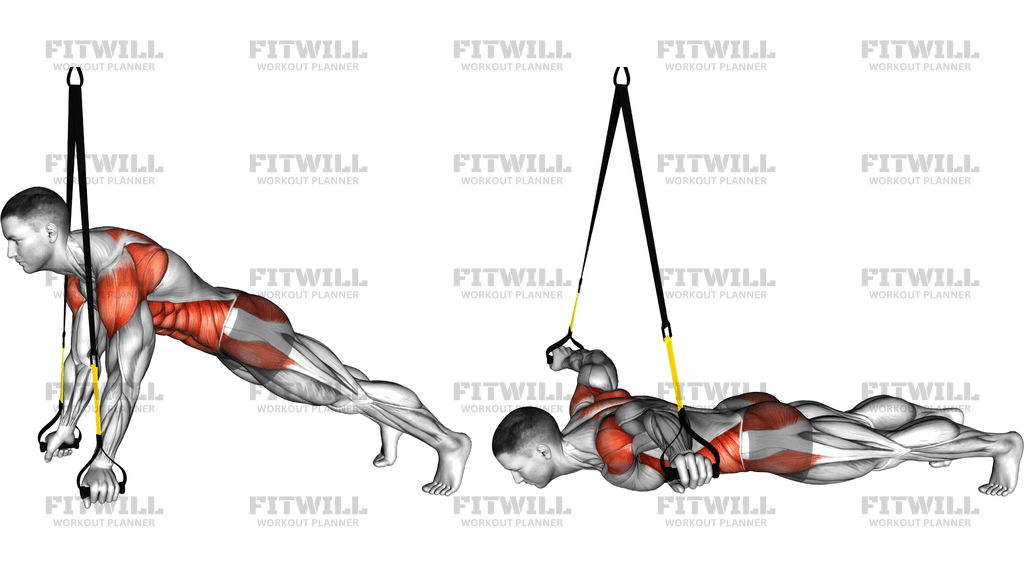
Instructions
- Set the suspension straps to about mid-length and anchor them overhead so the handles hang freely.
- Grip a handle in each hand and walk your feet back until your body forms a straight plank line, hands under your shoulders and arms nearly straight.
- Set your feet about hip-width apart with toes tucked under, and brace your abs and glutes before any movement begins.
- Keeping your elbows slightly soft, lower your chest toward the floor and let your arms spread out to the sides into a wide T position.
- Descend over two to three seconds, stopping when your chest approaches the floor or when you feel you can no longer control the straps.
- Pause briefly in the T position with your shoulder blades engaged, avoiding a shrug toward your ears.
- Press through the handles and pull them back under your shoulders to return to the plank, exhaling as you drive up.
- Breathe in during the lowering phase and out on the way back to the start.
- Reset your brace at the top of each rep, and end the set as soon as your hips sag or your form changes.
Tips & Tricks
- The most common failure is the hips dropping as the arms widen, which shifts the load to the lower back. Cue yourself to keep the ribs down and glutes squeezed before lowering even one inch.
- If your shoulders shrug in the T position, the straps are likely set too long. Shorten them so the descent stays under muscular control instead of strap slack.
- Do not turn the return into a straight-arm pull. Bend the elbows slightly and think of pressing the floor away, which keeps the chest and shoulders doing the work.
- Widen the T only as far as you can keep the handles taut. Letting the straps go slack mid-rep means you have passed your controllable range.
- Keep your neck long and eyes slightly ahead of your hands rather than craning up; the head should follow the spine the whole way down and up.
- Walk your feet closer to the anchor point to make the set easier, or further back for more challenge, adjusting difficulty with foot position rather than form.
- If your wrists ache gripping the handles, hold them more through the palm with a firm wrap rather than letting the fingers carry the load loosely.
- Warm up the shoulders with a few slow push-ups or band pull-aparts first, since cold shoulders tend to compensate here by shrugging.
- Film one set from the side: if your hip line dips noticeably at the bottom compared with the top, reduce the range or reps next time.
Frequently Asked Questions
What muscles does the Suspender Prone T work?
It primarily trains the core, especially the deep trunk muscles that resist extension, while the chest, front shoulders, and upper back handle the lowering and pressing. The glutes and lower back work isometrically to hold the plank line.
Is the Suspender Prone T suitable for beginners?
It can be, if the straps are set short and the feet are walked close to the anchor to reduce leverage. Beginners should first show they can hold a stable floor plank and several push-ups before adding the unstable strap element.
How high should I set the suspension straps for the Suspender Prone T?
Set them around mid-length so your hands rest under your shoulders in the plank and your chest can approach the floor with control. If you cannot slow the descent or your shoulders shrug, shorten the straps.
Why do my lower back and hips feel the Suspender Prone T so much?
The straps pull you toward the floor as the arms widen, so your trunk has to fight extension the entire rep. That is intended, but if you feel straining rather than bracing, shorten the range or reduce the strap length.
How wide should my arms go in the T position?
Open only to the width where both straps stay taut and your shoulders remain comfortable, usually forming roughly a T with your torso. Going wider than that usually causes the handles to go slack or the shoulders to collapse.
What can I substitute if I do not have a suspension trainer?
Slow push-up negatives with a wide hand position, prone T raises on a bench with light weight, and plank shoulder taps cover similar ground, though none reproduce the unstable strap pull exactly.
Should my elbows be locked out during the Suspender Prone T?
No. Keep a slight bend in the elbows throughout so the tension stays on the chest, shoulders, and trunk instead of hanging on the joints, especially at the wide bottom position.
How many reps and sets should I do?
Two to four sets of six to twelve controlled reps works well, since quality of the lowering phase matters more than volume. Stop the set when your hip line or control breaks down.
Is it safe for my shoulders?
Generally yes when the range is controlled and the straps stay taut, but if you have a history of shoulder instability, keep the T position shallow and stop any rep that produces pinching at the front of the shoulder.
Where should the Suspender Prone T go in my workout?
It fits well early in a session as trunk and shoulder preparation, or at the end as a finishing movement for the core after heavier pressing or pulling work.