Side Crow Yoga Pose
The Side Crow Yoga Pose, known in traditional yoga as Parsva Bakasana, is an arm balance that combines a deep twist with full weight-bearing on the hands. You start in a low squat with both hands planted on the floor, then rotate your knees to one side so they stack on the back of the opposite upper arm. From there you shift your weight forward over your hands, lift both feet off the floor, and balance on straight or slightly bent arms with your hips twisted to the side.
This pose rewards people who already feel comfortable in a basic crow pose. The added rotation changes the balance point and demands more from the obliques, which have to hold the ribcage and hips facing sideways while the shoulders carry the load. It is a common stepping stone toward more advanced twisted arm balances and is often used in vinyasa and power yoga sequences as a peak pose.
The main areas working here are the shoulders, triceps, and forearms, which support your entire bodyweight, along with the obliques and deep core, which control the twist and keep the knees from sliding off the arm. The hip flexors also stay active to hold the knees tucked toward the torso. Because the wrists take the full load at an angle, wrist strength and mobility matter just as much as core strength.
Setup makes or breaks this pose. The hand placement and the exact spot where the knees rest on the upper arm determine whether you balance smoothly or fall out instantly. Knees should sit as high up the back of the arm as possible, close to the armpit, with the elbows stacked over the wrists and the fingers spread wide to distribute pressure. Keeping the gaze slightly forward rather than straight down also helps you hold the balance longer.
People typically practice Side Crow on a mat with a blanket or cushion nearby, especially when learning, because tipping over sideways is common at first. Expect to build the pose in stages: first getting the knees hooked on the arm, then lifting one foot, then both. Practicing it two to three times a week within a yoga or mobility session is plenty, and it works well after warming up the wrists, shoulders, and hips.
[ Workout Log & Planner ]
Put your next workout in Fitwill
Keep your plan and training log ready when you are.


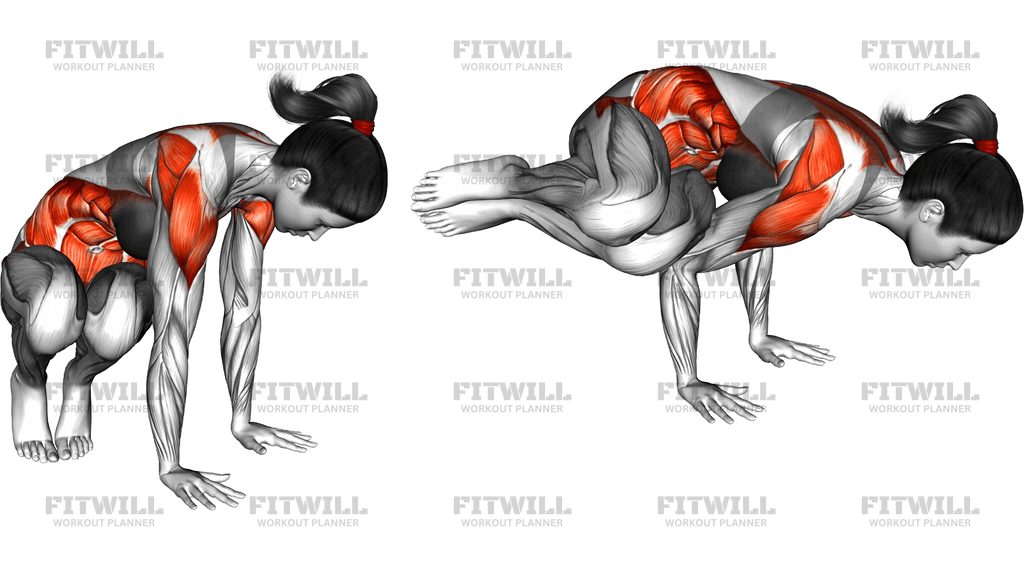
Instructions
- Start in a low squat with your feet about hip-width apart on an exercise mat and place both palms flat on the floor in front of you, fingers spread wide and shoulders stacked directly over the wrists.
- Rotate your torso to the right and walk both knees toward your left upper arm so the outside of your left knee and thigh stack against the back of the right upper arm, letting your toes stay lightly on the floor.
- Squeeze your knees and arm together and bend your elbows slightly to create a shelf, keeping the elbows tracking over the wrists rather than flaring outward.
- Brace your core and twist deeper, pulling your belly toward your spine so your ribcage and hips stay rotated to the side instead of squaring forward.
- Lean your weight forward over your hands and lift both feet off the floor at the same time, keeping the knees hooked firmly on the back of the arm.
- Reach the end position with your entire bodyweight balanced on your hands, feet drawn up beside or behind your hips, arms straight or only slightly bent, and your gaze a few inches ahead of your fingertips.
- Hold for one to five breaths, breathing steadily through the nose while continuing to press the floor away with your palms.
- To come out, shift your weight slightly back, lower your toes to the mat with control, and lift the knees off the arm rather than collapsing down.
- Reset by returning to the low squat, taking a breath, and repeating the same steps on the opposite side.
- Practice five to eight balanced attempts per side per session, resting between attempts so wrist and shoulder fatigue does not erode your technique.
Tips & Tricks
- Hook the knees higher up the arm than feels natural. Most people rest them near the elbow, which makes the knees slip off as soon as the feet leave the floor; the shelf near the armpit is far more stable.
- If your knees slide off the arm, the problem is usually squeeze, not strength. Press the outside knee firmly into the arm and the arm back into the knee to create friction before you lean forward.
- Look at a spot on the floor about a foot in front of your hands. Staring straight down shortens the counterbalance you need and often sends you tipping back instead of lifting.
- Bend the elbows slightly when learning, but keep them over the wrists. Elbows collapsing inward toward each other under load is the most common wrist and shoulder strain pattern in this pose.
- Place a folded blanket or cushion in front of your face on the mat. Knowing a soft landing exists makes it much easier to commit your weight forward, which is exactly what the pose requires.
- If lifting both feet at once is too jumpy, lift one foot first, re-settle, then bring up the second. The transition gets smoother within a few sessions.
- Warm up your wrists before practicing: a minute or two of wrist circles, gentle stretches, and a few basic crow poses prepares them for the angled load of the twist.
- Keep the hips twisted with the lower knee slightly ahead of the upper one. When the hips square forward mid-hold, the balance point shifts and the pose falls apart toward the heavy side.
- Avoid jumping into the balance with cold shoulders or trying it after heavy pressing work, when tired elbows tend to buckle under the forward lean.
Frequently Asked Questions
Which muscles does the Side Crow Yoga Pose work the most?
The shoulders, triceps, and forearms carry your bodyweight while the obliques and deep core control the twist and hold the knees against the arm. The hip flexors stay active to keep the legs tucked once the feet lift.
Do I need to master regular Crow Pose before trying the Side Crow Yoga Pose?
It is strongly recommended. Side Crow uses the same forward weight shift but adds a rotation and a single-arm shelf, which makes the balance point trickier. Being able to hold basic crow for several breaths makes the progression much safer.
Where exactly should my knees rest on my arm in the Side Crow Yoga Pose?
The outside of one knee and thigh should stack against the back of the opposite upper arm, as high toward the armpit as you can manage. Resting them near the elbow is the most common reason the knees slip off during the lift.
My wrists hurt when I practice this pose. What can I change?
Spread your fingers wide, grip the mat with your fingertips, and keep your weight distributed across the whole palm instead of dumping it into the heel of the hand. You can also practice with a folded towel under the heels of your hands or reduce your hold time while wrist strength catches up.
How long should I hold the Side Crow Yoga Pose?
One to five calm breaths is a solid target. Quality matters more than duration, and short, clean holds with a controlled exit build the balance skills faster than straining through long, wobbly ones.
Can beginners practice the Side Crow Yoga Pose safely?
Cautiously, yes, with a cushion in front of the face and the option to keep one toe on the floor while learning. Anyone with wrist, elbow, or shoulder injuries should work on gentler twisted poses and build arm-balance foundations first.
What is a good substitution if I cannot lift both feet yet?
Practice the setup with both toes lightly touching the floor and just lean most of your weight into the arm shelf, or work on regular Crow Pose to build the forward-shift habit. Lifting one foot at a time is another useful intermediate step.
Why do I keep falling over sideways in the Side Crow Yoga Pose?
Falling sideways usually means the hips have squared forward or the knees have lost their grip on the arm. Deepen the twist before lifting, keep the lower knee slightly in front of the upper one, and move your weight slowly forward rather than in one sudden shift.
Should my arms be straight or bent in this pose?
Straight arms are the traditional end position and rely more on core control, while slightly bent elbows make the shelf for your knees more secure. Many practitioners hold the balance with a small bend and only straighten once the knees are stable.
How often should I practice the Side Crow Yoga Pose?
Two to three short sessions per week is enough, ideally with your wrists and shoulders warmed up first. Treat it as a skill drill at the start of a yoga or mobility session rather than something to grind out at the end when you are fatigued.