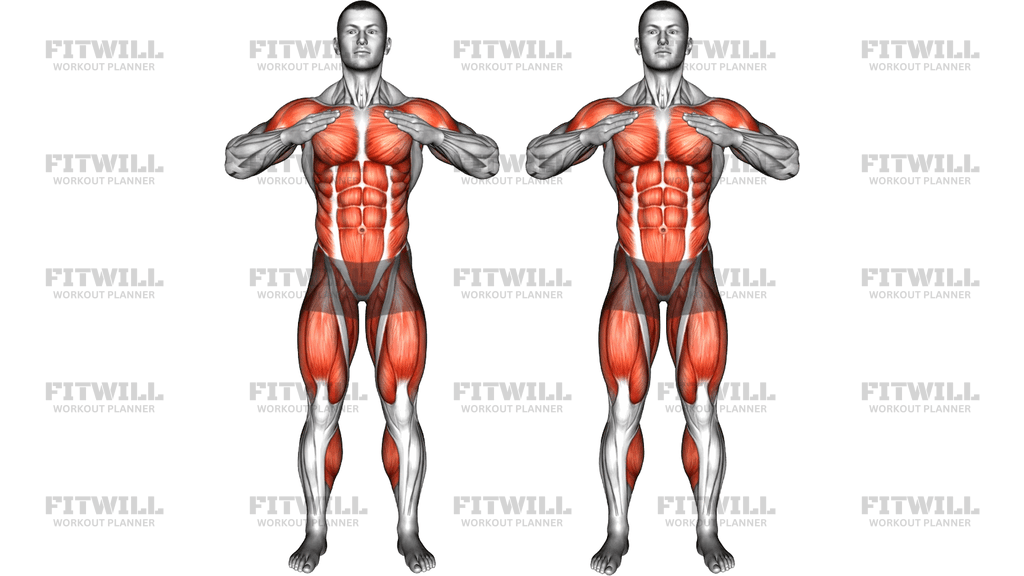
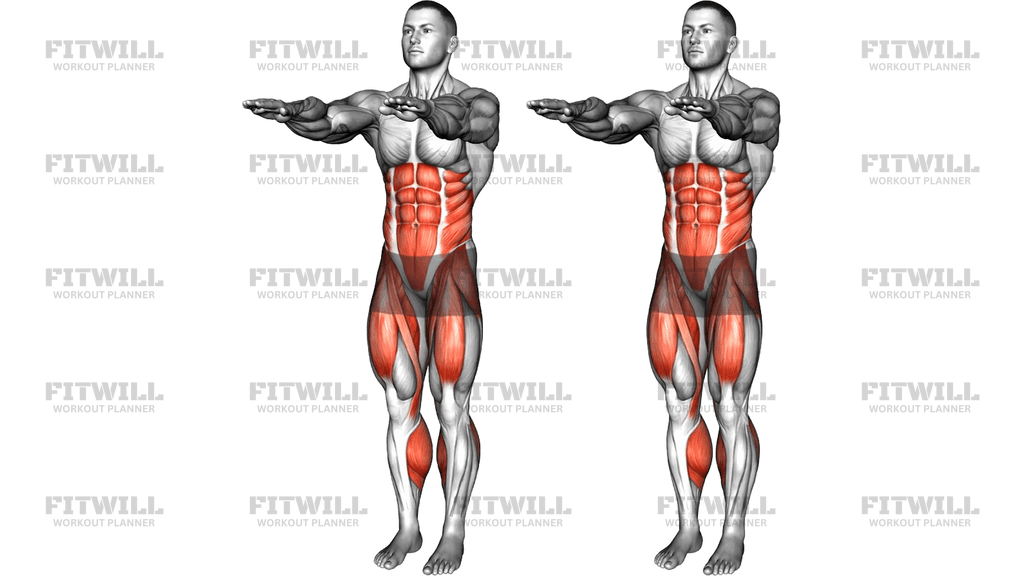
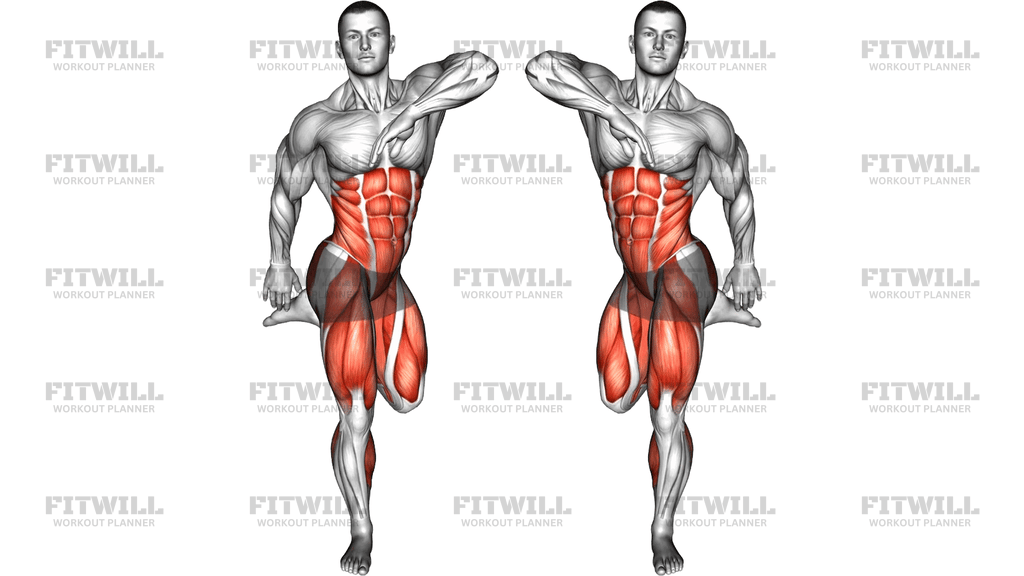
Squat Twist
The Squat Twist combines a bodyweight squat with a rotational reach, so you train your legs and your trunk in the same rep. You stand with your feet roughly shoulder-width apart and your hands behind your head, sink into a full squat, and as you rise you rotate your torso so one elbow travels toward the opposite knee. The next rep rotates to the other side, which keeps the movement balanced and prevents one side of your trunk from doing all the work.
This movement is useful for anyone who wants more than a plain squat. Because your torso rotates under load from your own body weight, the obliques and deep core muscles have to control the twist while your quads and glutes drive you back up to standing. That combination makes it a solid choice for warm-ups, circuit training, and general conditioning work where you want the trunk and legs working together instead of in isolation.
Setup matters more than it looks. Your hands sit lightly behind your head with the elbows flared wide, which means your arms are not pulling on your neck and your chest stays open. If your stance is too narrow, the rotation at the top tends to pull your knee inward; if it is too wide, the squat itself gets shallow. A comfortable shoulder-width stance with the toes turned out slightly gives you room to squat deep and rotate freely.
Execution comes down to separating the two phases. Descend straight down into the squat with your chest tall, then start the rotation as you drive up, letting the elbow and opposite knee meet near the top of the rep rather than twisting on the way down. Twisting at the bottom with a rounded back is where most people lose form, so keep the rotation for the standing phase.
You will see the Squat Twist used in group classes, home workouts, and athletic warm-ups because it needs no equipment and little space. It also works well as a core finisher after a leg session. Move at a controlled pace, alternate sides each rep, and stop before your squat depth collapses from fatigue.
[ Workout Log & Planner ]
Put your next workout in Fitwill
Keep your plan and training log ready when you are.


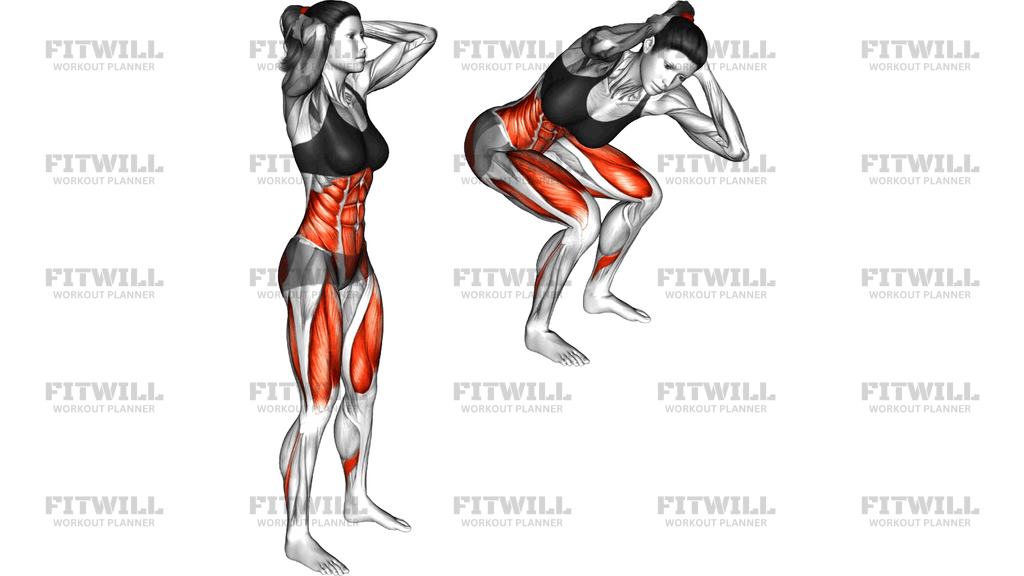
Instructions
- Stand with your feet about shoulder-width apart, toes turned out slightly, and your weight spread across your whole foot.
- Place both hands lightly behind your head with your elbows flared out to the sides; do not interlock your fingers or pull on your neck.
- Brace your core as if bracing for a light push, keep your chest tall, and look straight ahead.
- Push your hips back and bend your knees to lower into a full squat, keeping your heels down and your knees tracking over your toes.
- Drive through your heels to stand back up, and as you rise, rotate your torso to bring your right elbow across toward your left knee.
- Squeeze the rotation briefly at the top while your torso stays upright and your hips stay facing forward as much as possible.
- Untwist back to center, then immediately lower into the next squat and rotate the opposite elbow toward the other knee.
- Exhale as you stand and rotate; inhale as you lower into each squat.
- Continue alternating sides for your target number of reps, keeping the squat depth consistent from first rep to last.
- To reset between sets, stand tall, let your arms down, and shake out your legs before starting again.
Tips & Tricks
- The most common mistake is pulling on the back of your head with your hands, which drags your chin down and rounds your upper back. Keep your hands as light contact only and let your elbows do the pointing.
- If your elbow keeps missing the knee, the problem is usually a shallow squat rather than poor flexibility. Sink lower first, because the rotation naturally becomes easier when the knee travels higher.
- Do not let the rotation start while you are still descending. Twisting at the bottom puts your spine under combined flexion and rotation when it is least supported.
- Watch your knees during the twist. If the squat knee caves inward as your torso turns, narrow your attention to pressing that knee out over your little toe.
- Keep your heels glued to the floor. Rising onto the toes during the rotation usually means the squat was too deep for your current ankle mobility, so reduce depth a little instead.
- Alternate sides every rep rather than doing all reps on one side. This keeps the workload even and makes counting simpler.
- Slow the standing phase down instead of rushing it. The rotation is where the obliques work, and snapping through it turns the exercise into a momentum drill.
- If your lower back complains, check whether your ribs are flaring as you twist. Keep your trunk long and rotate from the waist without leaning backward.
Frequently Asked Questions
Which muscles does the Squat Twist work?
The main movers are the quads and glutes during the squat, while the obliques and deep core muscles handle the rotation at the top. The abs also work hard to keep your trunk stable as you rise and turn.
Is the Squat Twist suitable for beginners?
Yes, as long as you can already perform a comfortable bodyweight squat. Beginners can reduce the depth and rotate less aggressively until the pattern feels natural.
Should my hands pull on my head during the Squat Twist?
No. Your hands rest lightly behind your head purely for position, and your elbows stay flared wide. Pulling on your neck rounds your upper back and reduces the rotation range.
Why do I rotate at the top of the squat instead of the bottom?
Rotating while standing keeps your spine in a tall, supported position and lets the elbow and knee meet cleanly. Twisting at the bottom, when your torso is inclined, increases strain on the lower back.
How deep should I squat in the Squat Twist?
Aim for a depth where your thighs are at or near parallel while your heels stay flat and your chest stays upright. If depth forces your heels up or your back to round, squat slightly higher and build up over time.
What can I use instead of the Squat Twist if squats bother my knees?
Standing torso rotations with a partial hip hinge, or standing knee-to-elbow crunches without the squat, train a similar rotational pattern with much less knee flexion.
How many reps of the Squat Twist should I do?
Ten to twenty alternating reps per set works well for warm-ups and circuits. Because it is bodyweight only, higher rep ranges are common, but stop once your squat depth or rotation quality drops.
Can I hold a weight while doing the Squat Twist?
The hands-behind-head position is part of the standard setup, and adding load behind the head makes neck and upper back strain more likely. If you want more challenge, add reps or slow the rotation rather than adding weight.
My lower back feels the Squat Twist more than my abs. What should I change?
You are likely leaning back or over-rotating at the top. Shorten the rotation so the elbow only travels partway to the knee, and keep your ribs stacked over your hips throughout.