Side Step Crossover Arms
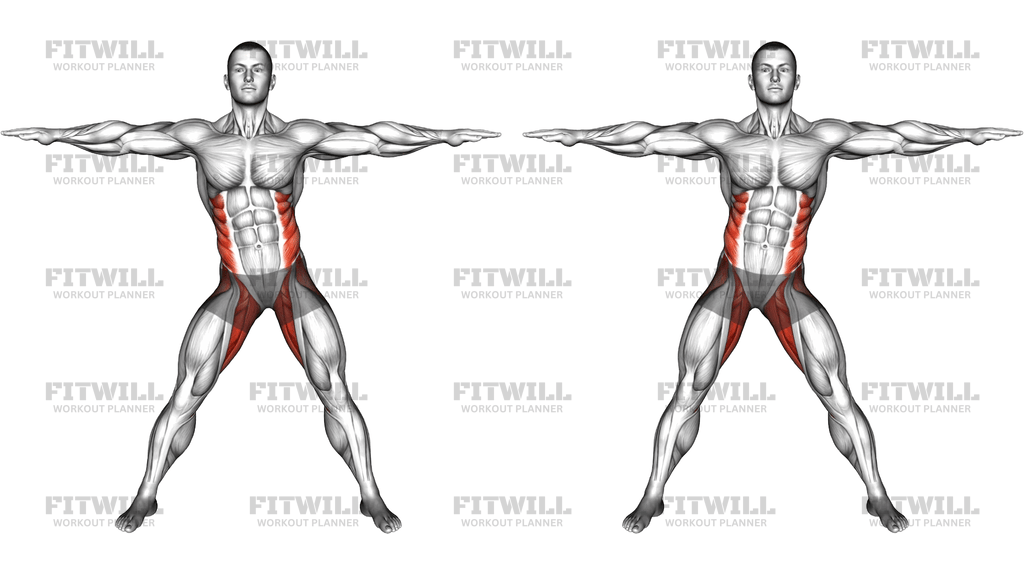
Side Step Crossover Arms is a standing, body weight movement that combines a rhythmic side-to-side foot pattern with sweeping arm crossovers at chest height. You begin in a wide stance with both arms lifted straight out to your sides at shoulder height, then step one foot toward the other while bringing your arms across the front of your chest, and step back out to the wide position as the arms return to the T. The result is a flowing, full-body pattern that keeps your lower body and upper body moving in coordination.
The footwork targets the inner thighs and hips, since every step out and back in forces the adductors to control the legs through a wide range. The outer hip muscles work to stabilize your pelvis each time you shift your weight onto one leg, and the constant lateral weight transfer quietly challenges your obliques and deep core. Holding the arms at shoulder height and crossing them trains the chest and shoulders in a sustained, endurance-style effort rather than a heavy strength effort.
Setup matters more than it looks. A genuinely wide stance gives the adductors something to do and creates room for the side step; a narrow stance turns the movement into a shallow shuffle with very little hip involvement. The arms should be genuinely straight and level with the shoulders, not drooping toward the floor, because the crossover only stretches and works the chest effectively when the arms travel through a true horizontal arc.
To execute it well, stay light on your feet and let the arms and legs work as one unit: feet in, arms crossed; feet out, arms open. Keep your torso upright and your gaze forward, and avoid letting your shoulders creep up toward your ears as the arms sweep. Breathe steadily throughout instead of holding your breath during the crossover.
This exercise fits well into warm-ups, general conditioning circuits, active recovery days, and home workouts where no equipment is available. Because it raises the heart rate while mobilizing the hips and shoulders, many coaches use it as a bridge between a static warm-up and more demanding lateral work. It is also a sensible choice for beginners learning to coordinate upper and lower body movement before progressing to jumping jacks, cross-country skiers, or loaded lateral drills.
From a safety standpoint, keep the stepping foot landing flat and controlled rather than slapping down, and reduce the width of the stance if you feel any pinching in the groin or hips. The movement should feel rhythmic and sustainable; if your shoulders burn before your legs do, lower the arms slightly or slow the tempo until your form holds up.
[ Workout Log & Planner ]
Put your next workout in Fitwill
Keep your plan and training log ready when you are.


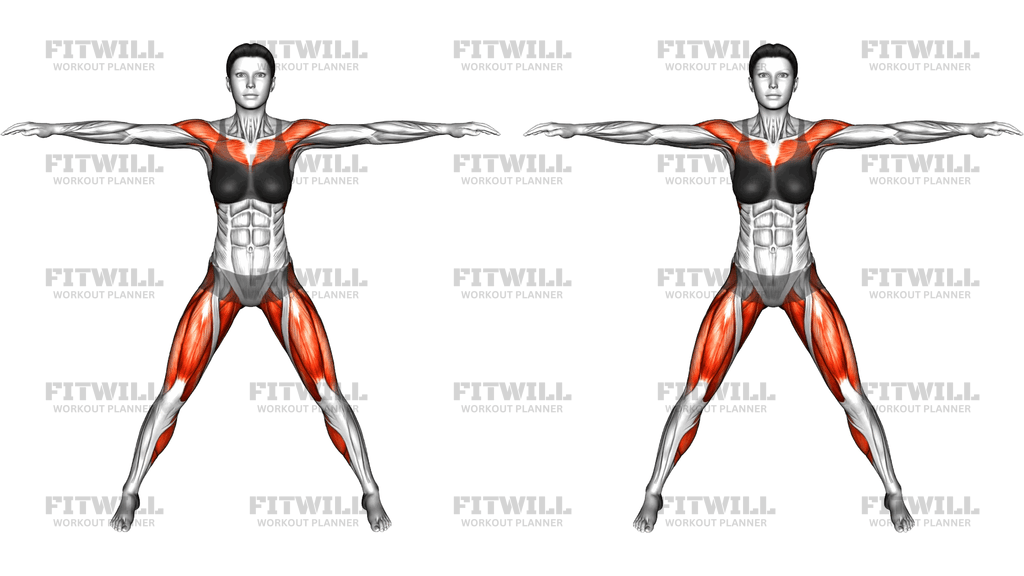
Instructions
- Stand with your feet in a wide stance, roughly two to three shoulder-widths apart, toes turned out slightly and weight distributed evenly across both feet.
- Raise both arms straight out to your sides until they are level with your shoulders, palms facing down, forming a T shape with your torso.
- Draw your shoulder blades down slightly so your neck stays long, and brace your core as if preparing for a gentle push from the side.
- Shift your weight toward one leg and step the other foot inward toward the center of your stance, keeping the knee of the moving leg soft.
- As the foot steps in, sweep both straight arms across the front of your chest so they cross over one another at chest height.
- Step the same foot back out to the wide starting stance while opening the arms back out to the T position at shoulder height.
- Repeat on the opposite leg, alternating sides each rep so the crossover switches which arm is on top.
- Breathe in a steady rhythm throughout, exhaling as the arms cross and inhaling as they open, and avoid holding your breath.
- Continue alternating for your target time or rep count, keeping the pace smooth and the landing of each step quiet and controlled.
- To finish, bring your feet together slowly, lower your arms to your sides, and take a few relaxed breaths before your next exercise.
Tips & Tricks
- The most common fault is letting the arms sink below shoulder height as they cross, which removes the chest involvement; if your shoulders fatigue, shorten the set rather than dropping the arms.
- Keep the crossover happening in front of the chest, not at the face or waist; if your hands pass at neck height, your shoulders have crept upward and you should consciously relax the upper traps.
- A shallow side step is the second most common mistake. If your knees barely move, your stance is too narrow, so widen it until you feel the inner thighs working on each step out.
- Land with the whole foot contacting the floor instead of letting the inside edge of the foot collapse, which helps protect the arches during repeated lateral steps.
- Alternate which arm crosses on top each rep by switching sides consistently, otherwise one side of the chest and shoulders does more work over a set.
- Stay upright; if you find yourself leaning forward over the crossing arms, reset your posture and imagine a string lifting the crown of your head.
- Slow the tempo down if your feet and arms fall out of sync. Coordination fails before conditioning in this movement, and a slower rhythm rebuilds it.
- If stepping in causes a pinching feeling in the groin, reduce the width of the stance or step in only halfway rather than forcing the full range.
- On a slippery floor, wear athletic shoes with grip and keep your steps modest; the wide stance makes sudden lateral slips more likely than in narrow-stance moves.
Frequently Asked Questions
What muscles does the Side Step Crossover Arms work?
The primary work comes from the adductors on the inner thighs and the hip stabilizers as you step in and out of the wide stance. The chest and middle shoulders support the arms through the crossover, and the obliques help control the repeated side-to-side weight shift.
Is the Side Step Crossover Arms suitable for beginners?
Yes. It requires no equipment and the intensity is easily scaled by narrowing the stance or slowing the tempo. Beginners should master the foot-arm rhythm at a slow pace before increasing speed or duration.
How wide should my stance be at the start?
Aim for roughly two to three shoulder-widths so that stepping one foot inward still leaves room for a meaningful return step. If you feel strain in the groin at the wide position, reduce the width slightly.
Should the arms cross in front of the chest or stay open the whole time?
They cross in front of the chest each time a foot steps in and open back to the T position as the foot steps out. Keeping the arms straight and at shoulder height is what makes the crossover effective for the chest and shoulders.
Why do my shoulders burn before my legs during Side Step Crossover Arms?
Holding the arms at shoulder height for continuous reps is endurance work for the delts, and untrained shoulders fatigue first. Lower the arms slightly between sets, shorten the set duration, or build up gradually over a few weeks.
Can I use the Side Step Crossover Arms in a warm-up?
Yes, it works very well as a warm-up because it raises the heart rate while taking the hips and shoulders through lateral ranges of motion. Use a slow to moderate tempo for 30 to 60 seconds before more demanding training.
What can I substitute if stepping side to side bothers my hips or knees?
Try a narrower stance with shorter steps, or perform the arm crossovers while marching in place to keep the upper body pattern without the wide lateral base. Both options preserve the coordination demand with less hip travel.
How many reps or how long should I perform this exercise?
For conditioning or warm-up use, 30 to 60 seconds of continuous alternating steps is typical. For a rep-based approach, 10 to 20 alternating side steps per set works well, adjusting for your fitness level.
Is it a problem if one arm always ends up on top during the crossover?
Yes, that usually means you are stepping to the same side repeatedly instead of alternating. Consciously switch the leading leg every rep so the crossover alternates and both sides of the chest and shoulders share the work.