Cable Split Stance Single Arm Row
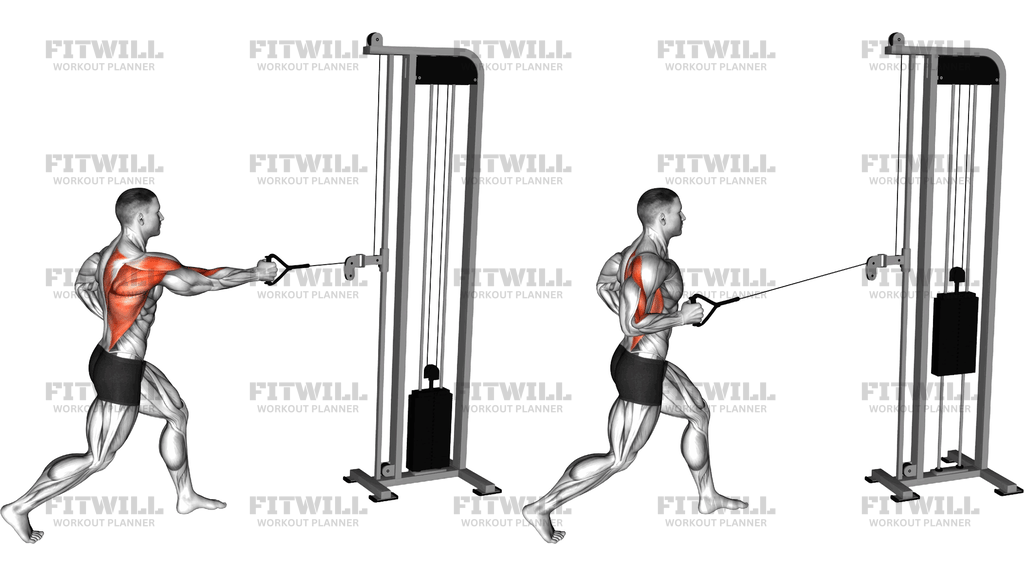
The Cable Split Stance Single Arm Row is a standing one-arm row performed with a single handle attached to a cable pulley set around mid-torso height. You stand facing the machine in a staggered split stance, brace your torso, and pull the handle from a fully extended arm position back to your lower ribs. Because you are on your feet rather than seated or chest-supported, the movement trains your upper back while also challenging the hips, glutes, and trunk to hold a stable position against the pull of the cable.
This exercise suits a wide range of lifters. Beginners can use it to learn scapular retraction and lat engagement with light, adjustable resistance, while more experienced trainees use it to address left-to-right strength differences that stay hidden on two-arm rows. Runners and field-sport athletes also benefit from the split stance, since it mirrors the contralateral hip and arm positions of sprinting and changing direction.
The primary work comes from the lats, which drive the upper arm down and back toward the torso. The rhomboids and middle traps pull the shoulder blade in toward the spine, the rear shoulder assists at the end range, and the biceps contribute as the elbow bends. Meanwhile, the front leg's glute and the deep core work isometrically to stop your pelvis from rotating toward the handle.
The split stance is what separates this from an ordinary standing row. Placing one foot forward and one back narrows your base, which forces the hips and obliques to resist rotation as the cable pulls you forward and toward the machine. Getting this setup right matters: a stance that is too narrow turns the exercise into a balance test, while one that is too wide removes the anti-rotation demand almost entirely.
Execution should stay clean and deliberate. Keep the torso tall with only a slight forward lean from the ankles, let the shoulder blade travel forward with the arm on the way out, and pull the handle to the same-side hip without shrugging or twisting the trunk. Pause briefly at the hip, then let the arm extend under control until the shoulder blade slides forward again before starting the next rep.
Practically, this movement fits well as a secondary pulling exercise on upper body days, as a core-integrated back exercise in minimal-equipment or hotel gym sessions, or as a rehab-friendly rowing option because the cable's line of pull can be adjusted to suit shoulder comfort. Keep the load moderate, prioritize a full stretch at the start of each rep, and switch sides evenly so both halves of your back receive the same volume.
[ Workout Log & Planner ]
Put your next workout in Fitwill
Keep your plan and training log ready when you are.


Instructions
- Attach a single handle to the pulley of a cable machine and set the pulley to roughly chest or mid-torso height.
- Select your weight, then stand facing the machine and take a split stance: the leg on the same side as your working arm steps back, with your front knee soft and your rear heel able to stay low or lift slightly.
- Grip the handle with one hand using a neutral palm-inward grip and walk back far enough that the weight stack lifts off and the cable stays taut with your arm fully extended.
- Set your posture tall, ribs down, and brace your abs as if about to take a light punch; keep your hips square to the machine rather than opened outward.
- Pull the handle back toward your lower ribs by driving your elbow past your side, letting the shoulder blade squeeze toward your spine at the end of the pull.
- Hold the handle at your hip for a one-count, keeping your shoulders level and your torso from twisting toward the working arm.
- Slowly extend your arm back toward the machine until the elbow is straight and the shoulder blade has protracted forward around the ribcage.
- Exhale as you pull the handle in and inhale as your arm returns to the extended position.
- Complete all reps on one side, then re-brace and perform the same number on the other arm before resting.
- Between sets, release the handle with control so the stack does not slam, and reset your stance identically each time.
Tips & Tricks
- A common mistake is turning this into an arm exercise: if your elbow flares out to the side, the biceps take over. Keep your elbow tracking close to your ribs so the lat does the pulling.
- Watch for hip rotation toward the handle as fatigue sets in. Pin your pelvis square to the machine, or drop the weight slightly rather than letting your torso wind up.
- Do not shrug the working shoulder at the top of the pull. If your upper trap starts doing the work, think of pulling with your elbow and lower shoulder instead.
- Cut the range short on the return and you lose half the benefit. Let the shoulder blade slide forward and feel a mild stretch across the back of the shoulder before each pull.
- If you wobble in the split stance, widen your stance front to back and press the big toe of your front foot into the floor for a more stable tripod.
- Avoid leaning back away from the machine to help the weight move. If your torso angle changes mid-set, that is a signal the load is too heavy.
- Match your stance to your working arm deliberately: pulling with the right arm while the right leg is back creates a strong anti-rotation demand through the obliques, which is a feature, not a flaw.
- Keep your front knee soft rather than locked. A slightly bent knee lets the glutes contribute to stability and eases pressure on the joint.
- Alternate which arm you start with each session so the weaker side always gets your freshest effort.
Frequently Asked Questions
What muscles does the Cable Split Stance Single Arm Row work?
The lats are the primary mover, with strong assistance from the rhomboids, middle traps, rear shoulders, and biceps. The split stance additionally recruits the glutes and obliques to keep your hips and trunk from rotating.
Why use a split stance instead of standing with feet parallel?
The staggered stance narrows your base side to side, which forces the hips and core to resist the cable's pull and prevents you from bracing with both legs evenly. It also mimics the hip and arm positions used in running and cutting movements.
Which leg should be forward during the Cable Split Stance Single Arm Row?
A common setup is to step back with the leg on the same side as your working arm, which maximizes the anti-rotation challenge. Either arrangement works, but keep it consistent and match volume on both sides.
Is this exercise suitable for beginners?
Yes, provided you start with light weight and focus on the setup. Beginners should master pulling the elbow to the hip without twisting or shrugging before adding load, since the standing position demands more coordination than a seated row.
Can I do the Cable Split Stance Single Arm Row if one side is weaker than the other?
That is exactly what single-arm rows are useful for. Always start with your weaker arm, and stop the stronger side at the same number of reps so the gap gradually closes.
What is the most common mistake with this movement?
Rotating the torso toward the handle to help finish the pull. Your hips should stay square to the machine throughout; if they drift, the weight is too heavy or your bracing needs work.
What can I substitute if my gym has no cable machine?
A single-arm dumbbell row with one hand braced on a bench trains the same lats and upper back, though it loses the constant cable tension and the anti-rotation demand of the split stance. A resistance band anchored at chest height can also work with the same standing setup.
How high should the pulley be set?
Mid-torso to chest height works best, so the cable pulls roughly level with your hand path as you draw the handle to your hip. Much higher turns it into a pulldown pattern, much lower shifts tension toward the lower traps.
Is it safe for my lower back?
When performed with a braced trunk, soft knees, and a moderate load, the standing position is generally comfortable because no load compresses the spine externally. Keep the weight controlled, avoid jerking the stack, and stop if you feel your low back rounding or twisting.
How many sets and reps should I use?
Two to four sets of 8 to 12 reps per arm covers most strength and hypertrophy goals. Because balance and anti-rotation are part of the challenge, favor controlled reps over heavy weights.