Standing Hand To Big Toe Yoga Pose Utthita Hasta P
The Standing Hand To Big Toe Yoga Pose Utthita Hasta P, known in traditional yoga as Utthita Hasta Padangusthasana, is a single-leg balance and hamstring stretch performed entirely with your body weight. From a tall standing position, you shift your weight onto one leg, draw the opposite knee up, and hook your fingers or first two fingers around the big toe. You then extend that leg forward while keeping your torso upright, holding the raised foot at roughly hip height with a straight working leg beneath you.
This pose is best known for the deep stretch it places on the hamstring and calf of the lifted leg, but the standing leg does just as much work. It has to stabilize the hip, knee, and ankle for the entire hold, while the core keeps your ribs stacked over your pelvis so you don't lean back or drift sideways. The result is a posture that trains balance, hip mobility, and hamstring flexibility at the same time, which is why it appears in so many standing yoga sequences.
Setup matters more than people expect. Your standing foot should be grounded with the toes spread and the weight spread evenly between the heel and the ball of the foot. If your base foot rolls to the outer edge or your hip juts sideways, the stretch on the lifted leg will be compromised and your balance will collapse quickly. A braced core and a level pelvis give the lifted leg something stable to move from.
To execute it well, lift one knee toward your chest and take hold of the big toe with the hand on the same side, using a secure hook grip with the index and middle fingers. From there, walk the leg forward toward extension only as far as your hamstring allows. Keep your shoulders relaxed and your chest open rather than rounding forward to chase the foot. If the leg won't straighten, a slightly bent knee with a tall spine is the better version of the pose.
Common use cases include yoga practice, warm-ups for running or sprinting, and general mobility work for tight hamstrings and hips. Because it requires no equipment and very little space, it fits easily into home routines and travel workouts. People withBalance challenges or very tight hamstrings often start with a bent-knee version or place a hand on a wall for light support before progressing to the free-standing hold.
From a safety standpoint, the risk isn't in the stretch itself but in forcing it. Yanking the leg higher, locking the standing knee hard, or holding your breath while wobbling are the usual culprits behind strain. Move into the extension gradually, keep a soft bend available in the standing knee, and step out of the pose under control rather than letting the foot drop. Swap sides evenly so both hips and hamstrings get the same attention.
[ Workout Log & Planner ]
Put your next workout in Fitwill
Keep your plan and training log ready when you are.


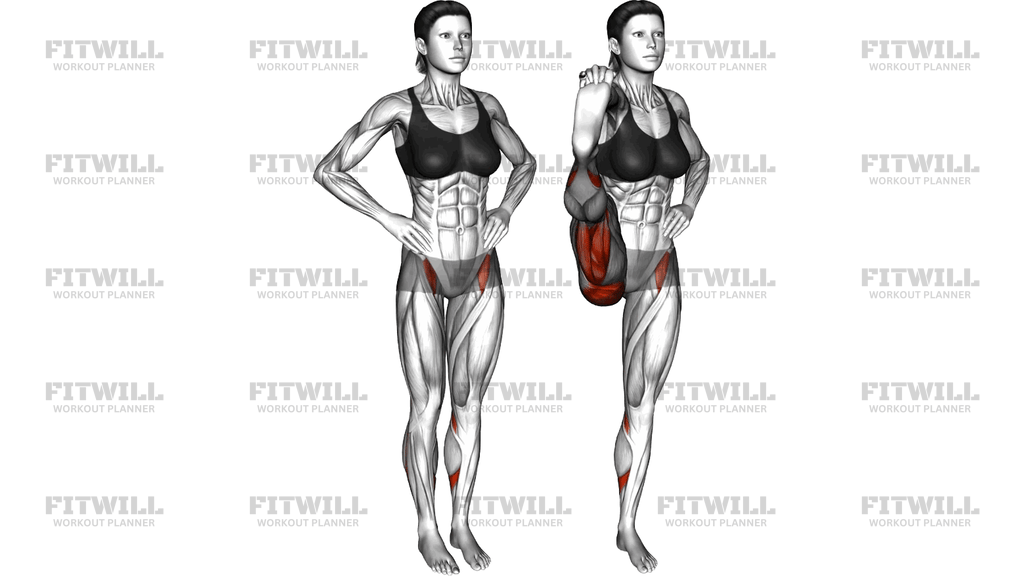
Instructions
- Stand tall with your feet together or hip-width apart, arms at your sides, and find a fixed point at eye level to focus on for balance.
- Shift your weight onto your left leg, spreading the toes of the standing foot and pressing evenly through the heel and ball of the foot.
- Draw your right knee up toward your chest and hook the index and middle fingers of your right hand around the big toe, keeping your right hand on your hip if using the two-hand setup shown in the stance.
- Brace your core gently and level your hips so both sides of the pelvis stay even and your torso stays upright.
- Begin extending the right leg forward, letting the fingers hold the toe as the knee straightens, and bring the leg only as high as your hamstring allows without your back rounding.
- At the top, aim for the raised leg at or near hip height with a straight standing leg, relaxed shoulders, and a long spine.
- Hold the position for several slow breaths, keeping your gaze fixed and your weight centered over the standing foot.
- To release, bend the lifted knee back in toward your chest, let go of the big toe, and lower the foot to the floor with control.
- Reset your stance, then repeat the same sequence on the other leg for an equal hold.
Tips & Tricks
- If your hamstring stops the leg short of full extension, keep a small bend in the lifted knee instead of leaning your chest forward to meet the foot — a bent knee with a tall spine beats a straight leg with a rounded back.
- Watch for the standing hip pushing out to the side as the leg lifts; draw it back over the standing ankle so your weight stays stacked.
- Don't lock the standing knee into a hard hyperextension — keep it straight but active, with the thigh muscle engaged to protect the joint.
- If you wobble immediately, stand near a wall and rest your fingertips on it lightly; the goal is balance practice, not gripping the wall for support.
- A common mistake is pulling on the toe with the arm and hunching the shoulder — keep the holding arm relatively relaxed and let the leg do the lifting.
- If your toes are out of reach, loop a towel or strap around the ball of the foot and hold the ends instead of forcing the fingers to the big toe.
- Keep breathing steadily through the hold; breath-holding is the first sign you've pushed the stretch beyond a comfortable range.
- Spread the toes of the standing foot and press through all four corners of it — a collapsed arch or rolled-outward foot is the usual reason the pose tips sideways.
- Hold each side for the same length of time, and if one hamstring is noticeably tighter, give the tighter side a slightly longer hold rather than a harder pull.
Frequently Asked Questions
What muscles does the Standing Hand To Big Toe Yoga Pose Utthita Hasta P work?
The lifted leg's hamstrings and calf get a deep stretch, while the standing leg's glutes, hip stabilizers, and ankle muscles hold you upright. The core works throughout to keep your torso from leaning back or twisting.
Is this pose suitable for beginners?
Yes, with modifications. Beginners can keep the lifted knee bent while holding the knee or the back of the thigh, or stand next to a wall for light fingertip support until balance improves.
Why can't I straighten my lifted leg in the Standing Hand To Big Toe Yoga Pose Utthita Hasta P?
Tight hamstrings are the usual reason, and forcing the knee straight often rounds the lower back. Keep a slight bend in the knee and let the range improve gradually over weeks of practice.
Should I hold the big toe with the same-side hand or the opposite hand?
The traditional setup uses the hand on the same side as the lifted leg, hooking the index and middle fingers around the big toe. Using the opposite hand changes the hip rotation and turns it into a different variation.
How long should I hold the Standing Hand To Big Toe Yoga Pose Utthita Hasta P?
Start with 15 to 30 seconds per side, breathing steadily. As your balance and flexibility improve, you can extend the hold to a minute or link it into a flowing sequence.
What should I do if I can't reach my big toe?
Loop a towel or yoga strap around the ball of the foot and hold the ends with your hand. This gives you the same stretch and position without straining your shoulder or rounding your spine.
Is it safe to do this pose every day?
For most people, yes, since it's a body weight stretch and balance drill with no external load. Just avoid forcing range, keep the standing knee soft, and step out of the pose slowly if you feel any pulling or cramping.
Why do I keep losing my balance during this pose?
The most common causes are an unfocused gaze, a collapsed arch in the standing foot, and hips that drift sideways as the leg lifts. Fix your eyes on one fixed point, spread the standing toes, and square the pelvis before extending the leg.
Can this pose replace my regular hamstring stretching?
It's an effective standing hamstring stretch, but it also demands balance, so it works best as one tool among several. Pair it with seated or lying hamstring stretches on days when your balance is off.