Alternating Hamstring Curl Pulldown
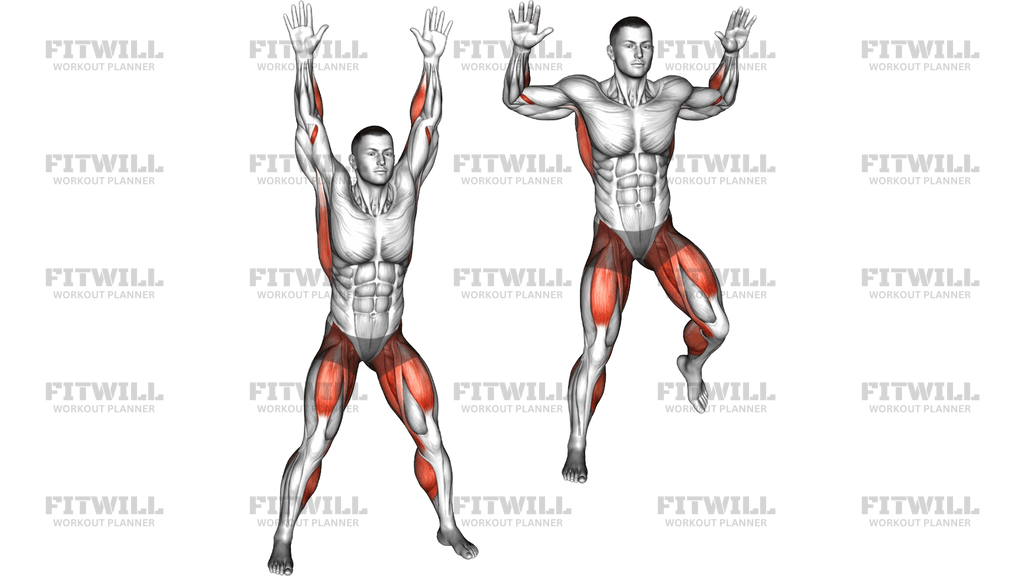
The Alternating Hamstring Curl Pulldown is a standing cable movement that pairs an overhead pulldown with a single-leg hamstring curl. You start with one or both hands gripping handles from a high pulley, arms fully extended overhead, then pull the handle(s) down toward your shoulder while the opposite leg curls up — knee driving forward, heel tucking toward the glute. Each rep switches sides, so the movement stays balanced and rhythmic rather than one-sided.
Because you are on one leg for half of every rep, this exercise trains more than the prime movers. The hamstrings work as knee flexors on the curling leg, the quadriceps and adductors stabilize and help lift the thigh, and the lats and shoulders handle the pulldown. Meanwhile the standing leg, glutes, and core — especially the obliques — fight to keep your torso upright as load shifts from side to side. That combination makes it a useful tool when you want leg work that also challenges coordination and trunk control.
Setup matters here more than with a seated leg curl. The pulley needs to be at its highest setting so your arms reach overhead without your shoulders shrugging, and your stance should be about hip-width with a soft bend in the standing knee. If you stand too far from the cable, the line of pull drags you forward; too close, and the pulldown loses tension at the top. Take a moment to find the distance where the handle stays loaded through the whole range.
To execute well, think of the pulldown and the curl as one coordinated action: drive your elbow down and in while the opposite heel rises toward your backside. Avoid yanking with the arm or swinging the curling leg — the tempo should feel smooth, roughly two seconds down, a brief pause, then a controlled return of both the arm and the leg. Exhale on the pull-and-curl, inhale as you reset to the overhead position.
This movement fits several situations. It works as a dynamic warm-up before lower-body lifting, as a conditioning drill in circuit training, or as a unilateral hamstring option when your seated or lying curl machines are busy. It is also practical for lifters who want to train knee flexion and lat engagement together without loading the spine with heavy weight.
A few practical points will keep it safe and effective. Keep the weight light enough that you never have to lean sideways or hop on the standing foot to complete the rep, and stop if your lower back starts arching to help the leg lift. If balance is the limiting factor at first, that is normal — reduce the range and let your stability catch up before adding load.
[ Workout Log & Planner ]
Put your next workout in Fitwill
Keep your plan and training log ready when you are.


Instructions
- Set both pulleys to the highest position on the cable machine and attach single handles, or use one handle if the station has a single stack.
- Stand facing the machine about an arm's length away, feet roughly hip-width apart, and grip the handles with a neutral grip, palms facing in.
- Step back slightly until your arms extend fully overhead and the weights are already lifting slightly off the stacks, then set your feet at hip width with a soft bend in both knees.
- Brace your abs, pull your shoulders down away from your ears, and keep your chest tall before starting the first rep.
- Pull one handle down toward your shoulder, elbow driving down and slightly in, while simultaneously curling the opposite leg — knee lifting forward and heel tucking up toward the glute.
- Pause briefly at the bottom with the handle near shoulder height and the curled leg's knee up, keeping your torso upright rather than leaning back.
- Reverse the motion in a controlled way: let the handle rise back overhead as the leg lowers back to the floor under control.
- Repeat the pull-and-curl on the other side, and keep alternating legs for the planned number of reps.
- Breathe out as you pull down and curl, breathe in as you return to the overhead position.
- At the end of the set, let the handles return fully, step away from the cable, and release your grip only after the weights have settled.
Tips & Tricks
- A very common mistake is turning the pulldown into an arm exercise — if your elbow flares out wide and your shoulder shrugs, drop the weight and focus on driving the elbow down toward your hip pocket.
- Do not let the curling leg just swing forward; actively tuck the heel toward the glute so the hamstring actually flexes the knee instead of the hip flexors doing all the work.
- If you find yourself hopping or rocking on the standing foot, widen your stance slightly and slow the tempo — the balance demand usually fades within a few sessions.
- Watch your lower back: arching and leaning back to help the knee rise means the load is too heavy or the range is too big for your current control.
- Keep the handle's path close to the front of your body. Letting the cable pull your arm out to the side shifts tension away from the lats and strains the shoulder.
- Match the timing of the arm and the leg. When the pulldown finishes before the curl starts, the movement turns into two separate exercises — start both together and finish together.
- Because each side works alone, do all reps to one side first or alternate strictly rep by rep, but count reps per leg so the weaker side gets the same volume.
- If the standing leg's calf or foot cramps, you are gripping the floor too hard with your toes; spread your toes and distribute weight across the whole foot.
- Shorter, cleaner reps beat long, sloppy ones — curl only as high as you can without your torso rotating toward the working leg.
Frequently Asked Questions
Which muscles does the Alternating Hamstring Curl Pulldown work hardest?
The hamstrings on the curling leg are the primary movers as they flex the knee, with the quadriceps, adductors, and hip flexors assisting the leg lift. The lats handle the pulldown, and the glutes, obliques, and deep core stabilize you on the standing leg.
Is the Alternating Hamstring Curl Pulldown suitable for beginners?
Yes, as long as the weight stays light. Beginners often need a few sessions just to coordinate the arm pull with the opposite-leg curl and to feel steady on one leg, so start with a small range and no added resistance before progressing.
Why does the cable pulldown use the opposite leg instead of the same side?
Opposing the arm and leg creates a cross-body pattern that mimics natural gait and rotation control. It also challenges the obliques and hip stabilizers more than a same-side version, which tends to let you lean into the movement.
Can I do the Alternating Hamstring Curl Pulldown without a cable machine?
You can mimic the pattern with just body weight by pulling your arms down from overhead as you curl one heel up, but you lose the resistance the cable provides. A resistance band anchored overhead is the closest substitute.
How heavy should I go on the Alternating Hamstring Curl Pulldown?
Choose a weight you can pull down and curl smoothly for all planned reps without leaning sideways, shrugging, or hopping on the standing foot. If your form breaks on either the arm path or the leg curl, the load is past the point of good technique.
Should the heel actually touch the glute during the hamstring curl?
Not necessarily. Curl only as high as you can while keeping your torso square and your standing knee soft — forcing the heel all the way up usually causes the lower back to arch and the hips to rotate.
What is the most common mistake with this movement?
Separating the two actions: pulling the handle down first and then lifting the leg afterward. This turns a coordinated exercise into two easy ones and removes most of the core and balance demand, so start the pulldown and the curl at the same moment.
Can the Alternating Hamstring Curl Pulldown replace a seated or lying leg curl?
It can supplement hamstring work, but it is hard to load as heavily as a machine curl because balance and grip become limiting factors. Use it as a unilateral, stability-focused option alongside — not instead of — heavier dedicated knee-flexion work if maximal hamstring strength is the goal.
Where should I position my feet during the exercise?
Keep your feet about hip-width apart with the standing knee slightly bent and your weight spread across the whole foot. A stance that is too narrow makes balancing harder, while pointing the feet or gripping with the toes reduces stability.
Is it safe for people with knee or shoulder discomfort?
Keep the ranges modest — curl the knee only as high as feels comfortable and pull the handle no lower than shoulder height — and stay within a pain-free range. If either joint complains during the movement, reduce the load or range and consult a qualified professional before continuing.