Elevated Staggered Leg Hip Thrust
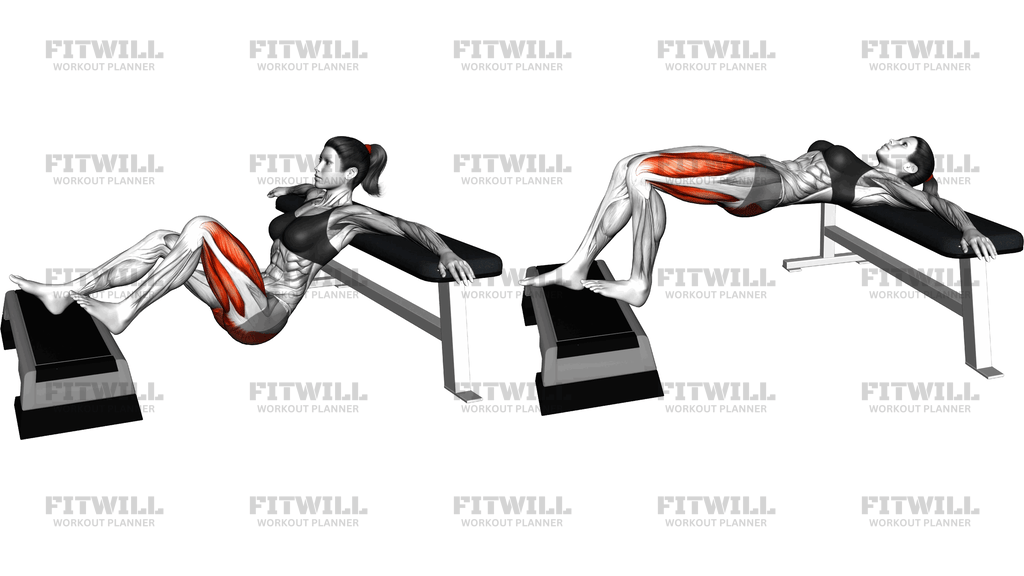
The Elevated Staggered Leg Hip Thrust is a bodyweight hip extension exercise performed with your upper back resting on a flat bench and your feet placed on a step platform in an offset, staggered stance. Instead of driving both feet evenly like a standard hip thrust, one foot sits slightly in front of the other, which shifts the emphasis toward the hip and thigh of the lead leg and challenges each side to contribute on its own terms. Because there is no external load, the movement works well as a warm-up, a glute activation drill, or a higher-rep finisher.
This setup suits people who want to train their glutes and thighs without a barbell, anyone rebuilding hip extension after time away from training, and lifters who want to expose and correct side-to-side differences. The elevated foot position increases the range of motion at the hip compared with a floor bridge, so you get a longer stretch at the bottom and a fuller squeeze at the top. The staggered stance also loads the front leg's glutes and hamstrings more directly while the rear leg provides balance and support.
The main muscles at work are the glutes, particularly the gluteus maximus, which drives the hips up into full extension. The hamstrings and quads assist, with the quads working to keep the knee stable on the step, and the core works isometrically to keep your ribs down and your torso steady on the bench. The highlighted emphasis falls along the thigh and hip of the working leg, which is exactly where you should feel this movement.
Setup matters here more than in most bodyweight exercises. Your shoulder blades should sit near the top edge of the bench so your upper back is supported but your neck stays free, and the step platform should be positioned so your shins end up roughly vertical at the top of the thrust. If the step is too close, your knees drift past your feet; too far away and your hamstrings cramp or your heels lift. The staggered stance needs to feel deliberate, not accidental, or the lead leg will quietly take over or the rear leg will push unevenly.
Execution comes down to one idea: push the floor away through the step with your lead foot and finish with your hips, not your lower back. Drive up until your torso and front thigh form a straight line, squeeze the glute of the working leg at the top, then lower under control until your hips are just above the floor before starting the next rep. Keep your chin tucked and your hands relaxed on the bench for balance rather than pushing with your arms.
A few practical points will keep this movement productive. Complete all reps on one side before switching, so you can compare how each hip feels and performs. Stop the set if you feel the work shifting into your lower back or if a hamstring cramp pulls you out of position, and reset your stance rather than grinding through bad reps. As you get stronger, you can progress by slowing the lowering phase, pausing at the top, or eventually adding load across the hips.
[ Workout Log & Planner ]
Put your next workout in Fitwill
Keep your plan and training log ready when you are.


Instructions
- Place a flat bench behind you and position a step platform about two to three feet in front of it, leaving room to plant your feet fully on top of the step.
- Sit on the floor with your back to the bench, then walk your feet onto the step platform and set them in a staggered stance, one foot placed slightly ahead of the other with both soles flat on the step.
- Lean back so your upper shoulder blades rest against the edge of the bench, keep your chin tucked, and let your arms rest out to the sides on the bench for balance.
- Brace your core gently and exhale as you push through the step with your lead foot, extending your hips upward.
- Drive up until your torso and front thigh form a straight line and your hips reach full extension, squeezing the glute of the working leg at the top.
- Hold the top position for a brief moment without arching your lower back or letting your hips twist.
- Inhale as you lower your hips in a controlled manner until they hover just above the floor, keeping tension in the glutes rather than dropping to rest.
- Complete your target repetitions on this side, then reset your stance with the opposite foot in front and work the other side.
- Between sets, stand up and shake out your legs, then recheck your foot position on the step before the next set.
Tips & Tricks
- If your front knee caves inward as you press up, think about pushing through the whole foot on the step, especially the big-toe side, to keep the knee tracking over the toes.
- A hamstring cramp usually means the step is too far from the bench; move the step closer so your shin can finish close to vertical at the top.
- If your lower back arches at the top, you are chasing extra height with your spine. Cut the rep short at the point where your glutes finish the lift and keep your ribs down.
- Keep the stagger subtle. A stance that is too wide front to back turns the rep into an awkward single-leg variation and pulls your hips out of line.
- Your hands should rest on the bench, not push. If your arms are doing noticeable work, your hips are probably dropping between reps.
- Drive the lead leg with intent and let the rear foot act as a kickstand. If both legs feel equal, check that your hips are squared to the ceiling rather than rotated toward the rear leg.
- Slow the lowering phase to two or three seconds if the movement feels too easy; the eccentric portion is where this bodyweight version gets most of its challenge.
- Avoid letting your hips sag toward the floor between reps. Hovering just above the ground keeps the glutes loaded for the entire set.
- If your neck strains against the bench edge, shift slightly so more of your upper back, not your shoulders or head, is supported.
Frequently Asked Questions
What muscles does the Elevated Staggered Leg Hip Thrust work?
The glutes are the primary mover, especially on the lead leg, with the hamstrings and quads assisting. Your core works to keep your torso steady on the bench throughout each rep.
Why use a staggered stance instead of placing both feet side by side on the step?
The offset stance shifts more load onto the front leg's glutes and hamstrings and makes side-to-side differences obvious. It also lets each hip work through its own path, which helps address imbalances.
Is the Elevated Staggered Leg Hip Thrust good for beginners?
Yes, because it uses only bodyweight and a bench and step, it is an accessible way to learn hip extension before adding a barbell. Beginners should start with a smaller range and focus on feeling the lead glute do the work.
How far should the step platform be from the bench?
Set it so your shins are close to vertical at the top of the thrust. If your heels lift or your hamstrings cramp, the step is too far away; if your knees push well past your toes, it is too close.
Why do I feel this in my hamstrings instead of my glutes?
That usually means the step is too far from the bench or you are extending with your lower back rather than finishing with your hips. Move the step closer, keep your ribs down, and squeeze the lead glute deliberately at the top.
How many reps should I do on each side?
Because this is a bodyweight movement, higher reps in the 12 to 20 range per side work well for activation and endurance. Finish all reps on one side before switching so you can compare how each hip feels.
Can I add weight to the Elevated Staggered Leg Hip Thrust?
Yes, once your form is consistent you can hold a dumbbell or place a light weight across your hips. Master the bodyweight version first, since the staggered stance already adds a coordination demand.
What can I use if I don't have a step platform?
Any stable, low, non-slip surface of similar height works, such as a low plyo box or a sturdy stack of steps. Avoid anything that can slide, since your feet push hard into it every rep.
Is it safe for my lower back?
When performed with a braced core and full control, the movement loads the hips rather than the spine. Stop if you feel pinching or arching at the top, and reduce your range so the glutes, not the lower back, finish each rep.