Resistance Band Elbow Plank With Single Arm Pulldo
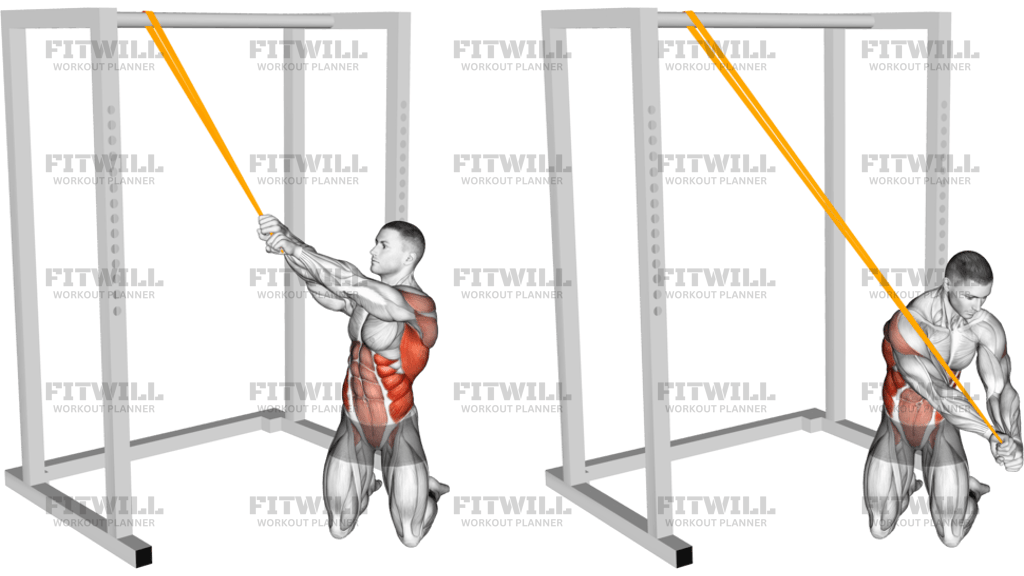
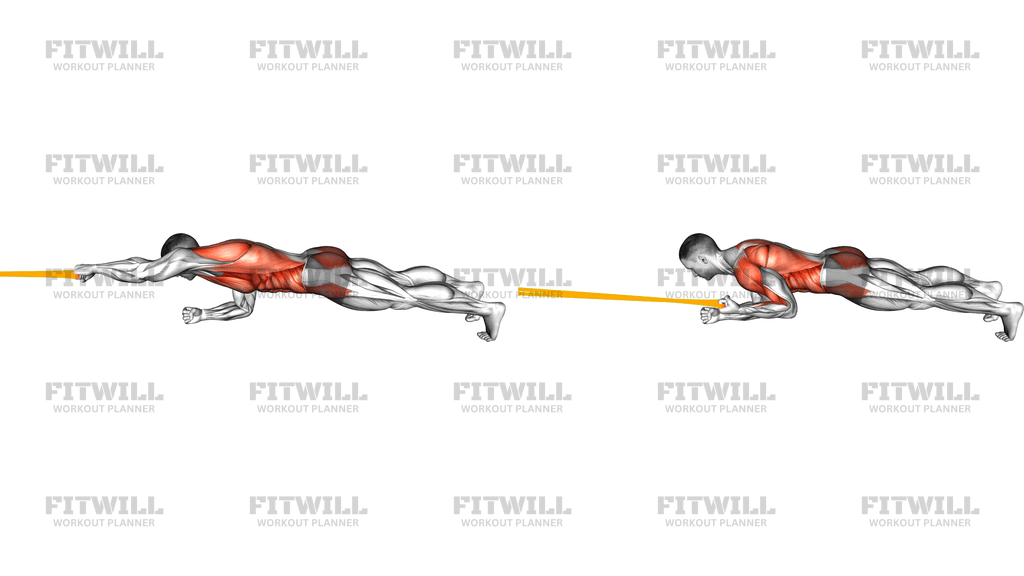
The Resistance Band Elbow Plank With Single Arm Pulldown combines two demanding elements into one exercise: a forearm plank hold and a one-arm band pulldown. You set up in a low plank with the band anchored off to one side in front of you, hold the band with one hand while the opposite forearm supports you, and pull the band down and back toward your ribs. The band pulls you forward and toward the anchor the entire time, so your trunk has to fight rotation and extension on every rep.
This movement earns its place in a program because it trains the lats through a real pulldown path while your core works overtime to keep your hips square to the floor. Unlike a machine pulldown, where the bench or seat stabilizes you, here your torso, hips, and legs must provide all the stability. That makes it a strong choice for anyone who wants their pulling and anti-rotation work in the same set, such as lifters short on time or people rehabbing toward heavier pulling movements.
The setup matters more than in most plank variations because the band's tension changes everything. Anchor the band at roughly floor height or slightly above, a few feet in front of you and off to one side. If the anchor is too close, the pull becomes trivially easy and the plank does all the work; too far, and you lose tension at the start of each rep. Take a firm grip, extend the working arm out along the band's line, and only then settle into the plank.
To execute well, keep your supporting elbow directly under your shoulder and your body in one straight line from head to heels. As you pull, drive the elbow down toward your ribcage, letting the hand travel toward your hip, and resist the urge to let your shoulders twist. The finish position has your upper arm close to your side, lat engaged, and torso level with the floor. Extend the arm back out under control so the band does not yank you forward.
Expect this in functional training circuits, core-focused finishers, and home workouts where a single band replaces a cable stack. It is also useful for athletes who need to transfer force while braced, since the plank position mimics the trunk demands of sprinting, throwing, and contact sports.
A few practical points: start with a light band, because the leverage in a plank makes even modest tension feel heavy. Keep your feet slightly wider than hip width if your hips want to swing, and place a mat under your forearms and knees for comfort. If your lower back sags before your lat fatigues, that is your signal to shorten the set or reduce band tension rather than pushing through.
[ Workout Log & Planner ]
Put your next workout in Fitwill
Keep your plan and training log ready when you are.


Instructions
- Anchor a resistance band at or just above floor height, a few feet in front of you and off to one side, so the band runs away from your body at an angle.
- Grip the free end of the band with one hand, then walk back on your knees until the band has light tension with your arm extended out toward the anchor.
- Lower onto the opposite forearm with that elbow directly beneath your shoulder, and step your feet back into a forearm plank with your body in a straight line from head to heels.
- Set your feet about hip-width apart or slightly wider, brace your abdominals, and squeeze your glutes so your hips cannot rotate toward the band.
- Exhale and pull the band down and back, driving your elbow toward your ribcage until your hand is near your hip and your upper arm sits close to your side.
- Pause briefly at the bottom with your lat engaged and your shoulders level with the floor, making sure the pulling shoulder has not shrugged up toward your ear.
- Inhale and extend your arm back out along the band's line with control, letting the shoulder reach forward without letting your trunk twist or sag.
- Complete all repetitions on one side, then release the band, reset your plank, and switch to the other arm so you grip with the opposite hand.
- If your hips or lower back break form mid-set, drop to your knees, release the band tension, and either rest or restart with a lighter band.
Tips & Tricks
- The most common failure point is hip rotation toward the anchor. Fix it by widening your feet slightly and actively pressing the floor away with your supporting forearm.
- Do not let the band snap your arm back on the return. The eccentric part of the pulldown is where much of the lat work happens, so take two full seconds to extend.
- If your lower back arches as the set goes on, your abdominals have stopped doing their job. Reduce band tension rather than tolerating a sagging plank.
- Check that your supporting elbow stays stacked under your shoulder for the whole set. Leting it drift forward shortens the lever and steals work from the core.
- Pull with your elbow, not your hand. Thinking about driving the elbow to the ribs keeps the lat involved and stops the biceps from taking over the movement.
- Grip the band firmly but do not strangle it. Excess grip tension often creeps up into the neck and shoulders during long plank holds.
- Keep your head neutral by looking at the floor about a foot ahead of your hands. Craning up to watch the working arm encourages upper-back rounding.
- Breathe in a steady rhythm instead of holding your breath, since breath-holding under band tension tends to collapse the plank position quickly.
- Chalk or a mat under the anchor point can stop the band from sliding if you are attaching it to a smooth post or rack upright.
Frequently Asked Questions
Which muscles does the Resistance Band Elbow Plank With Single Arm Pulldown work?
The lats drive the pulldown, while the abs, obliques, and deep core work to stop your torso from rotating against the band. The rear shoulders, biceps, and glutes assist to a lesser degree.
How high should I anchor the band for this exercise?
Anchor it at or slightly above floor height, a few feet in front of you and off to one side. The band should have light tension while your arm is extended and meaningful tension by the time your elbow reaches your ribs.
Is the Resistance Band Elbow Plank With Single Arm Pulldown suitable for beginners?
Yes, if you start with a light band and keep the sets short. If a full forearm plank is still difficult, you can perform the pulldown from a kneeling plank position while you build the required trunk strength.
Why do my hips twist toward the band during the pulldown?
The band pulls you forward and toward the anchor, so your obliques and glutes have to resist that rotation. Widen your stance, squeeze the glutes harder, and use less tension until you can keep both hips level.
Can I do this exercise with a cable machine instead of a band?
A low cable pulley can replicate the pulldown path, but the band is usually the better fit here because it anchors easily at floor level and its rising tension matches the strength curve of the plank position.
Should I do all reps on one arm before switching sides?
Yes, completing one side fully before switching is standard, since changing grips mid-set breaks your plank position and resets the band tension. Rest briefly between sides if needed.
How many sets and reps make sense for this movement?
Two to four sets of 8 to 12 controlled pulls per arm works well for most people. Because the plank hold adds fatigue, end the set when your torso position breaks, not when your lat alone gives out.
Is it a problem if my supporting shoulder tires before my pulling arm?
Some fatigue is normal since that shoulder carries part of your bodyweight, but if it fails early, shorten the set or alternate arms each set. Sharp pain, rather than fatigue, is a reason to stop and reassess your setup.
What should I do between sets of the Resistance Band Elbow Plank With Single Arm Pulldown?
Come down onto your knees and release the tension from the band so your shoulders and core recover fully. Staying in the plank between sets turns this into an endurance test rather than a pulling exercise.