Elevanted Pike Push Up From Deficit With Parallett
The Elevated Pike Push Up From Deficit With Parallett is a demanding overhead pressing variation built for calisthenics and handstand training. Your feet rest on a box or platform behind you, your hands grip a pair of parallettes, and because your palms are raised off the floor, your head and shoulders can sink below hand level at the bottom of each rep. That extra range is what separates this from a standard pike push up and makes it a genuine stepping stone toward handstand push ups.
The main load lands on the front and side shoulders, with the triceps working hard to extend the elbows out of the bottom. The upper traps, upper back, and serratus anterior stabilize and control the shoulder blades as you lower and press, while the core holds the hips stacked over the shoulders in the pike position. The highlighted triceps and shoulder area reflect just how much of the work comes from the pressing muscles through the deep portion of the movement.
This exercise suits intermediate to advanced trainees who already own solid push ups and standard pike push ups and want a harder overhead pressing stimulus without loading a barbell. It is a staple in handstand progression work, home gym programming, and anyone building vertical pressing strength with minimal equipment. Because the feet are elevated on the box, more bodyweight shifts onto the arms, and the pike angle closely mimics the overhead position you need for freestanding handstand pressing.
Setup matters here more than in most pressing variations. The parallettes need to be stable and spaced about shoulder width, and the box should be high enough to place your hips above your head but not so high that you fold into a cramped position or lose balance. The deficit only works if you can keep a straight line from hands to hips; if the range forces your lower back to sag or your elbows to flare wildly, reduce the depth or foot height.
Execute each rep by lowering under control until the top of your head drops between or just below your hands, then press back up to fully locked elbows while pushing the parallettes slightly apart to keep the shoulders active. Move your torso in a straight vertical path rather than drifting forward, which is the most common fault when fatigue sets in. Breathe in on the way down and exhale as you press.
Treat this as a strength movement, not a high-rep burner. Three to five sets of five to ten controlled reps is a realistic working range. Stop the set when your press begins to stall or your head starts reaching for the floor instead of your elbows bending evenly, and always test the stability of the parallettes and box before your first rep.
[ Workout Log & Planner ]
Put your next workout in Fitwill
Keep your plan and training log ready when you are.


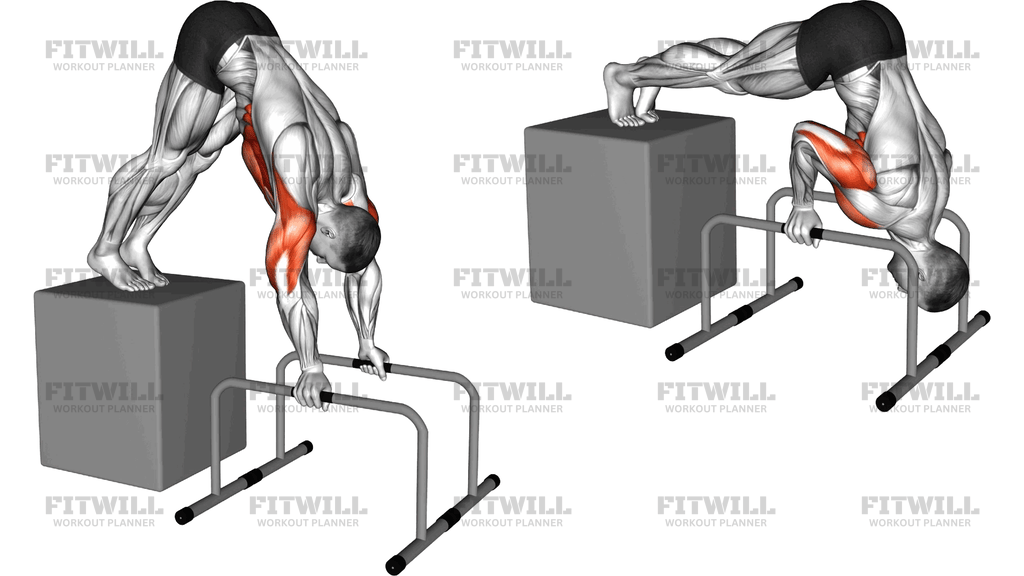
Instructions
- Place two parallettes on the floor about shoulder-width apart, parallel to each other, and check that they do not rock or slide when you press down on the handles.
- Position a sturdy box or platform roughly two to three feet behind the parallettes, high enough that your hips will sit above your shoulders when your toes are on top.
- Grip the parallette handles with a full overhand grip, arms straight, then walk your feet up onto the box one at a time until you are in an inverted V with hips high and legs nearly straight.
- Brace your midsection, squeeze your legs together, and push the floor away so your shoulder blades are protracted and your head sits between your arms, forming one long line from hands to hips.
- Inhale, then bend your elbows and lower your torso in a straight vertical line, letting your head descend between the parallettes until it is just below hand level.
- Keep your elbows tracking back at roughly 45 degrees to your torso rather than flaring straight out to the sides as you reach the bottom.
- Exhale and press firmly through the handles, extending your elbows until your arms are fully locked and your shoulders are pushed up toward your hips.
- Lower back down under control for two to three seconds on each rep, resisting the drop instead of letting gravity take your head toward the floor.
- Complete your set, then step one foot off the box at a time while keeping your hands on the parallettes until you are stable, before stepping fully away.
Tips & Tricks
- If your head dives toward one parallette instead of staying centered, your hands are probably unevenly spaced; recheck that both bars are an equal distance apart before your next set.
- A common failure point is the hips drifting backward as you press, which turns the movement into a shallow push up. Film yourself from the side and make sure your torso travels straight down and straight up.
- Start with a smaller deficit. If you cannot lower your head just past hand level without shrugging into your ears, the parallettes are too tall for your current pressing strength.
- Keep your toes gripping the edge of the box. If your feet slip even slightly, the whole structure of the pike collapses and your shoulders take the rep at an awkward angle.
- Push the parallettes outward slightly at the top of each press, as if trying to spread the floor, to keep the serratus and upper traps engaged instead of hanging passively in your shoulder joints.
- Elbows flaring fully sideways is the most frequent mistake on deep pressing work. Cue your elbows to point back toward the box so the triceps and front shoulders share the load safely.
- Do not chase depth at the cost of a rounded lower back. If your spine starts to sag as your head drops, elevate your hips higher or shorten the range until your line stays straight.
- Warm up your wrists and shoulders thoroughly first. Supporting your full weight on narrow handles with the shoulders deep under the torso demands more from the wrists than a floor-based pike push up.
- If the parallettes feel tippy at the bottom, set them on a non-slip surface or against a wall's base and confirm both feet are secure on the box before each set.
Frequently Asked Questions
Which muscles does the Elevated Pike Push Up From Deficit With Parallett target most?
The front and side shoulders do most of the pressing, with the triceps heavily involved in extending the elbows from the deep bottom position. The upper traps, upper back, and serratus anterior stabilize the shoulder blades throughout.
Why use parallettes instead of doing this on the floor?
The raised handles create a deficit, so your head can travel below hand level for a longer pressing range than a floor pike push up allows. The neutral grip is also easier on the wrists than a flat palm position.
How high should my feet be on the box?
Choose a box height that puts your hips clearly above your shoulders while still letting you hold a straight line from hands to hips. If your back sags or you feel cramped and off-balance, drop to a lower height.
Is this exercise suitable for beginners?
It is best saved for intermediates who can already perform controlled pike push ups on the floor with the feet elevated. Beginners should build a base with standard pike push ups and regular push ups before adding the deficit.
How deep should I lower my head in the deficit?
Lower until the top of your head is just below the level of the parallette handles, keeping elbows at roughly 45 degrees to your torso. Going deeper only helps if your torso line stays straight and your elbows keep tracking back.
What is the most common mistake with this movement?
Letting the hips drift back so the torso moves forward and down at an angle instead of straight vertically. This shortens the overhead stimulus and can strain the shoulders, so keep the press path strictly up and down.
Can I use this exercise to train for handstand push ups?
Yes, this is one of the classic progressions. The elevated pike position with a deficit closely matches the range and pressing angle of a handstand push up, letting you accumulate strength before balancing on your hands.
What can I substitute if I do not have parallettes?
You can place your hands on two sturdy dumbbells with hex heads, dip bars, or stable blocks to create a similar deficit. Without any elevation, a standard elevated pike push up on the floor is the nearest alternative.
How do I stay safe when doing the Elevated Pike Push Up From Deficit With Parallett?
Check that the parallettes and box cannot slide or tip before every set, and step off one foot at a time rather than jumping down. End the set as soon as your press stalls or your form line breaks, since fatigue on this movement usually shows up first in the shoulders and lower back.
How many sets and reps should I do?
Work in the range of three to five sets of five to ten reps with full control on every rep. Because the deep deficit is demanding on the pressing muscles, prioritize quality reps over squeezing out extra volume.